
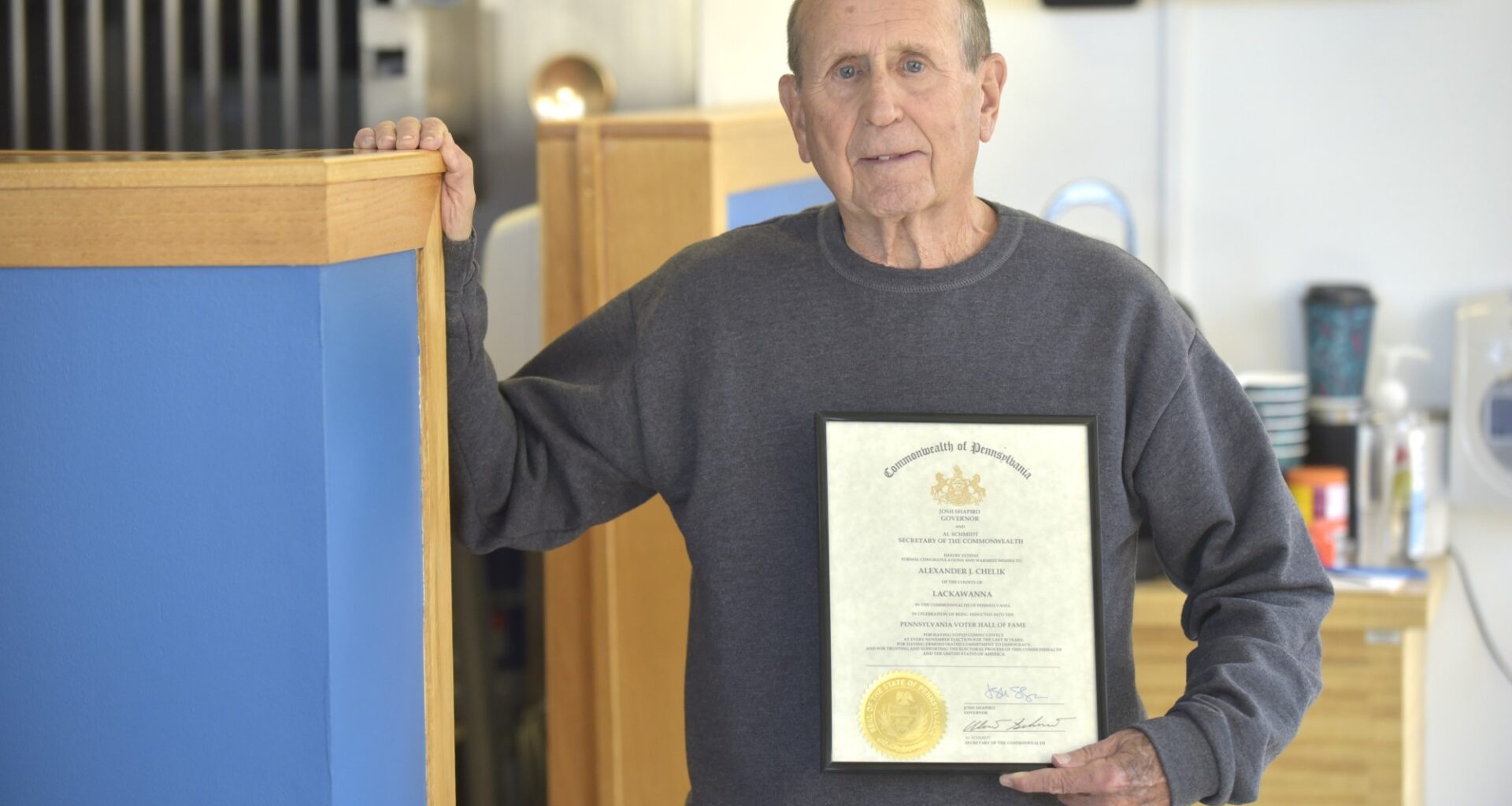
MAYFIELD — A certificate from the Pennsylvania Voter Hall of Fame arrived at Al Chelik’s house unexpectedly a few years ago. Once he figured out what it was, he framed it and hung it in his “man cave” as a memento of his devotion to voting.
“I can’t remember missing any election,” said Chelik, 83.
Chelik is one of 3,593 people from Lackawanna County listed in the Pennsylvania Voter Hall of Fame, an electronic list of people who have voted in at least 50 consecutive November general elections. Genie Lupini is another.
She said rain, sleet and snow don’t stop her from voting. “I just felt it’s my duty to do that,” Lupini said. “You know, I want to make my voice heard with my vote, to make sure that the right people, or the people that I feel are the right people, get in their positions.”

Mayfield Mayor Al Chelik’s Voter Hall of Fame certificate from the state of Pennsylvania. (CHAD SEBRING/STAFF PHOTO)
Show Caption
1 of 1
Mayfield Mayor Al Chelik’s Voter Hall of Fame certificate from the state of Pennsylvania. (CHAD SEBRING/STAFF PHOTO)
Expand
An incomplete honor
Lackawanna County has the most voters on the list. That likely has less to do with turnout than how frequently counties send in their statistics.
Voter statistics are meticulously tracked. The Hall of Fame is just an optional awareness campaign. Only three Luzerne County voters have been listed in 40 years. Pike County and York County each recently held ceremonies to honor new inductees.
What makes a voter?
Chelik and Lupini are rarities. Voting peaks in presidential years. For other November elections, such as Tuesday’s, it is not unusual for barely half of registered Pennsylvanians to turn out to choose governors, members of Congress, state legislators and local leaders. Approximately 10% of those eligible aren’t even registered.
Aside from their sense of duty, Chelik and Lupini each check various boxes in the demographics of champion voters.
Generation after generation, the older generation tends to vote at a high rate, which might reflect their long-standing engagement in their communities, said Adam Shprintzen, Ph.D., a Marywood University history professor and author.
Chelik is a veteran. He voted by military absentee ballot from Germany and Turkey during the Vietnam era. Active duty and veterans vote at higher rates than others. That may reflect their investment in American ideals, Shprintzen said.
There is a statistical link between college education and voting. Chelik spent his career as a social studies teacher and principal in the Lakeland School District. “My master’s degree is a Master of Arts in history, so I was pretty well versed in our history and what has worked and what hasn’t worked, you know?”
They are also among the young people invigorated by the presidency of John F. Kennedy. “The thing that I was most disappointed in is, I wanted to vote for Kennedy, but because he was assassinated the previous November,” he couldn’t, Chelik said.
Elections are personal for Chelik and Lupini. He is the longtime Democratic mayor of tiny Mayfield in Lackawanna County and also served on borough council, the zoning board and the planning commission. Lupini has been the Jessup tax collector for many years and succeeded her husband in office. She’s been active in all kinds of community efforts.
Shprintzen isn’t aware of any data that shows that people involved in politics are more frequent voters, but he said it makes sense. “Probably the people who are engaged directly understand how the process works, understand why it’s such an important process, are going to be more likely to engage with their vote as well,” he said.
Voting turnout is also linked to race and income. Chelik and Lupini are white and financially secure.
There are “issues related to voter suppression” nationwide, such as closing polling places in minority communities, Shprintzen said.
“If you live in densely populated areas where there may be long lines, and there may be long lines at particular points of time, say after the workday. These mitigating factors — availability of time, childcare, access to your polls — become much more significant,” Shprintzen said.
Mayfield has only one polling place, but the borough’s entire population is only 1,700. It’s a short trip for Chelik. He’ll linger to talk. “I’ll spend some time outside the poll after I vote, you know, or during the day when I deliver the meals.” Mayfield officials chip in money to buy meals for poll workers. Campaign buttons aren’t allowed inside polling places, but he plans to wear one outside to support a favorite candidate.
‘If you can keep it’
Lupini also votes in person. She wishes she had more company. Too many people don’t feel it’s necessary to vote. “And I can’t understand that at all, because they don’t realize that these people are going to make things happen for them, for their benefit. I clearly don’t understand why people don’t come out, and I do my best to try to get everybody out to vote.” Just talking to the people in your life is probably the best voter turnout technique, she said.
Chelik has several proposals, including moving elections to weekends or declaring election day a holiday. He favors opening the spring primaries to independent voters and those registered with small parties, allowing them to vote in one party’s primary without joining. He also suggests finding a way to send voter registration applications to teens turning 18.
“If you remember, Benjamin Franklin, when he was asked what kind of government we have: ‘It’s a republic, if you can keep it.’” Chelik said. “And I felt that, you know, it was my duty to get out there and express how I wanted my country to run.”
Voting in the current general election
Election Day is Tuesday, with polls open from 7 a.m. to 8 p.m. Anyone in line at 8 p.m. is allowed to vote. All votes — in person, in drop boxes and by mail — must be received by then.
Voters are already using drop boxes for mail ballots. If you plan to send your ballot through the mail, time is short. It must be received — not just postmarked — by Tuesday at 8 p.m. Pay careful attention to the instructions. A mistake can get your ballot tossed out.
Use Pa.gov/agencies/vote to find drop box and voting booth locations and what to do if you encounter a problem at the polls.
The offices on the ballot include the governor of Pennsylvania, members of the federal and state legislatures and local leaders.
Who is in the Pennsylvania Voter Hall of Fame?
The Pennsylvania Voter Hall of Fame honors people who have voted in at least 50 consecutive November elections. More than 25,000 have been entered in the online list since the state started it in 1986 to encourage voting. Voters who believe they qualify can send a form to their county election bureau. The form and the list of people in the Voter Hall of Fame are online at Pa.gov/agencies/vote/programs/voter-hall-of-fame.