
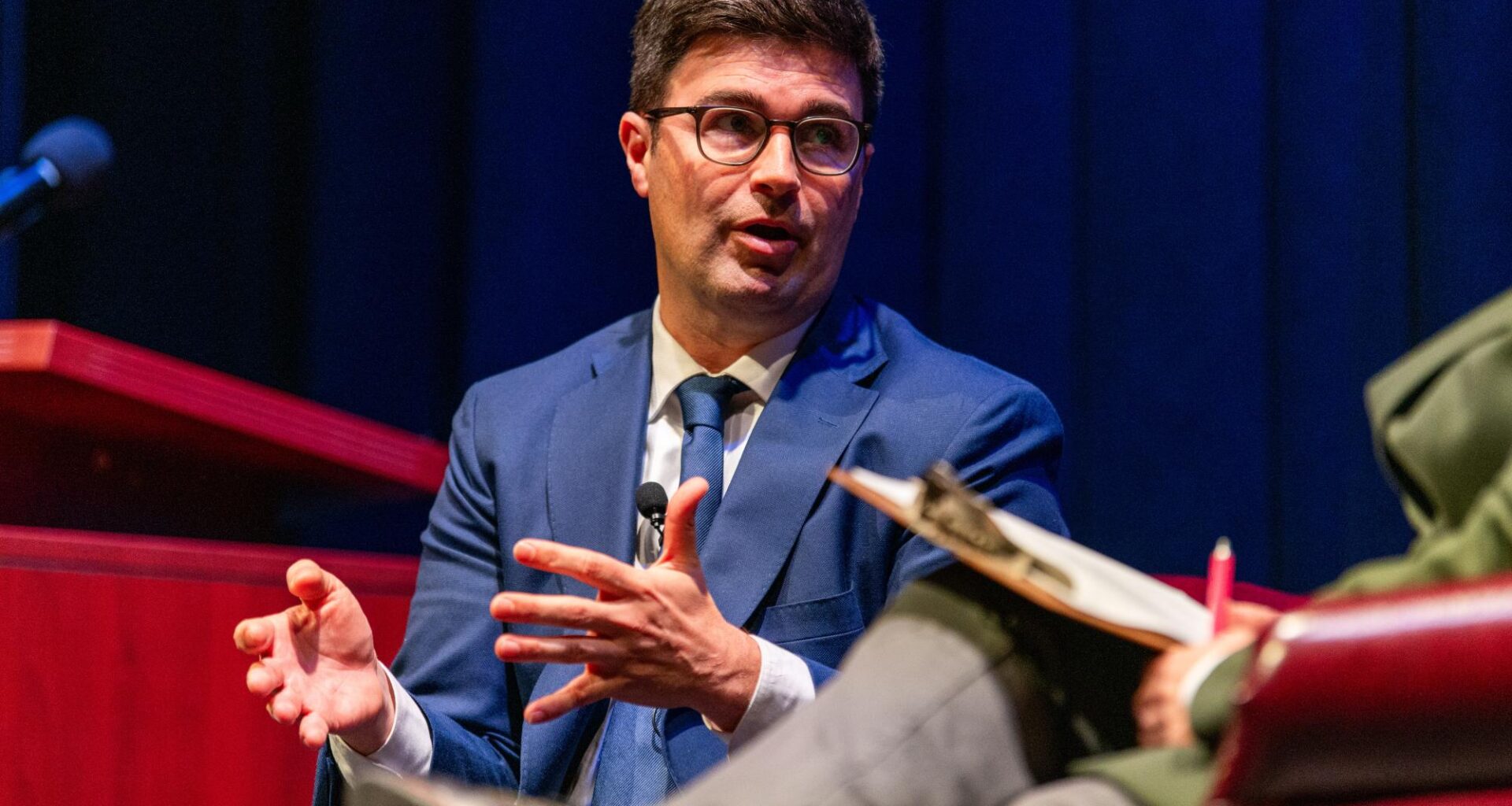
Mayor-elect Corey O’Connor is looking for students to help realize his vision for Pittsburgh.
On Nov. 4, Pittsburgh residents elected Democratic candidate Corey O’Connor to become the city’s 62nd mayor. Students and community members want the new administration to address concerns about affordable housing, the city budget and public safety.
Corey O’Connor served on Pittsburgh City Council starting in 2011, representing District 5. In 2022, he became Allegheny County Controller. In May 2025, he beat incumbent mayor Ed Gainey in the Democratic primary elections with 52.8% of the vote.
In the most recent election, O’Connor won with 87.5% of the vote against Republican candidate and retired police officer Tony Moreno. The Associated Press called the race at 8:26 p.m., shortly after the polls closed at 8:00 p.m.
O’Connor spoke with The Pitt News about changes students may see from the new administration after Jan. 5, 2026, when he will be sworn in as mayor.
According to O’Connor, Pitt students should expect to see more direct communication and collaboration with the community from the mayor’s office in coming years and an increased presence on campus compared to the outgoing Gainey administration.
“Being present on campus is pretty helpful because it’s an easy way for me to relay my vision and what’s happening [in city government], but also to hear back from students on what they’re seeing in our city daily,” O’Connor said.
George Dougherty, an associate professor in public and international affairs, believes that the transition from Gainey to O’Connor will be “more pragmatic, as opposed to ideological.” Dougherty said O’Connor’s first priority should be “working very clearly with and directly with [City] Council on a financial plan.”
O’Connor will face the task of reshaping Gainey’s 2026 budget proposal for the city, which was released on Nov. 10 alongside a final statement from the departing mayor. With city revenue falling and expenses rising, residents are concerned about how the city will recoup finances.
O’Connor further plans to address student concerns about unaffordable housing with rising enrollment. His plan is to use existing city assets like rent-to-own programs, The Housing Opportunity Fund and tax credits.
“We already have the tools to [develop affordable housing], we just need to make sure that we get it done,” O’Connor said. “We need to build all types of housing and build it fast.”
Colt Pierce, a teaching assistant professor in urban studies, shared his opinion on why O’Connor was more popular than Gainey in the primary.
“O’Connor was highlighting the slow progress Pittsburgh has made towards affordable units, which is true,” Pierce said. “Pittsburgh is very slow at producing affordable units.”
Pierce also spoke about differences in housing policy in the O’Connor administration compared to the Gainey administration.
Gainey proposed in his campaign to use city-wide inclusionary zoning, which sets aside a portion of housing development for households making less than the local median income. Pierce said O’Connor favors “a more localized approach” that addresses varying needs across neighborhoods and transit-oriented zoning development.
“Students use more of our public transit than probably anybody,” O’Connor said. “So if we can [increase] density around those lines, that will be beneficial to everyone.”
Pierce believes that O’Connor’s policies could be effective, but has concerns about long-term affordability.
“I think O’Connor — if he gets these policies passed and he can actually do what he wants — we are going to see a lot more [housing] development,” Pierce said. “But how do we keep houses affordable? And that’s the question that is not answered and that’s what makes me worried.”
Jesse Milston, a junior political science and history major and vice president of College Republicans at Pitt, is hoping for “less noise, just more decisive action” compared to Gainey. He believes O’Connor’s first course of action as mayor should be to address public safety and build stable relationships with the police chief, after controversy during Gainey’s administration.
“The simple truth is that we lack police officers. We need to put more [of them] on the street,” Milston said. “And I think that’s going to be Corey O’Connor’s number one job — getting both more officers on the street and also having a better rapport with the chief.”
O’Connor said he plans to prioritize “hiring [police] that have a community-oriented policing mindset and public safety mindset, so that on campus everybody feels safe.”
Milston is also concerned about Oakland’s growing population with increased enrollment at Pitt.
“Pittsburgh is growing, and the mayor is going to really impact how we get our housing situation in order,” Milston said. “I’m just hoping for a mayor who actually just puts his head down and gets the job done.”
Austin Wise, a senior political science major and president of College Democrats at Pitt, explained why the group endorsed O’Connor.
“O’Connor’s housing plan, which is mixed-use zoning, calls for faster permits, which will equal more apartments being built, which should in turn lower rents in Oakland for Pitt students as more units are built across the city.”
Along with a smooth transition of administrations, Wise believes that the city budget will be one of the most important tasks to tackle once O’Connor takes office.
“Balancing our budget is important so that we can make sure that we’re not headed towards a fiscal crisis with the city — like we have so many times in the past under different administrations,” Wise said.
Wise also spoke about Election Day, during which O’Connor visited the William Pitt Union to talk to students.
“Pitt Dems [endorsed] Corey because he made himself accessible to us,” Wise said. “He fought hard to earn our endorsement and to make sure that student voices were heard.”
Ara Das, a first-year nursing student, voted for O’Connor and other Democrats on the ballot with issues like education in mind.
“I’d agree with a lot of the Democratic or left-leaning policies, so it seemed like an obvious choice,” said Das. “I saw [O’Connor] was endorsed by the Pittsburgh Federation of Teachers — that’s important to me.”
Das also spoke about the difficulties she faced when researching Republican candidate Tony Moreno for the election.
“I felt like on [Moreno’s] website, I didn’t see as much about him and his endorsements as I did on O’Connor’s page,” Das said. “I just felt like it was easier to trust someone who was giving me more information.”
O’Connor believes college students are integral in attracting businesses and local talent to the city.
“I actually look for students to be ambassadors for the city — tell their friends why they picked Pittsburgh for college and why they’re looking to stay in Pittsburgh,” O’Connor said. “We don’t want you to just come here for your four years, we want you to look at Pittsburgh as a lifelong investment.”
O’Connor said he welcomes everyone when building a new vision for Pittsburgh. According to O’Connor, Pittsburgh has all the resources that students need not only for school, but also for building lifelong businesses and careers.
“It doesn’t bother me whether you supported me or not,” O’Connor said. “We’re all in this together, and why not Pittsburgh? Let’s put Pittsburgh on the map.”