
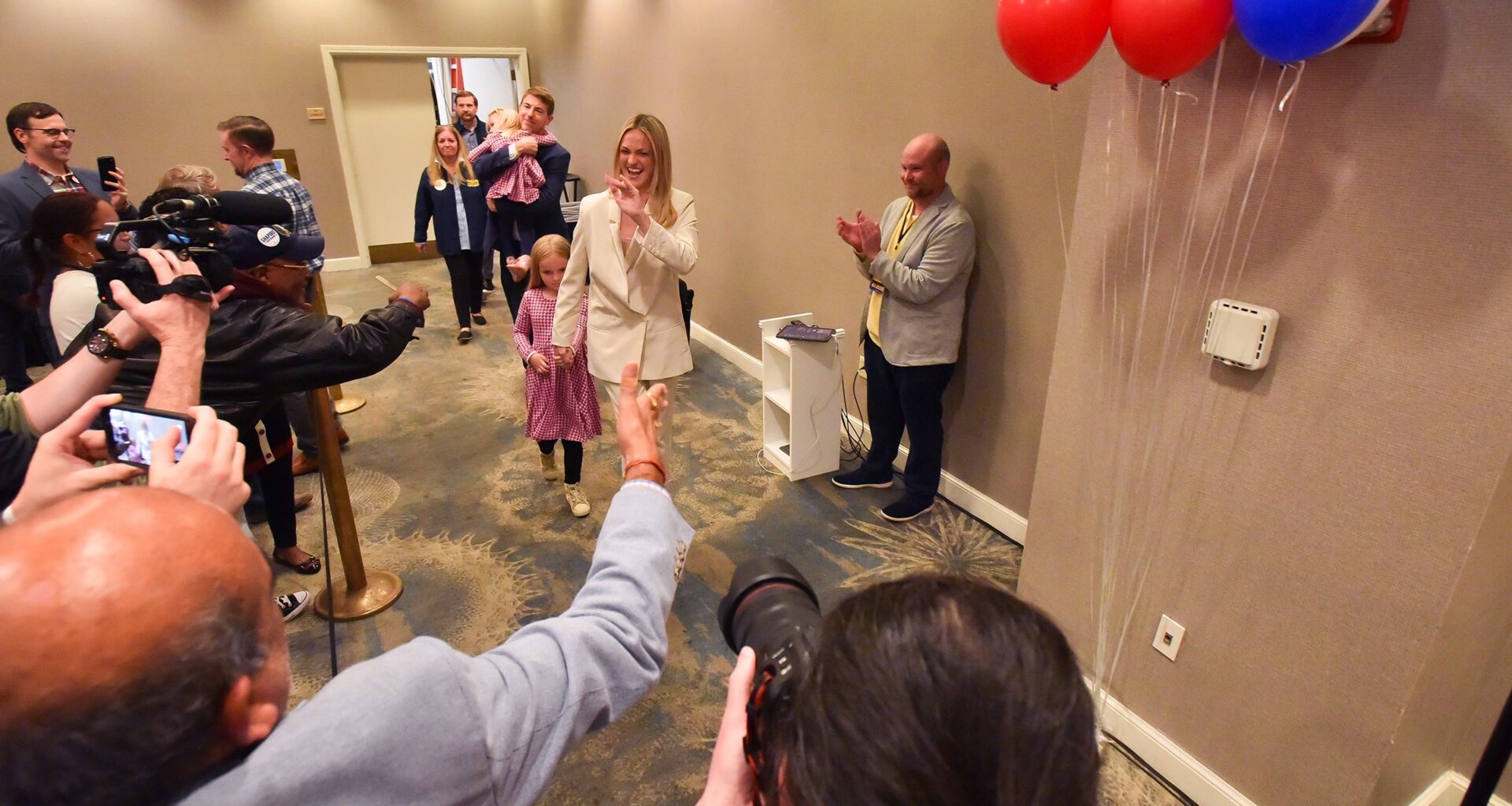
Describing Tuesday’s bloodbath of a midterm election for Republicans as a blue wave might be an understatement.
It was more of a blue tsunami — an historic Democratic deluge that wiped out GOP majorities in both chambers of Congress in a resounding repudiation of President Donald Trump while delivering Pennsylvania Democrats unified control of state government.
Democratic Scranton Mayor Paige Cognetti surfed the blue wave to victory over incumbent Republican U.S. Rep. Rob Bresnahan of Dallas Twp. in the 8th Congressional District that swung left this cycle after Bresnahan flipped the seat two years ago. Cognetti will join a new Democratic House majority swept into power by pronounced voter backlash to Republicans and the perceived failures and broken promises of the second Trump administration.
The blue wave that sunk Bresnahan also washed away incumbent Republican state Sen. Rosemary Brown in the 40th Senate District, where Archbald Democrat Brian Wrightson’s victory helped his party secure a long-elusive state Senate majority and a coveted trifecta in Harrisburg for the first time in decades. State House Democrats also grew their majority in the lower chamber Tuesday, when incumbent Democratic Gov. Josh Shapiro walloped Republican challenger and state Treasurer Stacy Garrity by 22 percentage points.
Here’s a closer look into how an historic election cycle played out in Northeast Pennsylvania:
Shifts in the 8th
Turnout Tuesday was unsurprisingly lower than in 2024, a presidential election year, but voters who did cast ballots in the 8th District spanning all of Lackawanna, Wayne and Pike and parts of Monroe and Luzerne counties shifted meaningfully toward Democrats.
Bolstered by Trump being on the ballot in a red wave year for Republicans, Bresnahan narrowly defeated longtime incumbent Democratic Congressman Matt Cartwright by 1.6 points in 2024, winning about 50.8% of the districtwide vote to his 49.2%.
Cognetti beat Bresnahan this cycle by about 8.8 points, 54.4% to 45.6%, a more than 10-point House race margin shift in her party’s direction compared to two years ago. The shift is even more pronounced when compared to the 2024 presidential margin in the congressional district Trump won.
The district voted 17 points more Democratic than it did in the last presidential election, according to The New York Times, which reported shifts of 18 points in both Lackawanna County and the Luzerne County portion of the district, 17 points in the Monroe County portion and shifts of 15 and 13 points in Pike and Wayne counties, respectively.
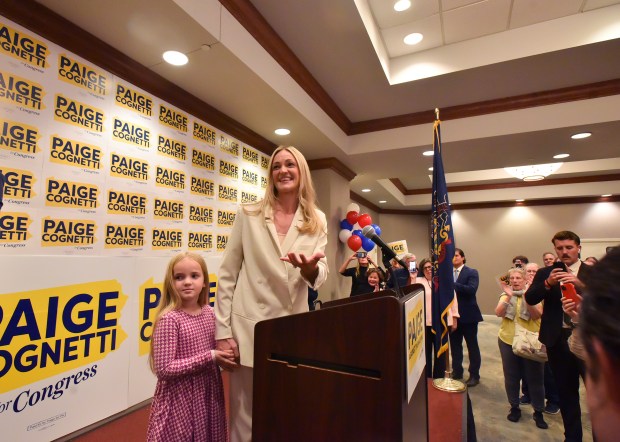 Democratic Scranton Mayor Paige Cognetti, with her daughter Sloane, is introduced in the grand ballroom of the Hilton Scranton & Conference Center in downtown Scranton Tuesday, November 3, 2026. (SEAN MCKEAG / STAFF PHOTOGRAPHER)
By percentage of the total vote, Cognetti outperformed Cartwright’s 2024 showing in all five counties, and won three of them outright. The more rural and Republican-heavy counties of Wayne and Pike still broke for Brensahan, but by smaller margins than in 2024, while Cognetti expanded Democratic margins in Lackawanna and Monroe and flipped the Luzerne County portion of the district, Bresnahan’s home turf.
Bresnahan won Pike and Wayne on Tuesday with about 54.7% and 61.9% of the vote in those counties, respectively, down from about 60.1% and 66.2% in 2024. Cognetti soundly beat him in the Democratic stronghold of Lackawanna with about 60.5% of the vote there, up from the 56% Cartwright won in Lackawanna last cycle, and won about 60.1% in Monroe, compared to Cartwright’s roughly 54.1% two years ago.
She flipped the Luzerne County portion of the district with 51.5% of the vote to Bresnahan’s 48.5%, a 3-point win there. Bresnahan beat Cartwright in Luzerne county by almost 8 points.
Some of the largest Democratic margin gains in Luzerne occurred in Hazleton wards Cognetti flipped, with members of the city’s large Hispanic and Latino populations contributing to that shift. A recent New York Times analysis of national trends found Hispanic voters, a demographic group the shifted toward Trump and the GOP in 2024, “shifted left more than any other racial or ethnic group this year.”
 Republican U.S. Rep. Rob Bresnahan is greeted by supporters after conceding the election to Democratic opponent Scranton Mayor Paige Cognetti during his election night party at Sabatini’s Bottle Shop & Bar in Exeter on Tuesday, Nov. 3, 2026. (Kristen Mullen / Contributing Photographer)
Bresnahan won 10 of Hazleton’s 11 wards in 2024, but lost nine of the 11 Tuesday. Among other examples, Cognetti won Hazleton’s Ward 8 by about 26.7 points after Bresnahan won it by about 7.4 points two years ago. She won the city’s Ward 10 by about 31.5 points; Bresnahan narrowly won it by 1.2 points in 2024.
While high gas and diesel prices stemming from Trump’s unpopular war with Iran and broader affordability challenges exacerbated by his erratic tariff policies fueled poor Republican showings here and elsewhere, his administration’s sweeping and aggressive approach to immigration enforcement also likely factored in the ballot box decisions of Hispanic voters and members of the broader electorate who punished GOP incumbents.
“There was again so many things, from immigration to costs and the war, and so many things that hit the same people,” said Jean Harris, Ph.D., a recently retired University of Scranton professor. “And there was a lot of education going on in groups, Latino groups, and in terms of just trying to get people to understand how their last vote may have actually harmed them more than benefited them.”
Beyond Bresnahan, fellow incumbent Pennsylvania Republican Congressmen Brian Fitzpatrick, Ryan Mackenzie and Scott Perry, a seven-term incumbent, all lost Tuesday, with Democrats winning at least 253 House seats so far as of Friday.
Incumbent Republican U.S. Rep. Dan Meuser still won reelection comfortably in the deep-red 9th Congressional District, defeating Democratic challenger Rachel Wallace by about 23.1 points, but that margin shrunk considerably compared to 2024, when he won by 41 points.
Democrats also flipped U.S. Senate seats in Kansas, Iowa, Ohio, Maine, North Carolina, South Carolina and Texas, and may have flipped a Senate seat in Mississippi in a race that was still too close to call Friday. A number of those outcomes would have been virtually unthinkable a year ago.
Wrightson wins
The most impactful local race at the state level Tuesday was in the 40th state Senate District, where Wrightson, a Democratic political newcomer, upset the incumbent Republican Sen. Brown. He won by almost 3 points in the district that includes all of Monroe and parts of Lackawanna and Wayne counties, earning about 51.4% of the vote to Brown’s roughly 48.6%.
The race fueled by the politically potent issue of data center development — both candidates took stances against data centers during their respective campaigns — was particularly significant in that it helped Democrats secure a 26-24 majority in the state Senate. By winning control that chamber for the first time in decades, expanding their majority in the state House and holding the governorship, Democrats achieved a trifecta that should bolster Gov. Shapiro’s ability to move legislation and enact policy.
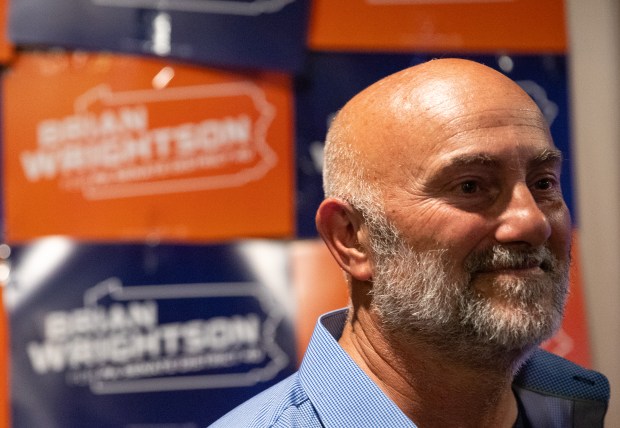 Democratic state Sen.-elect Brian Wrightson of Archbald talks to supporters after winning the state’s 40th District Senate seat during an Election Night celebration at the Moontower Bar and Grill in Archbald on Tuesday, Nov. 3, 2026. (FRANK WILKES LESNEFSKY / STAFF PHOTO)
“Pennsylvanians just came together to flip the State Senate for the first time in over THREE DECADES — delivering a Democratic trifecta that’s ready to raise the minimum wage, codify reproductive freedom, invest in mass transit, and so much more,” Shapiro said in a recent social media post that mentioned Wrightson. “Now, the real work begins.”
Wrightson’s nearly 3-point victory comes after Brown won her state Senate seat in 2022 by about 10.5 points, defeating Democrat Jennifer Shukaitis overall and in each of the three counties partly or fully contained in the 40th District. But Brown won only one of three this cycle, with Wrightson winning the Lackawanna part of the district by nearly 6 points and Monroe, Brown’s home county, by nearly 7. She won the Wayne County portion of the district overwhelmingly, by almost 26 points, but far fewer people voted in Wayne than did in the other counties.
Data center opposition is particularly fierce in Lackawanna County’s Midvalley region, and arguably fiercest in Archbald, where Wrightson lives and where developers propose at least 51 data centers and a power plant. He beat Brown in every Archbald voting district, as did Shukaitis four years ago.
Brown, a longtime state representative before winning the Senate seat she just lost, co-sponsored a pending bill from Democratic state Sen. Katie Muth calling for a three-year moratorium on data centers. But that and other efforts on the anti-data center front weren’t enough for her to beat Wrightson, a fellow moratorium proponent and data center critic, in Archbald or the district overall.
Voter frustration with Trump and national Republicans, and broader backlash against the GOP, also likely benefited Wrightson and hamstrung Brown.
“We like to say all politics are local, but … I definitely think that Republicans at the national level were a drag on those in other races,” Harris said. “I think unfortunately for the Republican Party, people did vote as if Donald Trump was on the ballot.”
Incumbents win
Incumbent candidates from both major parties otherwise prevailed across the region Tuesday, with Democratic state Sen. Marty Flynn winning reelection in the 22nd Senate District by about 31 points and Republican state Sen. Lisa Baker winning another term in 20th Senate District by about 23.
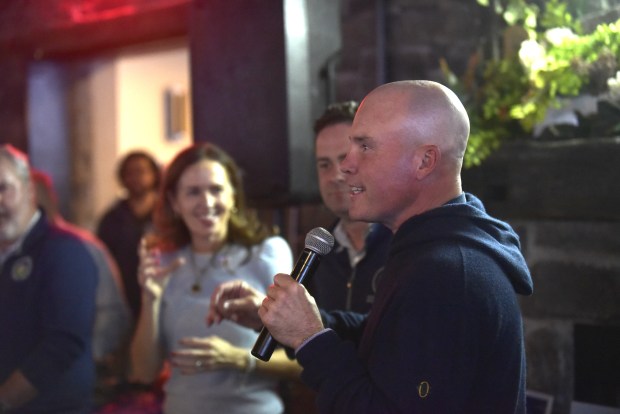 State Sen. Marty Flynn, D-22, Dunmore, addresses supporters at Benny’s of Downtown in Scranton on Tuesday, Nov. 3, 2026. (CHAD SEBRING/STAFF PHOTO)
Those margins also shifted in Democrats’ direction this cycle compared to 2022, when Flynn won by almost 21 points and Baker won by about 35.5. Baker’s race Tuesday against Democratic challenger Jackie Baker was a rematch of their 2022 contest.
Local state House seats also held, with all four incumbent Democratic state House members who represent Lackawanna County constituents — Kyle Donahue, Jim Haddock, Bridget Kosierowski and Kyle Mullins — cruising to reelection Tuesday.
Haddock, who defeated Republican Luzerne County Councilman John Lombardo in the 118th state House district that includes parts of Lackawanna and Luzerne counties, won by about 23.3 points. He was the only one of the four Democratic incumbents to win by fewer than 35 points.
Every incumbent state representative with Luzerne County constituents also won Tuesday, including Republican Reps. Dane Watro in the 116th district, Jamie Walsh in the 117th, Alec Ryncavage in the 119th and Brenda Pugh in the 120th. Watro was unopposed Tuesday and Walsh was unopposed in 2024, but Ryncavage and Pugh both won by smaller point margins this cycle than they did two years ago.
Pugh, who faced Democrat Fern Leard in both elections, won by more than 15 points in 2024 and by about 8.5 this cycle.
Elsewhere in the county, Wilkes-Barre City Councilwoman Jessica McClay defeated Republican Bear Creek Village Mayor Mike Harostock by about 16.3 points to win the 121st House District seat longtime Democratic state Rep. Eddie Day Pashinski will vacate when he retires in January at the end of his 10th term. Pashinski last won reelection by about 10.6 points in 2024, defeating Republican challenger Dino Disler.
In the broader region, incumbent GOP state Reps. JoAnne Stehr of Schuylkill County, Tina Pickett of Bradford County, Jonathan Fritz of Wayne County, Tim Twardzik of Schuylkill County, Jamie Barton of Schuylkill County, Jeff Olsommer of Wayne County and Jack Rader of Monroe County all won reelection in their districts, as did incumbent Democratic state Reps. Tarah Probst and Maureen Madden, both of Monroe County.
Democrats ended up growing the slim majority in the state House they carried into Tuesday despite the resilience of local GOP incumbents, and will enter the next Legislative session with at least 111 seats in the 203-member chamber.