
By MARTY LEVINE
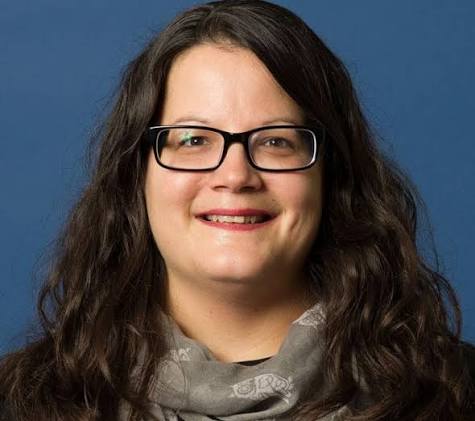
Monica Love started her undergraduate degree at Pitt in 1997 and never left, thanks to a student job at the School of Public Health in the spring of 1998.
“I’ve been in epidemiology ever since,” says Love, “and I never looked back,” though she had once planned to study law. “I’m glad my life worked out this way.”
 Now Love has won a Chancellor’s Distinguished Service Award for Staff. Her award, in the research support category, noted that she has served “as the trusted administrative partner” to Pitt Public Health Professor Emeritus Lewis H. Kuller who, when he died in 2022, was hailed as the “Father of Preventive Cardiology” for his research on reducing cardiovascular disease risk factors and for discovering the connection between menopause and heart disease. Kuller formed the modern epidemiology department as chair (1972-2002).
Kuller hired Love for her student job and then onto the Pitt staff the year he stepped down as chair, when his research expanded. “He was old school – all paper,” Love recalls. “His office was just piles and piles of paper. I would be able to go into his office and find” whatever was requested – or at least find it online as a last resort. “I called myself an information detective in those days.’
Kuller would also dictate papers for her to transcribe, and “I miss it,” she says. “It’s a skill not many have. I love typing. The faster I type the better I can type what I think.”
She also helped Kuller with submitting Institutional Review Board documents and manuscripts. In 2015, she took on the same function for epidemiology faculty member Akira Sekikawa, who conducts large studies on cardiovascular health in the US and Japan. Love became a project coordinator in 2021 of the Integrative Models of Metabolites, Equol and Atherosclerotic cardiovascular disease study, which aims to understand the causes of low rates of atherosclerotic cardiovascular disease deaths in Japan in the hope of developing new preventive and therapeutic strategies for the disease in the U.S.
She writes service agreements between Pitt and two Japanese universities, processing study invoices and making sure work is being done on time, alongside editing manuscripts for submission.
“These are studies that have made worldwide changes in health initiatives,” she says of her work. However, Love adds, “the participants in our research studies are the backbone of all we do in epidemiology.” Helping those who come to the school for the local portion of studies is tremendously satisfying, she explains. “The participants come first – that’s what Dr. Kuller taught me since day one. Everything I do, there in the back of my head is their safety.”
Her department’s Health Studies Research Center has seen more than 20,000 research participants over the years. Parts of the studies have involved people aged 60-plus years: “Some of our participants will tell us this is the only health care they receive,” she notes, describing her relationships with participants as “very rewarding.”
Love says she received the news of her award with surprise when Sekikawa told her he was nominating her. “First thing I said, ‘Oh no, I don’t qualify for something like that.’” But looking at her path – from student worker making deliveries around campus in the days before email to published author – she clearly qualifies.
“It was just such an honor,” she says now. “It’s just amazing.”
Marty Levine is a staff writer for the University Times. Reach him at martyl@pitt.edu or 412-758-4859.
Have a story idea or news to share? Share it with the University Times.
Follow the University Times on Facebook.