
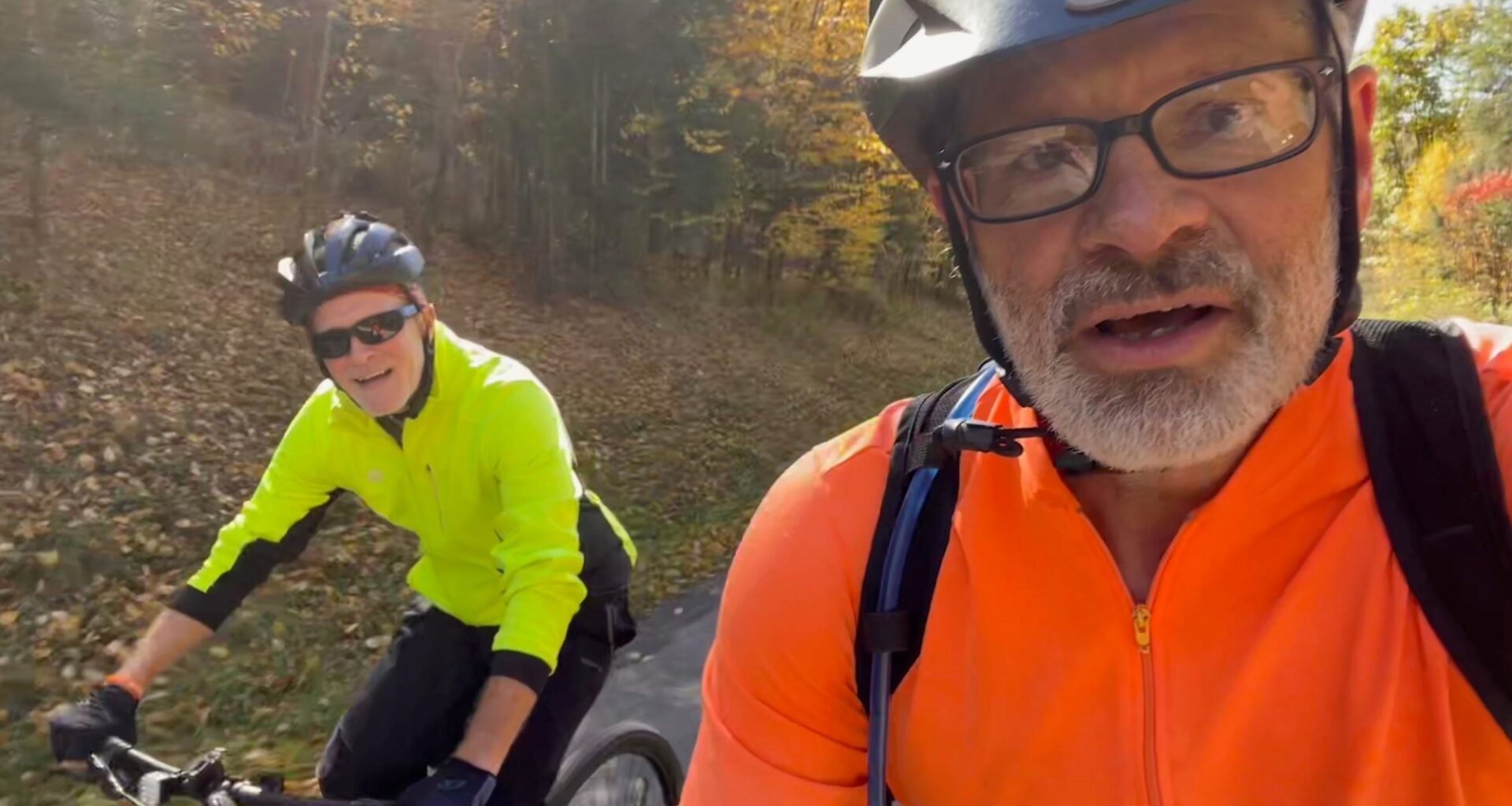
My left thigh muscles cramped with every turn of the pedal as I bicycled up the hill.
My brother, Bruce, up ahead, was doing better but still cranking in a low gear.
We were three quarters of the way through what Bruce later called our endless trip through the Endless Mountains, a 44-mile ride on quiet roads past autumn leaves, lakes, streams and farms that we chose for sightseeing, not exertion.
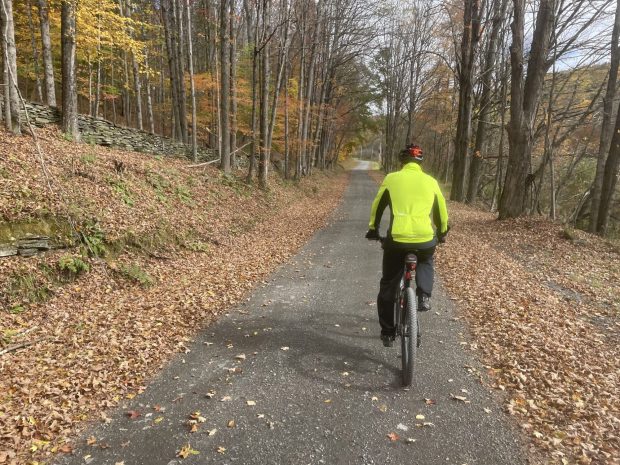 Bruce Jackson bicycles along a gravel road in the Endless Mountains of Wyoming and Susquehanna counties in Pennsylvania on Thursday, Oct. 15, 2026. (Kent Jackson / Staff Photo)
The loop we selected through Wyoming and Susquehanna counties started and ended in Nicholson and jogged between dirt and gravel roads through Hop Bottom, Kingsley, Alfred and Brooklyn Twp. while never straying far from Route 11.
Endless Gravel Pennsylvania’s website said the route had “grand views and below-average elevation gain for the region.”
Bruce and I, who are in our 60s but both ride about an hour a day, figured the trip, including sightseeing, would take four hours.
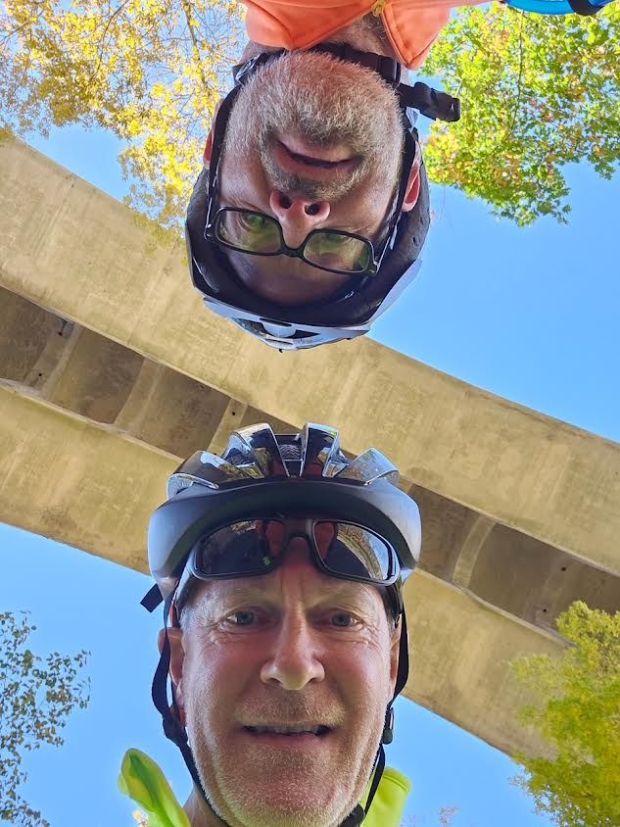 Kent Jackson, top, and Bruce Jackson stop beneath the Martins Creek Viaduct during a bike ride on gravel roads through the Endless Mountains in Wyoming and Susquehanna counties of Pennsylvania on Thursday, Oct. 15, 2026. (Bruce Jackson / Submitted Photo)
We ended up riding nearly six.
Along the way his phone with the route map and my distance-measuring watch died. A battery backup for my iPhone wouldn’t power his Android.
Turn-by-turn directions I’d written in my reporter’s notebook fell out of my pocket.
If our trip had been a movie, Bruce said the camera would have zoomed in on the three pages, stapled together, fluttering away as we screamed down a hill.
Unguided, we missed turns, dead ended and sometimes guessed which fork to take in the road, all of which extended our trip. My phone on low power kept showing my car as a dot on Google maps, so we never worried about not getting home.
Eventually.
We realized that below-average climbs for the region were above average for us. I was relieved after cramping to turn off the hill we had been ascending rather than remaining on a road that inclined further into the forest.
From another perspective any road we picked seemed like the right one. The trees were orange, yellow and pale green. The temperature required only shirtsleeves. We followed streams, spotted deer and gazed at mountains without being passed by cars.
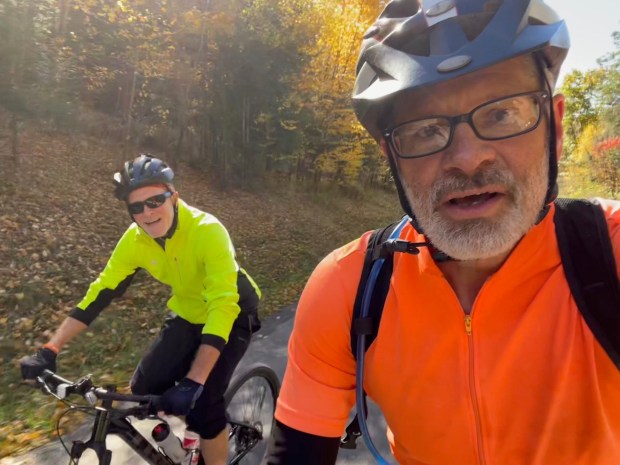 Bruce Jackson, left, and Kent Jackson bicycle along a gravel road in the Endless Mountains on Thursday, Oct. 15, 2026. (Kent Jackson / Staff Photo)
On the quiet lanes, we rode side by side, catching up after not seeing each for months. When an approaching pickup truck broke into our conversation, I reacted slowly because of how rarely we had been interrupted since starting at mid-morning on a Thursday.
The trip reconnected us with each other, but also our roots.
Our grandmother had talked about Hop Bottom, although Bruce and I never recalled visiting. The gravel roads past fields and farmhouses, I imagined, changed little since our grandfather might have traveled them, stringing wires as a lineman for Claverack, a co-op founded nearby as part of the New Deal program to electrify rural America.
Gramp had taken us to Nicholson when we were boys to show us the bridge called a viaduct although it carries trains, not water. He presented it to us as one of the wonders of the modern world.
When completed in 1915, it was the longest reinforced concrete structure in the world, a repeating pattern of arches stepped across the creek and trimmed 3.6 miles off the trip between Scranton and Binghamton, New York on the Delaware, Lackawanna and Western Railroad.
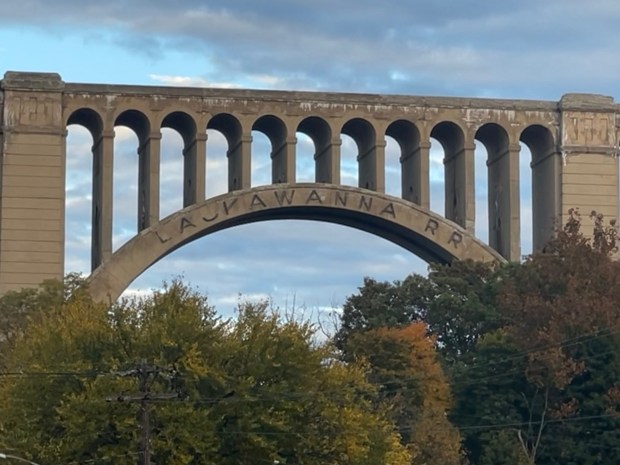 Tunkhannock Creek Viaduct photographed from Main Street in Nicholson, Pennsylvania on Thursday, Oct. 15, 2026. (Kent Jackson / Staff Photo)
The bridge is called the Tunkhannock Viaduct because it crosses Tunkhannock Creek, but Gramp lived in Tunkhannock, about 10 miles south, and called it the Nicholson Viaduct.
Worried that our bike route might not offer a great view of the viaduct, I stopped the car after driving an hour and 20 minutes from my home near Hazleton to take a picture with cows in the foreground that I sent to Bruce.
“Haha….here’s mine,” he texted with a smiley face. His picture had the same view with the same cows, but was snapped minutes earlier even though his drive from outside New York City was more than twice as long as mine.
Once in Nicholson, we realized the viaduct was easy to spot and photograph from town.
As we started riding narrow roads enclosed by mountains, the viaduct vanished and we enjoyed new sights for nearly an hour before stopping at a farm that Prince Perkins settled after mustering out of the Colonial Army. stayed in the Perkins-Dennis family for more than 200 years, making it the oldest farm owned by an African American family in the nation.
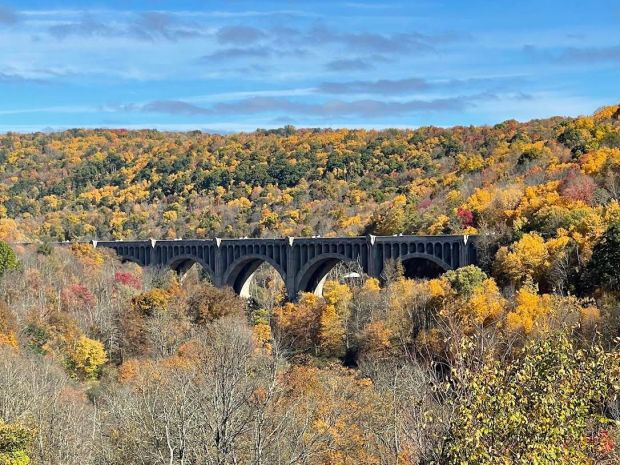 Martin’s Creek Viaduct on Thursday, Oct. 15, 2026. (Kent Jackson/Staff Photo)
From the farm, we took a detour uphill that promised and delivered a great view of the viaduct, which we thought we had ridden too far to see again.
Could there be two viaducts? Bruce wondered aloud.
An area this small couldn’t have two bridges so large so close together, I said while taking pictures before being proved wrong.
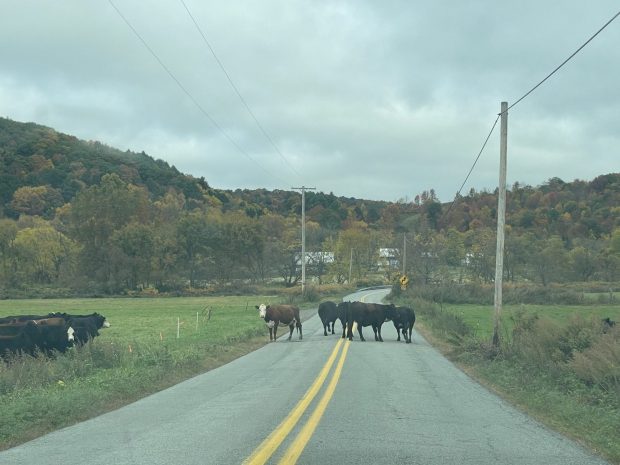 Cows block the road near Tunkhannock Creek Viaduct near Nicholson, Pennsylvania on Thursday, Oct. 15, 2026. (Kent Jackson / Staff Photo)
A poster at the overlook explained we were looking the Martin’s Creek Viaduct, which had been the world’s largest for a few months before the one in Nicholson opened.
Although we avoided congested roads on our bikes, traffic can grind to a standstill around the viaducts.
The cows came curious when I took photos and ambled into the road, where I noticed they were tall as my Subaru, which couldn’t pass until they moved.
Kent Jackson is a reporter for the Standard-Speaker.