
More than just medetomidine
Other potentially dangerous substances are also appearing in Philadelphia’s illicit drug supply.
Local anesthetics, which can mimic the numbing sensation caused by injected opioids, are increasingly common, Shaban said. In large doses, they can cause a potentially fatal condition known as local anesthetic systemic toxicity, according to the National Institutes of Health.
Nitazenes, a class of highly potent synthetic opioids, have also been found in the city’s drug supply since at least 2022, according to the Philadelphia Department of Public Health.
Maximized harm
Shaban, Morris and other experts interviewed by WHYY News said the proliferation of medetomidine and other additives reflects how drug-enforcement policies shape the illicit drug supply.
“What we’ve done, through prohibition, is maximize harm to drug users,” Morris said.
He pointed to the “Iron Law of Prohibition,” a theory that stricter drug enforcement encourages the production and distribution of more potent substances. During the period of alcohol prohibition in the United States, for example, high-proof spirits became more common on the black market than beer, which was bulkier and more difficult to transport.
Harris said nobody would choose fentanyl over heroin, but that drug enforcement has made it impossible to find actual heroin.
Organizations that traffic illicit drugs change their formulations in response to enforcement measures, Wallach said.
In 2024, Pennsylvania classified xylazine as a Schedule III controlled substance. That same year, medetomidine began appearing in Philadelphia’s drug supply.
“With xylazine, you used to be able to just go online and order a couple pounds of it,” Wallach said. “It’s a lot harder to find on the grey market now, but obviously not impossible.”
Medetomidine, by comparison, remains much easier to find, particularly online, where hundreds of vendors promise to deliver it to you — and your horse — with no verification required.
But restricting dangerous drugs also involves difficult trade-offs, Perrone said.
“Scheduling will always cause the emergence of new drugs,” she said, but leaving a drug unrestricted can create other risks.
The U.S. Drug Enforcement Administration disputes the idea that prohibition is the primary force driving changes in the illicit drug supply.
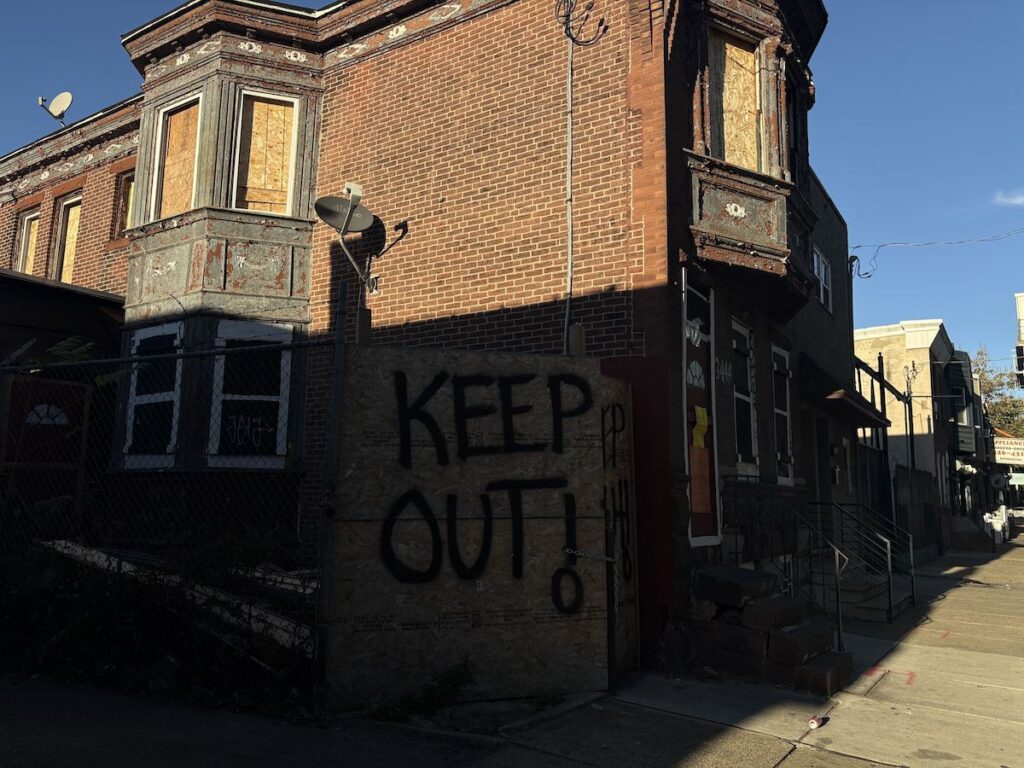 A residential building on Kensington Avenue that’s been sealed by the Philadelphia Department of Licenses and Inspections. (Andrew McGurl/WHYY)
Joshua Romig, assistant special agent in charge at the DEA’s Philadelphia division, argued that economics play a much larger role. He pointed to the replacement of heroin by fentanyl, which he attributed to Mexican drug trafficking organizations seeking to undercut Colombian competitors.
“It was straight economics,” Romig said.
Romig also rejected the suggestion that the emergence of medetomidine was a reason not to restrict xylazine.
“Some ideas are better on paper. … Not scheduling xylazine [for fear of incentivizing medetomidine’s introduction] would be an example,” he said.
Wallach said prohibition also makes it harder for scientists to study emerging substances and understand their long-term effects.
“We have no long-term data on how medetomidine impacts human beings; it’s the same for xylazine – drugs change too fast for researchers to keep up with,” he said. “To work with Schedule I compounds … has been made so incredibly difficult by prohibition.”
Wallach argued that regulation, rather than prohibition, would be a more effective way to reduce the harms associated with the illicit drug supply.
Steps forward
While overdose deaths decrease nationwide, experts debate the exact reasons why. Research published in the Journal of the American Medical Association this year found that supply-side fentanyl seizures in China led to an overall reduction of overdose deaths in the U.S.
Treatment, too, has to change, Shaban said. “Detox needs to be significantly longer,” he said. “Detox can’t be a five-day event; it has to be at least two weeks now. This detox is so severe, so violent, so taxing that the rate of [relapse] is so much higher.”
People dependent on opioids often feel like sobriety offers little hope, he said. Years living outside, on the margins of society, create a psychological distance between a newly sober person and the people around them, Kasper said.
“Rehabilitation needs more reintegration,” he added. “You’ve got to get people back in the workforce; give them some purpose,” he added.
Repairing relationships between people who use drugs, harm-reduction workers and residents is also essential, Shaban added. “[Residents] only saw harm reductionists while the city did nothing, so they blamed the harm reductionists,” he said.
“It’s easier to blame the user than the dealer or the dearth of resources [contributing to problematic drug use],” Shaban said. When residents are forced to navigate a maze of needles and drug users in various states of consciousness to get to the store, it becomes easy to see why many have an antagonistic relationship with harm-reduction workers, he added.
For Thomas Harris, even getting through withdrawal remains an obstacle. He said he has little confidence that hospitals or detox facilities can provide the care he needs.
“All I can really do is wean myself off the [dope],” he said.
“I went from eight to 10 bags a day to five or six,” Harris added. “In the hospital, I’d just suffer. My best bet is to just do it myself; I won’t end up tweaking out in the [emergency room], at least.”