
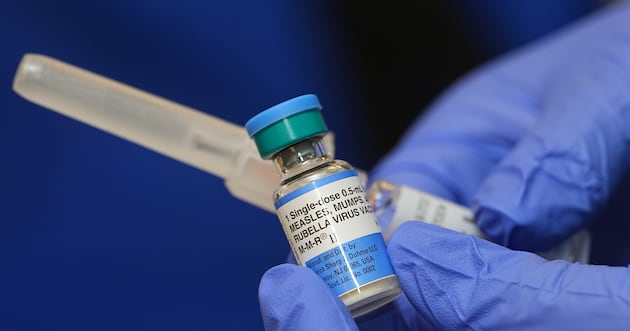
Measles cases in Pennsylvania are surging, now exceeding 1,500.The Pennsylvania Department of Health said only five of the cases involved fully vaccinated people.The U.S. could lose its status as a country that eliminated measles.
The measles outbreak in Pennsylvania now includes more than 1,500 cases, 290 hospitalizations and six deaths. Besides the size of the outbreak, it’s attracting attention because two-thirds of those who contracted measles are adults.
The health department has been urging the public to get vaccinated, noting the mumps, measles, rubella (MMR) vaccine is 97% effective when people have two doses. And when measles does break through, the case is typically much milder.
Demand for vaccination in Pennsylvania has increased dramatically, according to Phillyburbs.com, which reported that more than 56,000 doses were administered in September and more than 53,000 in the first four weeks of October, citing the health department. Both months saw more than double the typical 25,000 MMR doses administered each month.
 A sign is posted outside a Pennsylvania Department of Health measles vaccination clinic located in Lancaster County in Peach Bottom, Pa., Tuesday, Oct. 20, 2026. | Matt Rourke, Associated Press
The Pennsylvania Department of Health said just five of its cases involved individuals who were fully vaccinated.
According to the Centers for Disease Control and Prevention, in the decade before the vaccine became available in 1963, most children contracted the illness by the time they were 15. An estimated 3 million to 4 million people in the U.S. were infected each year. Between 400 and 500 people died from it each year, while 48,000 were hospitalized. And 1,000 a year suffer encephalitis, which means swelling of the brain.
Will U.S. lose its measles status?
The extended series of measles outbreaks could jeopardize America’s status as a country that has eliminated measles, a designation it earned a quarter century ago and that seemed secure until recently.
ABC News reported that the status decision may come when an “independent group of experts in epidemiology, public health, virology, pediatrics, and immunization, appointed by the Pan American Health Organization (PAHO), will review evidence to determine whether the U.S. has seen a year of continuous transmission.”
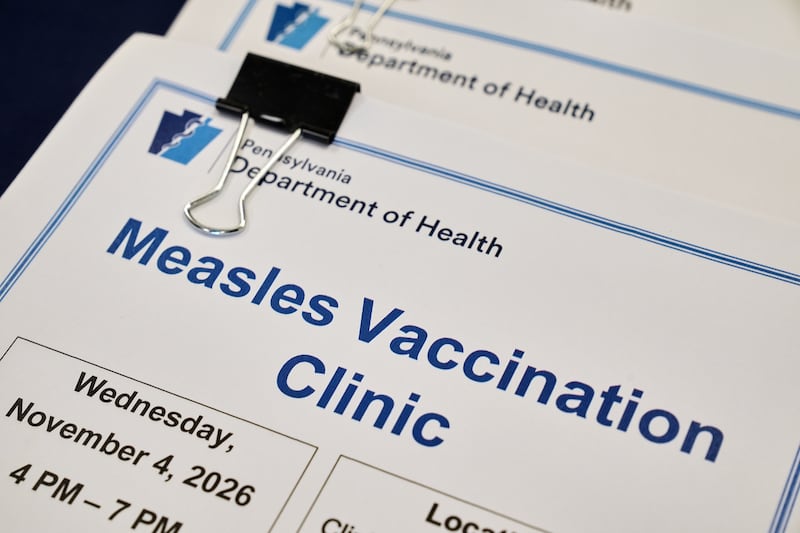 A flyer is displayed at a Pennsylvania Department of Health measles vaccination clinic located in Lancaster County in Peach Bottom, Pa., Tuesday, Oct. 20, 2026. | Matt Rourke, Associated Press
Per ABC, “The threat of the U.S. losing its elimination status looms, especially after Canada lost its measles elimination status last year after struggling to contain a year-long measles outbreak.”
“At best, losing the elimination status would be a call to arms,” Dr. Paul Offit, director of the Vaccine Education Center and an attending physician in the division of infectious diseases at Children’s Hospital of Philadelphia, told ABC News. “To lose that status (would be) a tremendous loss.”
The CDC calls measles elimination a “historical achievement,” explaining that “measles was declared eliminated from the United States in 2000. This meant the absence of the continuous spread of disease was greater than 12 months. This was thanks to a highly effective vaccination program in the United States, as well as better measles control in the Americas region.”
Pennsylvania’s unusual outbreak
The fact so many of those contracting the highly contagious disease are adults makes the Pennsylvania cases unusual, according to the Center for Infectious Disease Research and Policy (CIDRAP).
Its take on the rise in cases among adults focuses on the areas where herd immunity used to protect vulnerable populations that had low vaccination rates but no exposure to natural measles. That includes Plain communities, which are somewhat isolated from the outside world. When those outside the community had higher vaccination rates, the virus didn’t get into the more vulnerable community. Now that vaccine rates have dropped some, the herd immunity has waned.
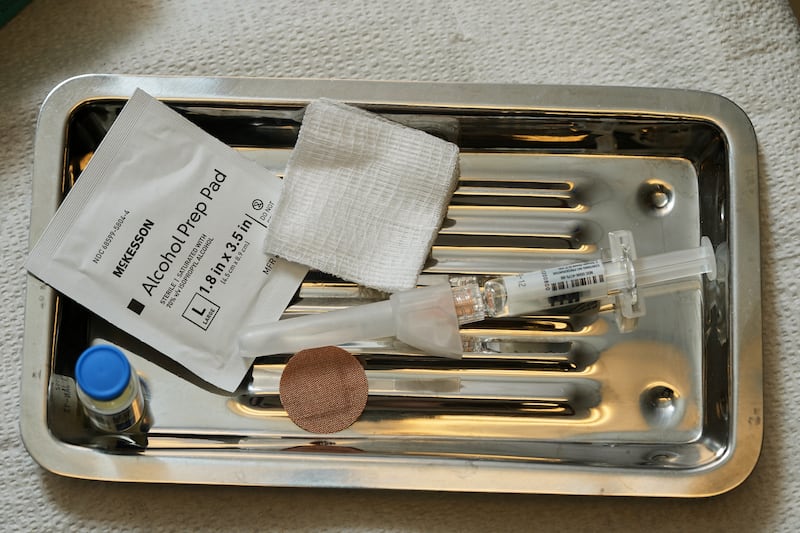 A combination measles, mumps and rubella vaccine stand in a tray at a Pennsylvania Department of Health measles vaccination clinic located in Lancaster County in Peach Bottom, Pa., Tuesday, Oct. 20, 2026. | Matt Rourke, Associated Press
The CDC has reported 5,182 lab-confirmed cases have been reported across the U.S. in 2026 as of Nov. 5. Just 18 of those were reported among international visitors to the U.S. The CDC notes that there are other cases, but its count waits for lab confirmation.
And not all measles cases get reported to a public health authority.
On its surveillance map, the CDC reports that behind Pennsylvania in the count are South Carolina, with 670 measles cases in 2026, and Utah, with 536. In all, cases have been lab-confirmed in 47 jurisdictions, including most states.
About measles
Measles is a highly contagious respiratory virus that is miserable in the short term and can cause both long- and short-term health complications, including brain swelling, pneumonia and in some cases death. Close to 20% of people diagnosed with measles end up in the hospital, per that health department. Other public health estimates range from 11% to 20%.
Long-term complications and deaths are quite rare, but occur.
The virus spreads through respiration, coughing and sneezing. It can also linger in the air for up to two hours, so people who don’t know they’ve been exposed can be infected if they inhale it. And people are contagious about four days before and four days after the rash sets in.
That rash doesn’t appear for between one and three weeks after exposure, typically. Symptoms begin with a cough, fever, runny nose and watery, red eyes. The rash comes a few days later, starting at the hairline and spreading downward.