
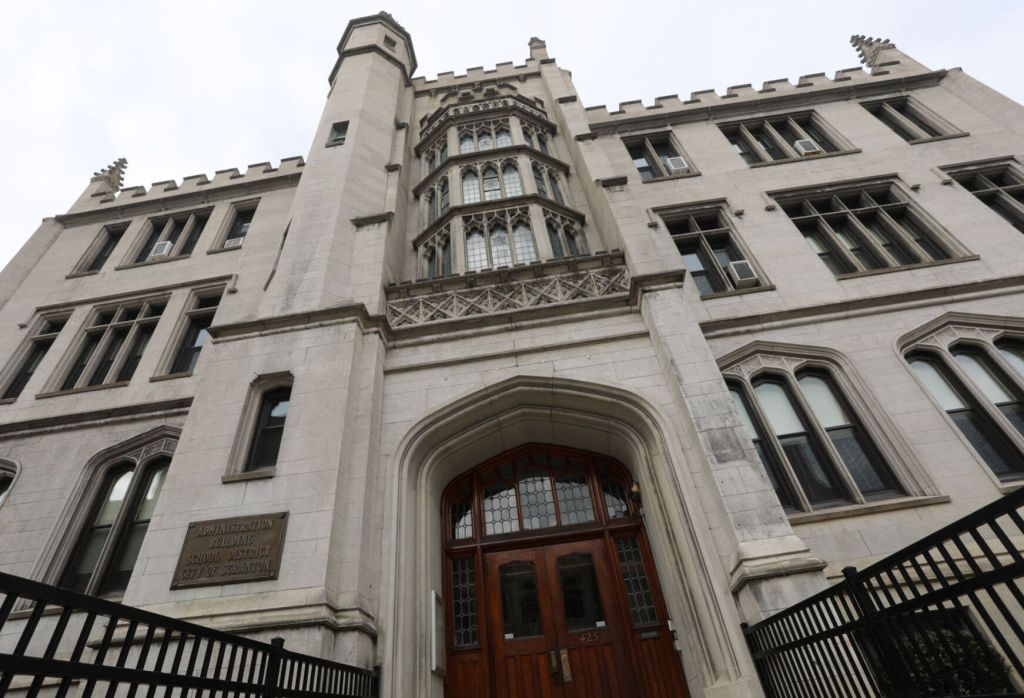
The Scranton School District’s proposed 2026 budget does not include a property tax hike next year, which would mark the third consecutive year without an increase.
Meeting virtually Wednesday, the school board voted unanimously to approve the proposed $241.4 million budget that includes about $236 million in expenditures and a roughly $5 million revenue surplus listed in the spending plan as a budgetary reserve. The proposed budget holds taxes steady and must remain on display for 30 days prior to adoption, with Wednesday’s board action setting up a final budget vote in mid-December.
The district, which operates on a calendar year budget as opposed to a traditional July-to-June fiscal year, last raised property taxes in 2023, by 3.4%. The proposed 2024 budget originally included a modest 1.25% increase the board ultimately voted to forgo in December 2023, leaving its property tax rate unchanged in 2024. The district’s 2025 budget also didn’t hike taxes.
Its current property tax rate is 147.85 mills, a mill being a $1 tax on every $1,000 of assessed value, but that rate will drop precipitously next year if Lackawanna County’s first property reassessment since 1968 proceeds as planned and officials implement new assessments for use in property taxation beginning in 2026 as required by a stipulated court order. The reassessment means property owners may see their 2026 tax bills fluctuate compared to 2025 despite the district not raising taxes.
Reassessment is designed to achieve tax fairness by bringing assessed property values in line with market values. By law reassessment must be revenue neutral, with taxing bodies collecting essentially the same amount of property tax revenue in the year after a reassessment as they did the year prior.
As assessed values rise as a result of the reassessment, school tax rates and those set by other taxing bodies will fall accordingly. Scranton’s proposed budget, for example, tentatively assumes an adjusted rate of about 8.9 mills. Pat Laffey, assistant to the superintendent for finance and operations, said that adjusted rate will likely change slightly after the county officially certifies the new assessments.
The impact on individual tax bills is not yet clear, but a general rule of thumb is that about a third of tax bills increase with reassessment, a third decrease and a third remain more or less the same.
It’s also unclear how the county will proceed despite the court order requiring it to follow through with the reassessment and implement the new values by Jan. 1. Republican Commissioner Chris Chermak and others have proposed a one-year extension, with an attorney for the county recently raising that prospect in a letter to another attorney representing plaintiffs in a lawsuit over the county’s decadeslong failure to reassess. The county agreed to the terms of the court order in 2022, postponing further action in the civil case.
The attorney for the plaintiffs, who are parties to the court order, said in a response letter Wednesday, “we do not consent to delaying implementation of the reassessed values.”
The deadline for the county assessor’s office to certify the new values for use next year is Saturday.
Reassessment uncertainty notwithstanding, neither the county nor the city of Scranton plan property tax increases next year.
The county’s $181 million proposed 2026 budget that commissioners introduced in mid-October holds taxes steady following a nearly 33% 2025 hike that helped address what was a pronounced fiscal crisis. Scranton City Council unanimously introduced last week a $115.5 million, tax-hike-free budget proposal submitted by Mayor Paige Gebhardt Cognetti’s administration.
Of the $241.4 million in total revenue included in the district’s budget, roughly $77.4 million comes from local revenue sources, including property, earned income, local service and payroll preparation taxes, among others. The budget also includes about $154.5 million in state revenue, up about $14.5 million from the 2025 budget, and about $9.06 million in federal revenue, a nearly $1 million reduction from 2025. It also includes about $435,000 in “other revenue.”
On the expenditure side, budgeted expenditures related to employee salary and benefit costs are approximately $10.7 million higher than in the 2025 district budget as a result of contractual salary increases, expansion of the district’s pre-K program, additional staffing requests and other factors. The district also projects a $5.1 million increase in purchased services, “primarily due to increases in Special Education contracted service, charter/cyber tuition ($3.9M) and contracted services for student transportation ($900K),” the budget notes.
Changes to the proposed spending plan are possible prior to final passage next month.
Tax revenue anticipation note
The Scranton School Board also voted Wednesday to authorize if necessary an up-to $32.8 million 2026 tax revenue anticipation note from Fidelity Bank at an interest rate of 3.5%. Sometimes simply called a tax anticipation note, a TRAN or TAN is a short-term loan taxing bodies often take early in their fiscal years to cover expenses pending receipt of tax revenues.
Whether the district will actually need to take the 2026 TAN given Wednesday’s state budget breakthrough still remains to be seen.
The district hasn’t had to take a TAN in recent years as a result of its improved financial position, but district officials had discussed such a borrowing in recent months in the context of the monthslong state budget impasse that delayed funding for public schools. Wednesday’s meeting followed the end of that impasse as state lawmakers from both parties finally reached agreement on a roughly $50.1 billion budget for Pennsylvania’s 2025-26 fiscal year that began in July.
Gov. Josh Shapiro signed the budget into law Wednesday, noting in a subsequent press release that it provides an overall increase in education funding of more than $900 million.
Albeit more than four months late, the state budget will also free up billions of dollars in funding for public schools and other entities that couldn’t be released while the stalemate in Harrisburg was ongoing.
The impasse had prompted a cash-flow crisis for the Scranton School District, forcing officials to freeze spending and rely on diminishing reserves. Scranton planned the 2026 TAN as a precaution in case the stalemate continued into next year and further delayed receipt of state funding.
Despite the state budget breakthrough, the board amended and ultimately passed the TAN motion Wednesday to give the district the flexibility to take the TAN should it ultimately need to pursue the borrowing. In that event the TAN would be managed on an “as needed drawdown basis,” per a summary of the motion.