
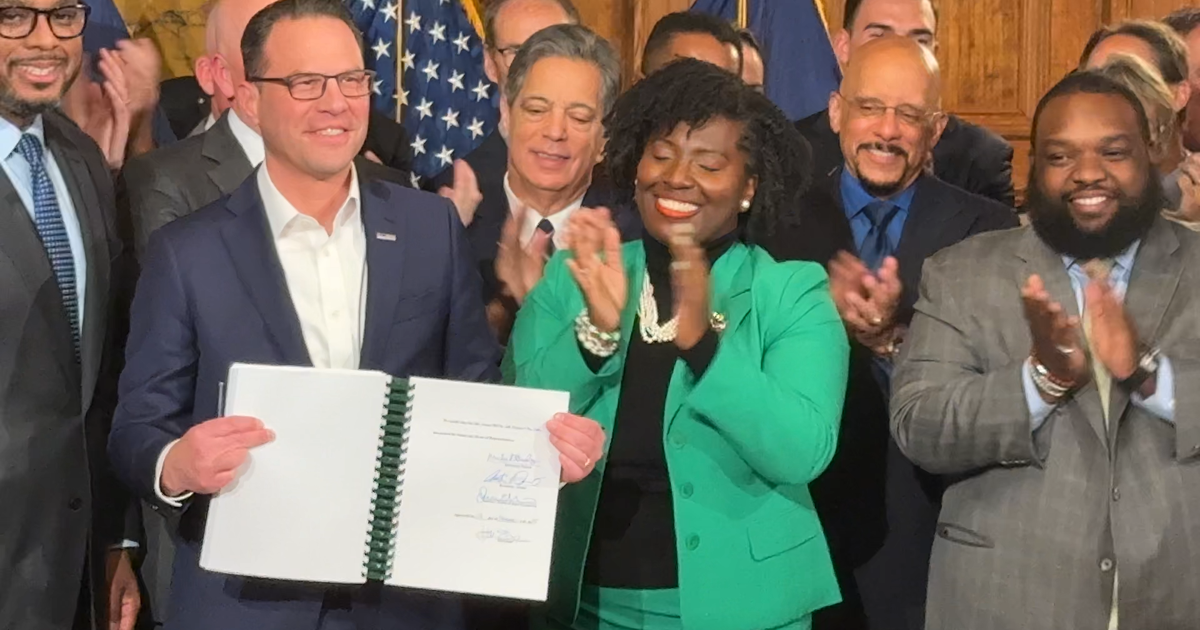
Today—representatives and senators voted on a state budget in Harrisburg… completing a task that was legally due on June 30th.
The $50.1 billion deal increases spending on education, makes slight tweaks to welfare programs, and codifies permitting reform.
“There is nothing in this budget and there’s a million things that are not in this budget, that weren’t discussed at length,” said Rep. Matthew Bradford, a Montgomery County Democrat and House Majority Leader. “I will tell you, finding that right formula of things to get that done is difficult.”
Democrats control the state house, and Republicans control the senate. Leaders from both chambers were stalled in negotiations for months.
“We stayed at the table. We continued to dialog,” said Democratic Gov. Josh Shapiro. “Sometimes that dialog was me running back and forth between leader Pittman and leader Bradford. Sometimes it was leader Pittman and leader Bradford having conversations.”
Shapiro put air quotes around “conversations” while answering the question from a reporter.
The gridlock kept state funding frozen for schools, counties, and other organizations. Many took out loans, laid off staff, or cut programs– strained by the lack of state money.
A breakthrough in talks happened just a few weeks ago; when more leaders were pulled into talks.
“In divided government, there has to be a compromise,” said Rep. Jesse Topper, a Bedford County Republican and House Minority Leader. “In our [Republican’s] world, if you were going to increase spending, you had to have policy initiatives that could eventually support that spending.”
The biggest compromise of the deal? Republicans successfully removed Pennsylvania from the Regional Greenhouse Gas Initiative (RGGI). The multi-state program taxes energy companies for carbon emissions, which Republicans argue stifles business expansion in the energy sector.
Environmentalists are not pleased at the state’s removal.
Over half of Pennsylvania’s energy comes from natural gas– and the state is the number two exporter of electricity in the nation.
“We’ve enacted historic reforms that I believe are going to unleash the promise of Pennsylvania,” said Sen. Joe Pittman, the Senate Republican Leader.
Some fiscally conservative Republicans are frustrated that the final spend number is so high– around $5 billion more than what the state could generate in revenue.
“What does that mean to the finances a year, two years, three years from now?” said Rep. Brad Roae, a Crawford County Republican who voted no on today’s budget bill. “What does that mean about potential tax increases?”
Democrats are touting a new earned income tax credit as a victory, as well as reforms to cyber charter school rules and funding.
“If a parent wants to send their child to a cyber school, that’s fine. That’s their prerogative. But we shouldn’t be over funding them at the expense of Pennsylvania’s public schools,” Shapiro said.
Money to schools, counties, and other groups should be flowing in the next day or so. We will continue coverage on the details of this budget, and how it impacts our local area in the coming weeks.