
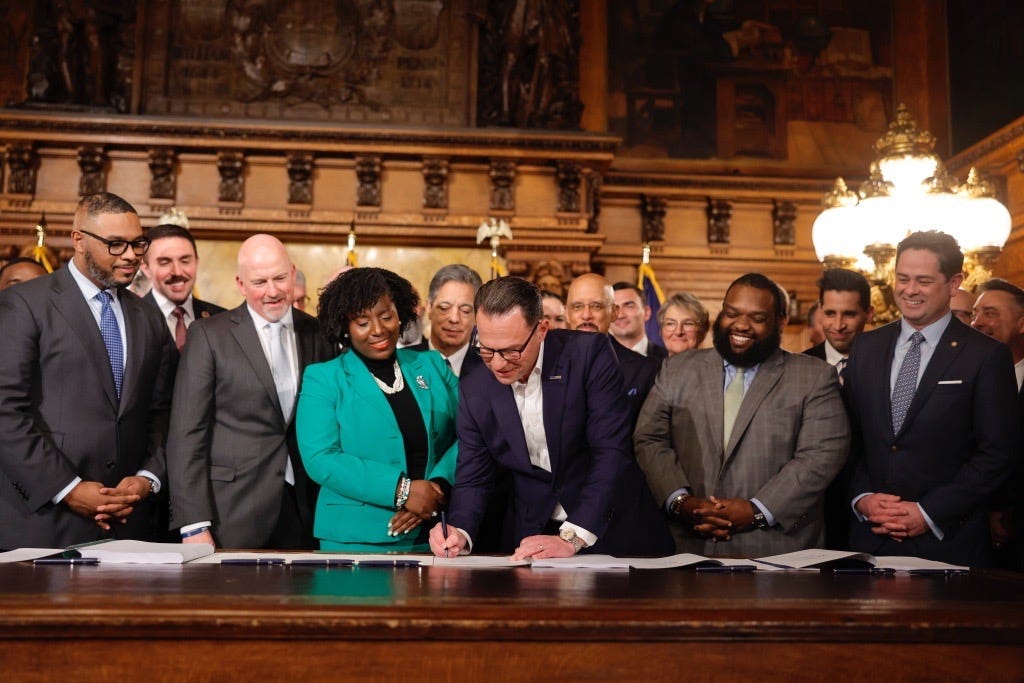
Pennsylvania lawmakers reached a deal on a state budget on Wednesday, Nov. 12, to end a four-month stalemate that held up critical funding to school districts, local governments and other agencies.
After reaching a deal with Gov. Josh Shapiro, the Pennsylvania House of Representatives voted 156-47 on the $50.1 billion spending plan. The GOP-controlled Pennsylvania Senate followed suit, approving the budget bill 40-9.
Earlier: $50.1 billion Pennsylvania budget could take shape after impasse of more than 4 months
Neither Democrats nor Republicans came out as clear victors in the nearly 20-week budget battle, which extended well past the June 30 state-mandated deadline. Democrats secured reforms to cyber charter school funding to ease the burden those schools place on public districts, while Republicans forced the state’s exit from the Regional Greenhouse Gas Initiative, an 11-state compact aimed at reducing carbon emissions from energy producers.
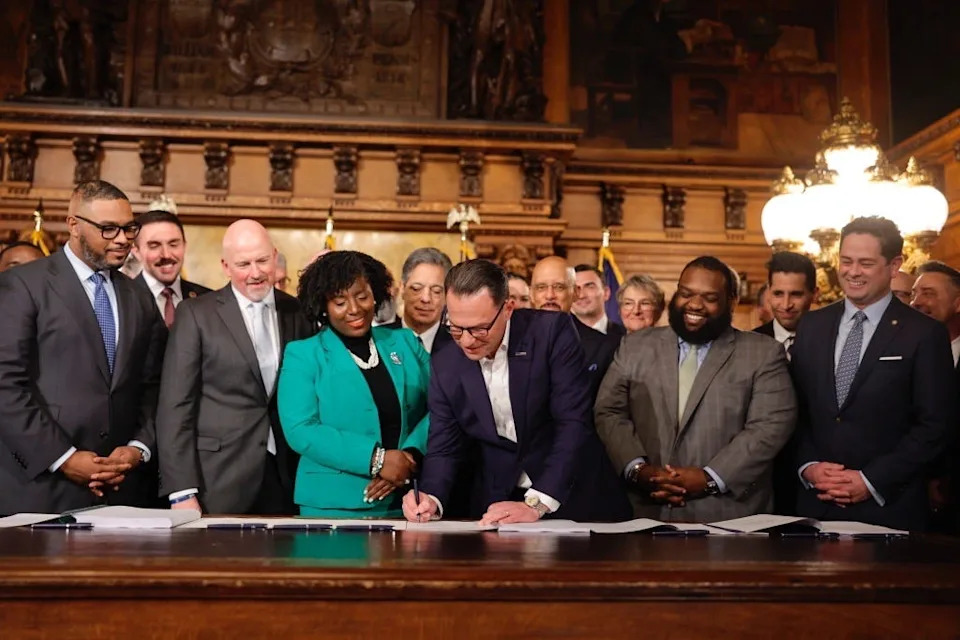
Gov. Josh Shapiro signs the fiscal year 2025-26 budget surrounded by General Assembly members on Nov. 12 at the Capitol in Harrisburg. The state budget had been due June 30, and Pennsylvania the final state in the country to approve a funding deal.
Shapiro, a Democrat, talked about the challenges of reaching an agreement.
“Pennsylvania is one of just a handful of states with a divided legislature, and it takes a majority of votes in the Republican-led Senate and the Democratic-led House to get a budget to my desk,” Shapiro said. “It requires all of us to compromise, have tough conversations and ultimately find common ground. I worked hard all summer and fall to get leaders in the General Assembly to come together and hash out their differences.
“As (Lieutenant Gov. Austin Davis) said, we stayed at the table, refusing to accept inaction and rejecting short-sighted attempts to cut health care services and slash critical initiatives, because my top priority was delivering a budget that makes a meaningful impact on the good people of Pennsylvania,” Shapiro continued. “And today, because we held the line — alongside my colleagues here in the House and Senate ― and stayed at the table, and demanded a serious budget that addresses our needs … today I am about to sign into law a budget that delivers for Pennsylvanians and builds on the progress we’ve made so far.”
More: What have Pennsylvania’s lawmakers been doing during months of state budget inaction?
Here are some of the winners and some of the losers of the new budget:
Winners in the Pennsylvania state budget
Public schools: The passage of any budget will relieve commonwealth school districts that have been strained by billions of dollars in delayed state payments over the four-month impasse.
Advocates for public education also had other reasons to celebrate the spending plan, which directed an additional $565 million to underfunded schools across the commonwealth. This money is part of a multi-year effort to fix resource disparities that courts say have created unconstitutional inequities in Pennsylvania schools.
The final plan also increases basic education funding by $105 million, allocates an additional $40 million for special education and sets aside $100 million for school safety and mental health grants.
“Given the blatant attacks on public education throughout the country, Pennsylvania has shown what we can achieve with a bipartisan vision for the future that values our students, schools, and educators,” Aaron Chapin, president of the Pennsylvania State Education Association, said in response to the budget’s passage.
The wealthy: The group Pennsylvanians for Accountability from Yass, Billionaires, and Corporations (PAYBAC) ― Yass being a reference to Susquehanna International Group’s Jeffrey Yass, the richest person in Pennsylvania and major political donor to conservative causes ― said the lack of revenue that could have been generated by imposing higher taxes on the wealthy creates “looming devastation” for the state come spring, when federal budget cuts will take effect.
“After months of delay and dysfunction, the General Assembly has handed another free ride to billionaires like Jeff Yass, leaving working people holding the bag,” PAYBAC’s organizer, Ray Murphy, said in a statement. “While we all celebrate the end of a budget impasse that has caused much harm, the fact is that this was the last chance to act before next year’s federal cuts push the state’s finances off a cliff — and the legislature choked. Lawmakers know the truth: unless we tax billionaires like Jeff Yass, we can’t even maintain basic services, let alone build a better future.”
The gambling industry: Shapiro’s original budget proposal called for imposing a tax on the unregulated video game terminals that populate many convenience stores and truck stops. Officials estimated the proposal would yield $8 billion in additional revenue over the coming five years.
More: How Pa. gambling helpline calls, number of self-imposed bans have changed in recent years
In addition, in recent weeks, sports betting operators have launched a pressure campaign to fend off any tax increase that might affect their industry. An ad aired by the Sports Betting Alliance warned that Pennsylvania lawmakers were “coming after poker and parlays.”
More: Pennsylvania men lost hundreds of thousands gambling on DraftKings. Now they’re suing.
The final plan, though, refrains from these tax changes and includes no new sources of revenue.
Losers in the Pennsylvania state budget
Regional Greenhouse Gas Initiative: The cooperative of Eastern states — Connecticut, Delaware, Maine, Maryland, Massachusetts, New Hampshire, New Jersey, New York, Rhode Island, Vermont and Pennsylvania — aimed to cap and reduce carbon emissions from large power producers. Pennsylvania joined in 2022 under former Gov. Tom Wolf, but the state’s participation never took effect as it was challenged in the courts. Republicans, energy companies and labor unions were opposed to the RGGI taking effect in Pennsylvania, the second-largest U.S. producer of natural gas. They successfully withdrew the state from the cooperative, a major concession for Democrats. It’s a major blow for environmental groups and renewable energy advocates.
More: Don’t sacrifice powerful climate regulations to end Pa. budget impasse | Opinion
Republican state Sen. Dan Laughlin of Erie celebrated the move, calling the RGGI “a $1.2 billion electricity tax that would have crushed Pennsylvania families and employers,” in his statement on the budget.
The Sierra Club noted that Pennsylvania has missed out on $3 billion in proceeds “that could have been re-invested to transform our energy economy” ever since participation in the RGGI was challenged in court. Those challenges were set to be resolved soon with an anticipated ruling from the Pennsylvania Supreme Court, the environmental group noted. Now, the state has no policy in place to reduce these emissions, which is a “major setback for Pennsylvania’s environment, economy, and public health,” the group said in a statement.
Agency caregivers: Caregivers for seniors and people with disabilities say their industry is in crisis because of an acute lack of funding and have pressed policymakers to increase their Medicaid reimbursement rates.
Pennsylvania’s existing rates lag behind those in surrounding states, and advocates for the commonwealth’s care workers had asked lawmakers to include a $370 million funding increase to help close the gap this year.
‘These are real people’: Pennsylvania care providers decry 4-month state funding delay
However, the final budget provides $21 million, directing that additional aid to the small fraction of caregivers who are not employed by an agency.
“This budget represents a devastating failure of leadership by Governor Shapiro, his Administration, and the General Assembly,” Mia Haney, CEO of the Pennsylvania Homecare Association, said in a statement. “This is not how you stabilize a collapsing system; this is how you deepen a crisis.”
For the non-agency caregivers, who are hired directly by clients, the funding bump was welcome. The additional aid will increase wages for these 8,000 workers to $15 per hour and provide them with paid time off.
Cyber charter schools: In addition to increasing funding to public schools, state lawmakers also reformed the system for funding Pennsylvania cyber charters, a change that will save an estimated $178 million for the school districts that make payments to these online academies.
While public school advocates have long said the payments to these virtual schools are excessive, cyber charters predicted the funding changes will have devastating financial effects for them.
“(Lawmakers) have approved the closure of some public schools, an onslaught of layoffs that will impact communities across the commonwealth, a disruption in learning for students in the middle of the school year, and a colossal step backwards in Pennsylvania’s school choice movement,” Dr. Rich Jensen, CEO at Agora Cyber Charter School, said in a statement.
Minimum-wage earners: Democrats and a handful of Republicans have discussed different plans to raise the hourly, minimum wage for the lowest paid in the workforce, but once again were not able to reach an agreement — at least not in the budget process. The Pennsylvania Working Families Party, which has worked with PAYBAC on this and other issues, decried the failure of state lawmakers to increase the minimum wage, which has been set at $7.25 an hour since 2009, among other issues.
Recreational marijuana legalization advocates: The budget includes no new revenue streams, and that includes from the legalization of adult-use cannabis, which proponents have argued would generate millions of dollars for the state instead of sending that potential revenue to nearly all of Pennsylvania’s neighbors. Chalk it up as a win for Ohio, New York, New Jersey, Delaware and Maryland that the budget bill doesn’t address legalization.
More: Anxiety diagnoses have overtaken Pennsylvania’s medical cannabis program, study finds
Matthew Rink and Bethany Rodgers are investigative reporters for USA TODAY Network Pennsylvania.
This article originally appeared on Erie Times-News: Who wins, loses as PA lawmakers finally end 4-month budget impasse?