
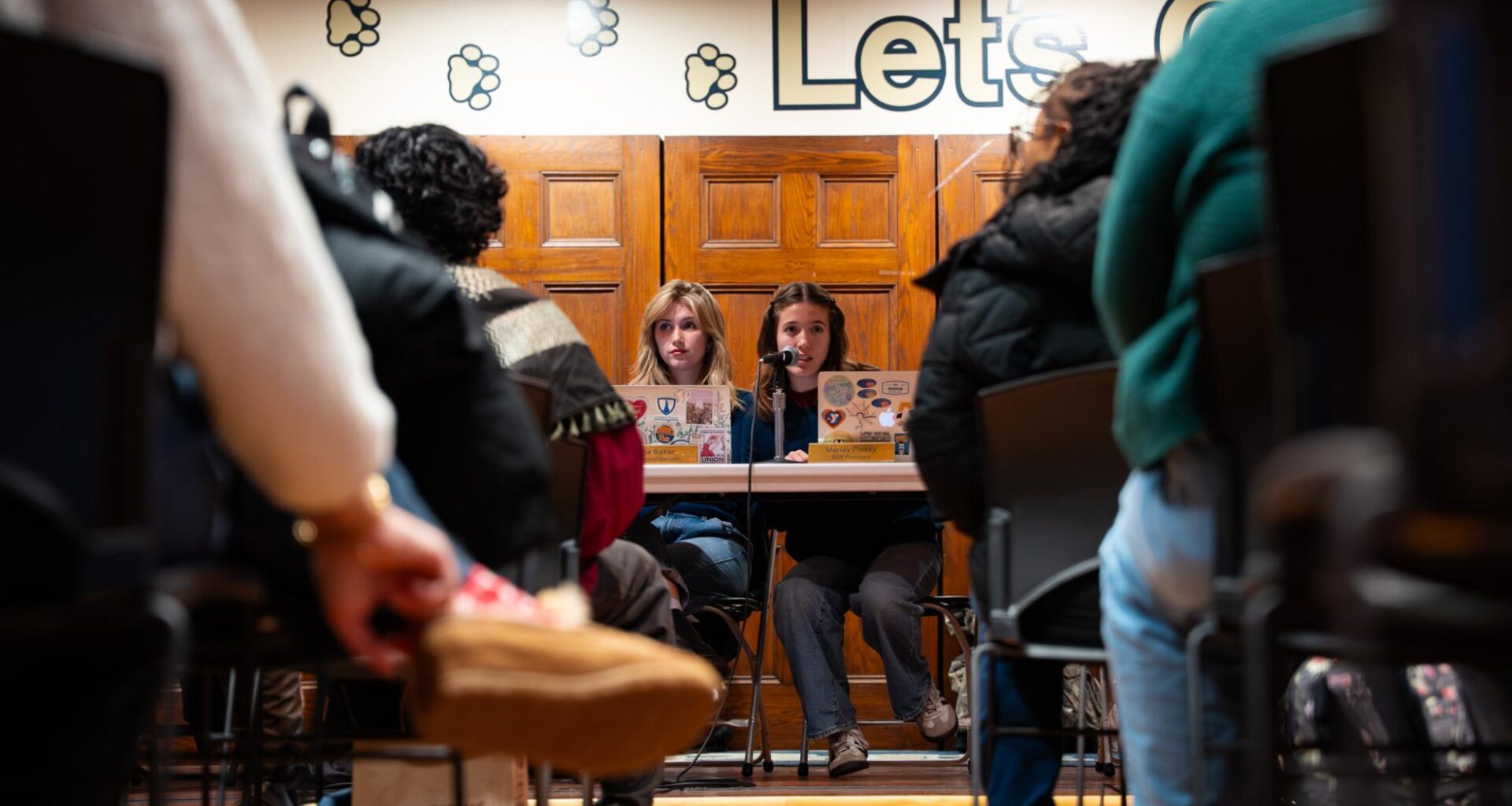
Student Government Board addressed concerns about discrimination against Muslim and Palestinian students and student worker wages at its weekly meeting Tuesday night at Nordy’s Place.
During the first open floor, representatives from Students for Justice in Palestine at Pitt criticized SGB for inaction on student discrimination and hate crimes.
“[SGB] parroted the same platitudes [of the administration] that either withheld information or just didn’t bother to ask [administration] for more [information about student visa termination],” a SJP representative said.
Another representative for SJP at Pitt urged SGB to advocate for increased transparency and student involvement in the administration’s regulation of student groups.
Last year, SJP was suspended by Pitt after a student conduct hearing. Afterwards, students and professors raised concerns about the University’s “vague conduct hearing rules.” A district court judge ordered Pitt to reinstate the club in August.
“We want transparency and peer oversight in all of the University’s decisions towards us, the students,” the representative said.
An additional representative was concerned about the possibility of ICE’s presence on campus.
“We need to hear a concrete plan from the University on protecting international students and immigrants,” the representative said.
According to University spokesperson Jared Stonesifer, Pitt works closely with federal, state and local elected officials and agencies — as well as professional organizations and other higher education institutions — to advocate on behalf of the international community.
He also said Pitt’s Office of Government Relations and Advocacy and University Center for International Studies, through its Office of International Services, work closely together on these issues. The University has issued guidance on what to do if approached by a government official on campus.
“We have a multi-tiered approach that ensures our international students have immediate, practical support for individual cases and institutional backing on broader policy matters,” Stonesifer said. “On the individual level, the Office of International Services provides access to free legal consultations for international students, and assistance with documentation and issue resolution with the Student Visitor and Exchange Program and [U.S. Citizenship and Immigration Services].”
The SJP representative also said SGB’s role is to advocate for students and believes SGB is not fulfilling that role.
“You are the students’ advocates — remind [the administration of SGB’s role],” the representative said.
SJP provided SGB with a list of demands for the administration including a public statement of non-compliance with ICE from the University, the condemnation of discrimination against Muslim and Arab students and the enforcement of the results of their March referendum. In this referendum, students voted to have the University disclose its investment portfolio and to divest from manufacturers funding Israel.
Stonesifer said the University maintains robust policies for responding to incidents of discrimination. The Office of Civil Rights and Title IX respond to such reports and provide education to reduce harmful incidents on campus, according to Stonesifer.
“The University of Pittsburgh does not tolerate any form of unlawful discrimination, including discrimination on the basis of race, ethnicity or religion,” Stonesifer said. “Outside of our policies and procedures, we work diligently to ensure that our students feel safe and to offer appropriate support when they’ve been made to feel unsafe.”
President Marley Pinsky responded and said SGB is willing to work with student groups like SJP to address these issues on Pitt’s campus.
“I’m open to having further dialogues with these students, especially regarding the issues that [SJP] raised,” Pinsky said.
Board member Kylie Baker addressed criticism from SJP about SGB’s response when the federal government revoked 6 student visas at Pitt, which were later reinstated. SJP claimed SGB did not put out a statement fast enough. Baker said SGB has to take the necessary steps to communicate with the University before making any official statements.
“The reason that [releasing a statement] took so long, unfortunately, was because we wanted to have all the information. We had to get into conversations with the Office of International Services,” Baker said. “We worked a lot with OIS.”
Pinsky said SGB is consistently putting in effort to address student concerns, but claimed the University isn’t always receptive.
“A lot of times, our power is undermined by the University,” Pinsky said.
Pinsky said SGB still has the power and the influence to enact change at Pitt in spite of pushbacks.
“We are powerful, especially when we work together,” Pinsky said. “Accepting that we are not powerful [is] exactly what people who don’t want change want us to think.”
Stonesifer said the Division of Student Affairs is “committed to fostering an environment where students can share concerns, engage in governance, and participate in meaningful dialogue.”
“The concerns shared at the recent meeting reflect strong student engagement with important campus topics,” Stonesifer said. “We are here to support student leaders — including SGB — and we remain open to feedback and look forward to continued dialogue as we work to support the needs of all students.”
Board member Shanthi Bhaskar said SGB is working to increase student workers’ hours and wages for the spring semester.
“[SGB is planning] a rollout of increased wages and increasing working hours for students,” Bhaskar said.
Allocations:
Middle Eastern North African Student Association requested $2,642.33 for an on-campus program. The board approved this request in full.
Club Gymnastics at Pitt requested $2,720 for general funds. The board amended and approved this request to $1,870.