
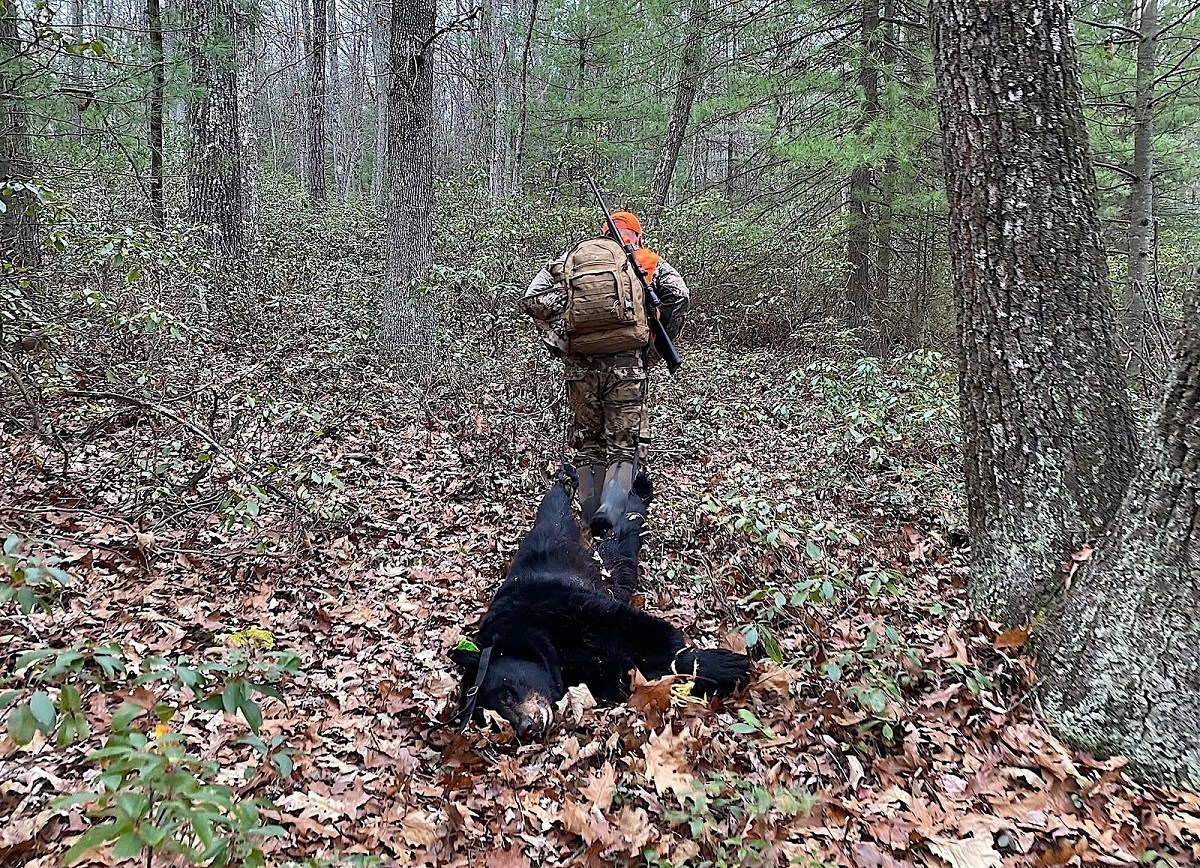
Pennsylvania offers some of the richest opportunities for bear hunting on the east coast. Success doesn’t always come easy, though, with less than 3% of license holders filling their tags annually.
Still, a remarkable number of bears – including those of record book quality – fall to hunters who’ve successfully mastered the art of breaking down bear country. The topography of Pennsylvania’s finest bear haunts is known for steep mountains gouged by deep valleys with ridges linked together by vast flats of nearly impenetrable laurel, hemlock, and mixed hardwoods. It’s in this remote solitude that bears feel at home in this terrain.
Trickling mountain runs provide a clean water source, sun-exposed hillsides offer secure bedding areas, and thick flats generously supply myriad food sources that vary from year-to-year based on hard mast abundance and the availability of small prey, including grubs and other insects.
Bears can meet all their basic needs for survival in these wild places while mostly sticking to the cover, which they highly prefer. The key is figuring out how to win on the bears’ home turf.
Craig Krause Jr., of Ashland, hunts from a traditional Northern Tier hunting camp, just as his father and grandfather did before him. His club has taken well more than 100 bears since its inception in the 1950s, almost exclusively through organized drives.
The gang meticulously plans three drives per day, using natural landmarks such as hollows, ridges or creeks, as well as manmade features like logging roads, power lines, or hiking trails as boundary guides to divide each section into manageable parcels based on hunter numbers. They rarely repeat a drive twice in the same season.
“For most drives, we try to have at least seven to 10 hunters on both teams, and we take turns alternating the two groups between drivers and standers every drive,” Krause explained. “We usually try to put those who’ve never shot a bear in the best locations to give everyone a good opportunity, but it’s never a guarantee.”
Occasionally, a driver will get a shot at a bear if it holds tightly to cover, but bears are more likely to run ahead towards standers or break up or down the hillside from the drive. For this reason, the gang likes to use three-to-four flankers on the edges of the drive whenever possible.
“We send teams of flankers – usually our older guys who can’t walk the steep hillsides as well anymore – ahead of the drivers, spreading them out to cover as much ground as possible,” Krause said. “The first guy will be about 100 yards ahead of the drive line, then maybe 150-200 yards ahead of him will be another guy, and maybe halfway out along the drive we’ll even add a third flanker. You wouldn’t believe how often these guys get shots, especially when the bears break down over those nasty hillsides.”
The cover is always thick, and the group usually moves bears. Krause said the younger bears seem to move faster and further out ahead. In those instances, drivers might hear shooting from the standers shortly after beginning the drive. On the other hand, the bigger bears always tend to stick to the cover until the very end.
“Some of our biggest bears were taken when the drive was almost finished,” Krause said. “It’s really important that guys stay ready and hold the line right up until the very end.”
An experienced veteran always leads the drive, typically using a ridge or bench as a guide, while all other drivers maintain an equal distance and stay in a solid line using verbal communication. On the stand team, the most experienced member drops off each stander based on topography and landmarks that have yielded positive results in the past. Everyone has a place and purpose, with the plan drawn up on a map and shared with the group on the evening before each hunt.
“The whole gang knows what to expect. People can see where they’re assigned, how they’ll need to dress each day, and how many layers to pack based on the setup of each drive. It’s an organized process that has worked well for us for more than 70 years.”
While driving bears is unquestionably effective, not all bear hunters have the capacity, strength in numbers, or desire to scale the mountains in such organized fashion.
Hunting the same region and terrain features as Krause, the camp has employed a vastly different approach that has yielded roughly 60 bears over the same timeframe. Instead of conspicuously pushing bruins from cover, we quietly disperse into smaller subgroups of four-to-eight hunters along the most remote and promising travel corridors we can locate without making our impact known.
This means finding the hot food sources, escape trails, and security cover, and then slipping into the heart of it all well before daybreak. It requires understanding how bears naturally navigate their surroundings, as well as how they will react once the pressure increases. It takes a great deal of patience and a willingness to sit all day, but it can pay off.
Collectively, they have learned through the years – especially when acorns are abundant – bears prefer to feed along the perimeters of the thick flats where laurel and scrub oaks offer ground-level cover and towering canopy oaks blanket the forest floor with hard mast. In these prime areas, evidence of feeding is clear with leaves rooted up to unearth a bumper crop of chestnut oak acorns covered by leaf drop, piles of scat lining ridges and trails, footprints left behind in muddy soils, and immature pine trees marked with territorial scratching.
Bears favor the hillsides below these areas, where they can loaf in the sun’s shadows, keep tabs on the wind, and continue to feed unnoticed with multiple laurel-choked exit strategies at their disposal. Finding small breaks in the cover along benches of various elevations – or just off points that wrap around two hillsides can be a great position to catch bears trying to give other hunters the slip.
Whether strategically driving bears or sitting in wait, Pennsylvania is one of the absolute best states to pursue bruins on large public tracts of prime bear country.
(Frantz is a past president of the Pennsylvania Outdoor Writers Association. Contact the writer: outdoors@republicanherald.com.)