
When it comes to improving local food systems, everything old is new again, says Robert Breen. Sustainability advocates often talk about “shortening” the modern food supply chain: reducing the steps between local food producers and consumers, as well as the physical distance that food travels.
“In Pittsburgh, we used to make ketchup here,” Breen tells Pittsburgh City Paper. “I know it’s a crazy idea, but what if we did that again?”
As a small-scale farmer and food producer, Breen has seen firsthand how difficult it is to earn a living today making a “value-added” product like ketchup (one that, according to the U.S. Department of Agriculture, has been changed in some way from a raw agricultural commodity). Aside from facing ecological challenges including extreme weather and climate change, today’s small farmers and food producers must also process, package, market, and sell their own goods, which can be costly and inefficient.
“It’s considered crucial for farms to see profit [while] getting away from subsidization and monoculture,” Breen says. “But only 4% of farms in Pennsylvania are making value-added products.”
The disconnect inspired Breen to create Zeromile, a dual food cooperative for both buyers and food producers. Zeromile — described on its website as “an old idea made new” — combines a retail food market for buyers (comparable to the East End Food Co-op or a year-round farmer’s market) with a small-scale production facility for farmers and food artisans.
Breen envisions it “providing a low-barrier spot for farmers to create value-added products.”
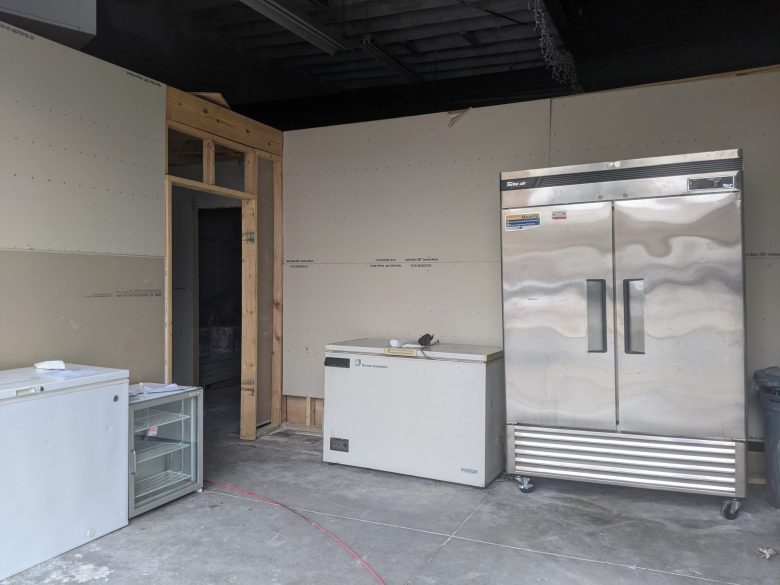 Kitchen equipment at the future Zeromile Co-op space in Lawrenceville Credit: Amanda Pagniello
In Zeromile’s model, local farmers and food producers would buy into the workers’ cooperative, gaining access to a commercial kitchen and dedicated storefront to sell their wares, while buyer-members shop local, farm-fresh food at reduced prices. In addition to a commercial kitchen and co-packing facility, the project would also function as community hub with retail and event space — including a possible grab-and-go window, dining area, and movie nights — all under one roof.
The concept comes with a myriad of benefits, Breen says, including connecting the local food system to farmers and artisans, increasing neighborhoods’ access to fresh and nutritious food, reducing “gatekeeping” for small food start-ups seeking affordable production space (Zeromile has also proposed sliding-scale membership and scholarships), and combatting food waste.
Zeromile is slated to take over the vacant River City Growers space in Lawrenceville, leased by Breen. The project was initially awarded a $100,000 USDA grant, but following the federal funding freeze in January and spending cuts, the award was reduced to $25,000. Through the Keystone Development Development Center, Zeromile launched its first round of fundraising last month to cover its initial buildout and launch.
A variety of founding worker-members have already signed onto the cooperative, including Trevor Ring of Community Cultures, Jayashree Iyengar of Popping Mustard Seeds (specializing in Indian vegetarian cuisine), Kim Flurry of A Kind Loving World Bone Broth, Marla Harvey of Made By Marla Mae pastries, and Marie Mencher of Lil’Loaf (selling fruit leather and baked goods).
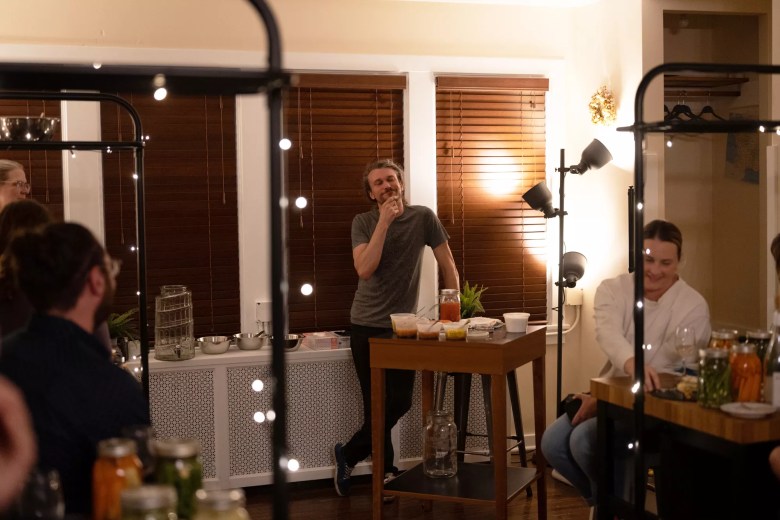 Trevor Ring, Founder of Community Cultures leads a fermentation class at Chantal’s Cheese Shop on May 29, 2025. Credit: CP Photo: Mars Johnson
Zeromile, Breen says, represents the culmination of many facets of his work in food systems and agriculture. After becoming legally blind at age 25 due a hereditary condition, Breen says that with no “generational background,” he transitioned from working as a veterinary technician to farming.
“I wanted to pick the hardest thing,” Breen says, “because I [thought], if I can do that, then there are not limitations to what could come after.”
After graduating from Bidwell Training Center’s Horticulture Technology Program, he operated a permaculture and goat farm in York County, Pa. for six years.
“And I had fallen in love, looking at these approaches to agriculture that mirror natural ecological systems,” Breen recalls. “That was just like a can of worms — it just spoke to me.”
He launched River City Growers, one of the region’s first vertical hydroponic farms, in a small commercial warehouse in 2021, growing salad greens and herbs stacked in a six-layer, 12-foot-high structure. Now a local urban grower, he again faced barriers to staying profitable, especially developing a value-added product.
“Again, it just was a matter of ‘you need to turn it into a product,’” Breen says. “But every kitchen I looked at was going to be $800, $1,500 more a month, [and] I’m selling a $3 product.”
Out of that experience, Breen co-founded Zeromile with Amanda Pagniello, a dispatcher at 412 Food Rescue, food security advocate, and industry veteran of a dozen years.
Driving Zeromile’s vision, Pagniello tells City Paper, is an eye toward collaboration and “decentralizing power” in food production, which often has a “huge, insanely high” bar to entry. Pagniello asserts that Zeromile’s cooperative framework stands in contrast to Pittsburgh’s food halls or other business incubators, top-down organizations that can price out workers like Breen. Instead, it aims for a linear power structure with shared resources and jointly written bylaws and governance.
According to its fundraising page, Zeromile’s worker-members gain access not only to a fully-equipped kitchen (with walk-in refrigeration and possible dry storage) and its small-batch co-packing space, but also to workshops and open source “equitable” business education that aims to build lasting jobs and a “longevity economy.”
“This idea is not just about our kitchen,” Pagniello says. “It’s about something bigger. It’s about creating a blueprint that’s making it easier for food producers to produce, making it easier for food access, making it easier for farmers, and creating community hubs.”
She imagines the Lawrenceville cooperative being replicated in other neighborhoods.
“The larger idea is we make a co-op of co-ops,” Pagniello says. Eventually, they hope to move beyond grant funding toward financial independence and food sovereignty, where “we utilize our financial or capital and our surplus to buy more land in Allegheny County, start a cooperative farm, and shorten the food chain even more.”
Drawing on her experience at 412 Food Rescue, Pagniello also envisions Zeromile engaging in mutual aid efforts amidst Pittsburgh’s rising food insecurity.
“I’ve seen it firsthand, how it’s getting worse in every neighborhood … we’re going to continue seeing the decline and access to a lot of resources, so it’s painful,” Pagniello said, speaking to CP before cuts to federal food aid including SNAP were announced in October. “We’re an individualistic society, and it’s really problematic; the rest of the world is a very collective society. What we need to understand is that we need to move in that direction.”
This article appears in Nov. 12-18, 2025.
RELATED