
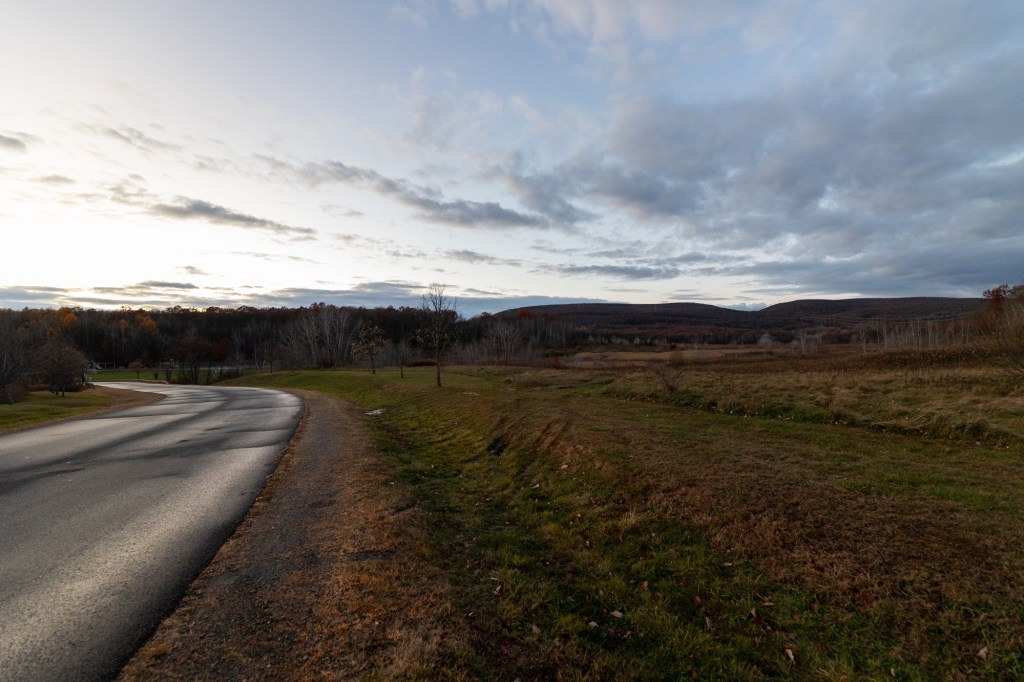
ARCHBALD — Staback Park offers a sweeping view of the borough’s northern tier. Fields of brush and wetlands thicken into dense woods that insulate the park from all but a glint of lights from Business Route 6. White transmission lines on towering poles stand out against the red-tipped trees that line the hillside.
The power lines could soon fuel up to 29 data centers across four campuses within about a mile of Eynon Jermyn Road. Developers look to transform 660 acres between Staback Park, the Archbald Pothole State Park and the Jermyn border into sweeping technology parks. Three campuses would fall between the two parks and Jermyn’s border, with a fourth campus on Eynon Jermyn Road at the Highway Auto Parts junkyard.
With all 29 data centers along Eynon Jermyn Road permitted in Archbald’s zoning, the industry could reshape the borough, wiping out hundreds of acres of forests while requiring transmission upgrades to power everything. The proposals total nearly 4.73 million square feet of exclusively data center buildings — without accounting for additional infrastructure like office buildings, roads, parking lots, substations and generator yards.
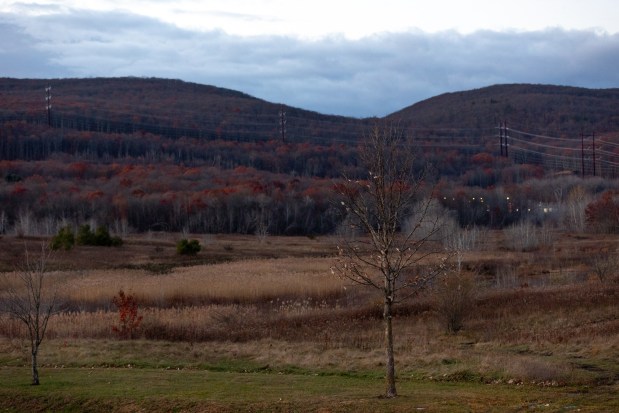 There are 18 data centers proposed to be built across 408 acres immediately adjacent to Archbald’s Staback Park on Eynon Jermyn Road, as seen on Thursday, Nov. 13, 2025. The data center campus begins about 40 feet north of the park on the land pictured in the background. The 230-kilovolt power lines in the distance will power the data centers. (FRANK WILKES LESNEFSKY / STAFF PHOTO)
Power and water
The power demand from data centers grew by nearly 150% in one year, according to PPL Electric Utilities. In its Nov. 5 third quarter investor update, the utility company said it has 20.5 gigawatts of power committed through signed data center agreements as of the third quarter of 2025, up from 8.3 gigawatts in Q3 of 2024.
The U.S. Energy Information Administration estimates the average U.S. household consumes about 10,500 kilowatt hours of electricity per year, or about an average of 1.2 kilowatts of continuous load per home. Data centers at 20.5 gigawatts, or 20.5 million kilowatts, would use the same amount of power as about 17.1 million homes in a state with about 5.3 million households.
In an emailed response to questions, PPL spokeswoman Dana N. Burns said the agreements with data centers are not publicly disclosed due to confidentiality provisions. The 20.5-gigawatt figure represents projects in advanced stages of planning, which means that each of those projects has signed an agreement with PPL. The projects are located in PPL’s service territory in eastern and central Pennsylvania, she said.
As a regulated transmission and distribution utility in Pennsylvania, PPL is obligated under state law to provide service to customers who meet the technical, financial and procedural requirements, Burns said.
“We don’t have the authority to deny service requests simply because of broader concerns about generation supply adequacy,” she said. “Section 1501 of the Pennsylvania Public Utility Code requires public utilities to furnish and maintain ‘adequate, efficient, safe and reasonable service and facilities’ for all customers within our service territory.”
PPL has leveraged investments in grid-enhancing technologies to increase capacity in its system, but the utility expects data centers, especially larger ones, to require additional investment into transmission infrastructure, she said. PPL works closely with developers to review each request to determine necessary upgrades and timelines, she said.
“That said, we are concerned about resource adequacy in PJM and grid resilience,” Burns said. “Retirements outpacing new generation additions has been a concern for many years now.”
PJM is a regional transmission organization that coordinates the movement of wholesale electricity throughout the eastern United States.
Burns said PPL is actively advocating for solutions to ensure reliability while smoothing price volatility for customers, which includes allowing regulated utilities to build and own generation to address supply gaps, she said.
“But we can’t unilaterally solve that problem by denying interconnections,” she said. “Instead, we focus on building a robust transmission system that can support both new load and new generation through added capacity, and we continue to raise the alarm about the need for coordinated action and new generation in the state to ensure reliability going forward.”
In July, during a Pennsylvania Energy and Innovation Summit at Carnegie Mellon University in Pittsburgh, which President Donald Trump attended, PPL and Blackstone announced a joint venture to invest over $25 billion into building data centers and the generation plants to power them in Pennsylvania.
Burns said the data center projects in the state represent real investment, jobs and opportunity, and PPL’s role is to ensure the grid is ready.
“We’ve made the investments to do just that,” she said.
Asked about whether concentrations of data centers could lead to higher electricity bills for existing customers, Burns said PPL is committed to maintaining affordability for all customers. Large load customers and hyperscalers pay directly for transmission upgrades that are only needed to serve their operation, while “residential and small business customers continue to benefit from reliable, affordable service.”
“It’s important to distinguish that these large load customers are primarily served by our transmission system, not the distribution system,” she said. “Transmission costs are not included in PPL Electric’s state-level distribution rate review request. Transmission rates are regulated at the federal level by the Federal Energy Regulatory Commission.”
As data centers contribute more to peak system demand, they take on a large share of transmission costs, which PPL says it expects will reduce the transmission portion of residential bills, Burns said. PPL estimates that the first gigawatt of new data center load could reduce an average residential customer’s transmission costs by 10%, or about $3 per month.
Pennsylvania American Water spokeswoman Susan Turcmanovich emailed a statement from the water utility in response to questions about its capacity to supply up to 29 data centers concentrated in one area.
“As a leader in the water and wastewater industry and a recognized solutions provider, American Water is committed to supporting the evolving needs of communities, collaborating with public officials, and supporting major economic drivers, including data centers,” according to the statement. “Through our disciplined approach, collaboration and innovation, we are well positioned to drive sustainable growth, safeguard residential customers, and uphold environmental stewardship across the communities we serve today and those we may be privileged to serve in the future.”
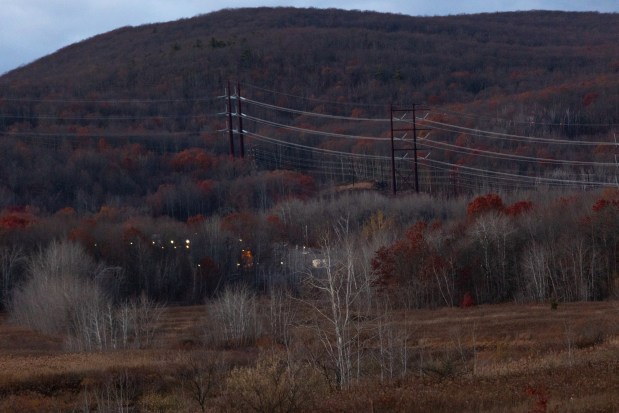 There are 18 data centers proposed to be built across 408 acres immediately adjacent to Archbald’s Staback Park on Eynon Jermyn Road, as seen on Thursday, Nov. 13, 2025. The data center campus begins about 40 feet north of the park on the land pictured in the background. The 230-kilovolt power lines in the distance will power the data centers. (FRANK WILKES LESNEFSKY / STAFF PHOTO)
‘A race to the finish’
A year ago, data centers were not much of a consideration in Lackawanna County. The landscape quickly changed.
Archbald in January was the first community to receive a proposal for a large data center park. Representatives for the Wildcat Ridge AI Data Center Campus pitched an estimated $2.1 billion investment to build 14 three-story-tall data center buildings across nearly 400 mountainside acres along Business Route 6 and Route 247, or Wildcat Road.
Archbald now has the most proposals for data center campuses of any Lackawanna County community with five. Two are proposed in Jessup and an especially large campus is proposed for Clifton and Covington townships along Interstate 380. A developer linked with two Archbald data center projects also sought to build up to four data centers in Blakely but withdrew an application seeking zoning relief in September.
There are at least 24 data center campuses proposed for Northeast Pennsylvania, said John Augustine, president and CEO of Penn’s Northeast, a Pittston-based collective that promotes Northeast Pennsylvania for new investments, jobs and business opportunities. Augustine was one of the panelists invited to testify in August at a Senate Majority Policy Committee hearing on data centers held at Valley View High School.
Augustine said his firm is involved either directly or indirectly with the 24 campuses. The majority are in Lackawanna and Luzerne counties, with a few others across Carbon, Monroe and Schuylkill counties, he said.
“You basically have Loudoun County, Virginia, phase two,” he said of Archbald.
Loudoun County was nicknamed “Data Center Alley” due to its significant concentration of data centers. To help draft its data center zoning, Archbald brought in a consulting firm with experience in Loudoun County.
However, Augustine doesn’t expect every project to materialize.
“They’re not all going to happen,” he said. “What’s going on right now is speculation, planning, but really, you’re going to see in the first quarter of next year who’s really happening. It’s kind of a race to the finish.”
Northeast Pennsylvania has more data centers proposed than anywhere else in the state across three markets: Lackawanna County’s Midvalley with Archbald and Jessup, and Salem Twp. and Hazleton in Luzerne County, Augustine said.
While he believes at least one of the Eynon Jermyn Road data center campuses will materialize, he doesn’t expect all four campuses with 29 total buildings to be built.
Talen Energy’s nuclear power plant in Salem Twp., which is under agreement to provide Amazon data centers with 1.9 gigawatts of power, made the region a hotspot for data centers, as did the power transmission infrastructure already in place, such as the 230-kilovolt power lines that will fuel the data centers in Archbald, he said. Augustine said companies are also looking at installing new 500-kilovolt lines in Lackawanna County.
He also anticipates more pipelines carrying Marcellus Shale natural gas for natural gas power plants to power data centers.
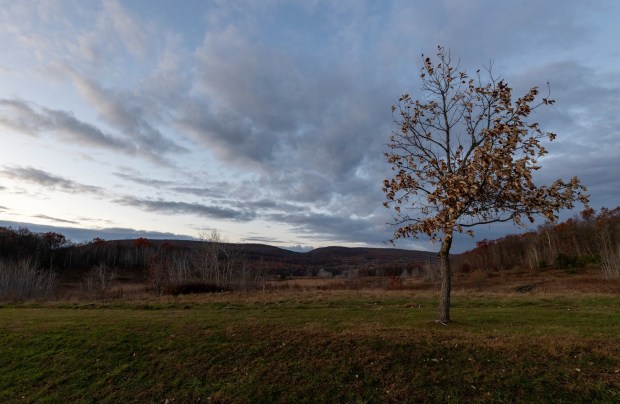 There are 18 data centers proposed to be built across 408 acres immediately adjacent to Archbald’s Staback Park on Eynon Jermyn Road, as seen on Thursday, Nov. 13, 2025. The data center campus begins about 40 feet north of the park on the land pictured in the background. (FRANK WILKES LESNEFSKY / STAFF PHOTO)
Fragmented ecosystems
In addition to impacts on electricity and water, building data centers across hundreds of acres in Archbald will affect wildlife.
David A. Ingber, Ph.D., a faculty specialist in biology at the University of Scranton, said clearing the land for data centers creates a twofold problem.
First, there’s the issue of clear-cutting the forests, a method that removes plants and animals, he said.
It also creates “edge.” Natural edge is the transition from, for example, a forest to a field-type ecosystem. When humans create unnatural edge, they fragment an ecosystem, Ingber said. The high-tension power lines running through the area to supply data centers already create unnatural edge.
“Edge is really, really bad whenever you start looking at human-environmental interactions as the whole,” Ingber said. “The less fragmented an ecosystem is, the better.”
Some animals have large ranges, and when humans interrupt that range, it pushes the animals out, he said. Edge also invites edge-loving species, and locally, that could attract brown-headed cowbirds, an especially pernicious species of bird, Ingber said. Cowbirds compete with existing birds for resources while also stealing existing birds’ nests, he said, calling them “nest parasites.”
Ingber noted the possibility of more animals trying to cross the busy 45 mph roads on either side of the proposed sites along Business Route 6 and Eynon Jermyn Road.
He broadly criticized data centers’ impact on electricity and water usage.
“It’s a nightmare,” he said. “Good land that could have harbored a lot of natural flora and fauna is gone.”
The need for additional power generation also increases the use of fossil fuels, further polluting the atmosphere, he said.
“There’s no way to look at it that is environmentally friendly, and our digital reality is requiring them more and more, which sucks,” Ingber said.
If data centers wipe out that land in Archbald, Ingber expects residents will see a drop in diversity. Although data centers aren’t loud, the humming sound associated with them could perturb some wildlife, and by removing trees and plants, the area loses the herbivores living and feeding on them, he said. That means losing the carnivores feeding on the herbivores, and the overall biomass available to the ecosystem quickly drops, he said.
Ingber teaches a course on science and the human environment where he talks to his students about data centers. The majority of public opinion is against them, he said.
Residents can’t be apathetic or give up when faced with data centers in their communities, he said.
“The more you make your voices heard, the louder and more annoying you are, the more you’re rattling sabers and attending town hall meetings and voting in local elections, the more we, with boots on the ground, can exact that change,” Ingber said. “It can feel hopeless when you’re looking at it moment to moment, but progress can be made if we’re persistent.”
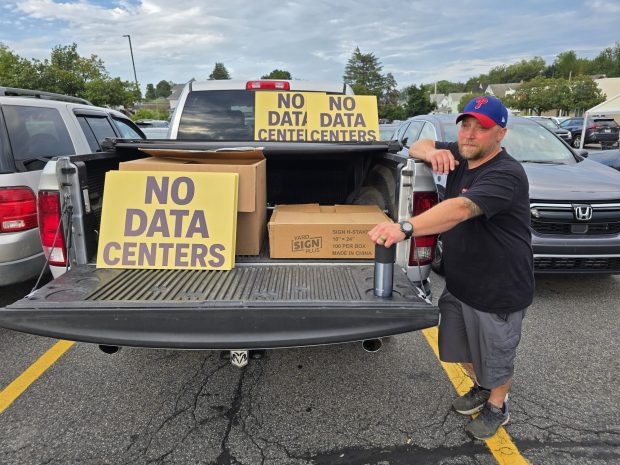 Bob Cicci of Peckville poses with his truck full of “No Data Center” signs on Wednesday, Aug. 13, 2025, in Peckville prior to the borough’s data center meeting. Cicci, of Snyder Granite Company in Peckville, sold the signs at cost for $6 each.
Opposition
Data center discussions have become a part of daily life in the Midvalley, with “No Data Center” signs popping up in yards and residents packing council meetings to voice opposition and concern.
Archbald residents Justin Healey, 35, and his wife, Tamara Misewicz-Healey, 37, are among those persistently opposing data centers. The parents of three young children testified against Archbald’s data center zoning ordinance, which failed to come to a vote during a special meeting Oct. 3.
Archbald drafted the 14-page ordinance to give borough officials more control. It would have made data centers conditional uses in four overlay districts, requiring developers to abide by conditions ranging from sound and water studies to prohibiting on-site power generation to aesthetics that minimize visual impacts with buffers and architectural design guidelines.
Residents urged council to limit the overlay districts to one location across the Casey Highway and away from homes and advocated for more safeguards and conditions.
After the ordinance failed, residents hoped council would adopt an amended ordinance further limiting data center locations and applying more restrictions.
The delay allowed a developer to apply for two more data center campuses Oct. 22, totaling 22 data center buildings across two campuses between Staback Park and Jermyn. The proposal would put 18 data centers next to Staback Park and the Archbald Pothole State Park, with four more buildings near the Jermyn border.
With the data centers permitted, Misewicz-Healey said she feels like they’re in a “survival mode” of just trying to get them zoned appropriately. She hopes for a regional study looking at water and electricity consumption.
The Healeys petitioned the borough to request a new zoning amendment regulating data centers with even more safeguards and fewer areas to build them. They received 153 signatures Oct. 5 and submitted the petition and ordinance to council.
Archbald will reconsider its zoning ordinance during a special meeting Nov. 24, borough Manager Dan Markey said in a text. A public notice advertising the meeting appeared in the Nov. 15 edition of The Times-Tribune.
As a professional industrial hygienist, Misewicz-Healey studies the impact of industry on human health and safety.
By placing data centers near parks and in close proximity to the Valley View School District’s intermediate, middle and high schools, the facilities will be built near one of the most vulnerable populations in terms of sensitivity — children.
“Young children are more vulnerable to carcinogens. They’re more vulnerable to asthma,” she said. “They breath a lot more. Their heart rates are quicker, so they get much higher exposure.”
Older residents at the nearby Highlands at Archbald housing development on Eynon Jermyn Road next door to a proposed data center campus are another vulnerable population, as are the low-income residents who will lose their homes to data centers in the Valley View Estates mobile home park, she said.
“The location itself could not be worse, and that’s really what we are pleading with (borough officials) about,” Misewicz-Healey said. “It doesn’t match our comprehensive plan, it doesn’t match the zoning ordinance, and it’s just reckless. We should be taking a caution-first approach putting them in an industrial area where they are better suited.”
Her husband said they bring their three kids to Staback Park at least twice a month, but that will never happen again once data centers start to emerge.
“It’s really kind of a humanitarian crisis,” Healey said. “It doesn’t belong there, straight up.”