
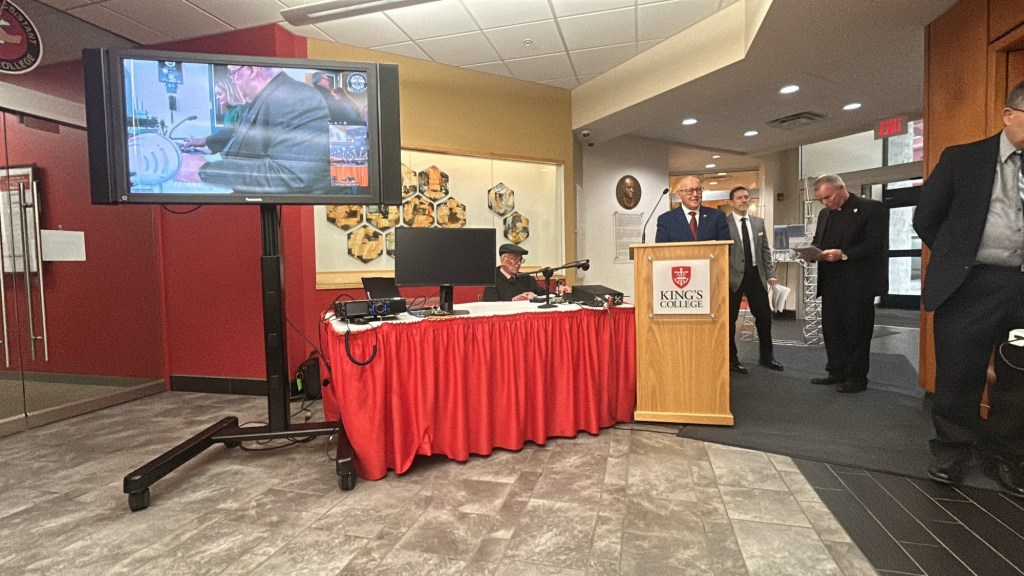
WILKES-BARRE — The mayors of Wilkes-Barre and Scranton communicated wirelessly Saturday afternoon from 20 miles apart — the same way it was done 120 years ago.
It wasn’t easy back then. The 1905 chat via Morse code used technology invented by the Rev. Jozef Murgas of Sacred Heart Church, a Wilkes-Barre priest. It was the first time in the world that wireless telegraphy messages were transmitted over land.
Wilkes-Barre Mayor George Brown, transmitting from King’s College, and Scranton Mayor Paige Gebhardt Cognetti, stationed at the University of Scranton, recreated the breakthrough Saturday during a celebration of the 120th anniversary of the world’s first successful wireless telegraph conversation.
Brown went first, reciting what Wilkes-Barre Mayor Fred Kirkendall said Nov. 23, 1905, to Scranton Mayor Alex Connell.
“Wilkes-Barre and Father Murgas send their best wishes to you and to our healthy daughter, Miss Scranton. Since the last election, the wires of the machines have been cut and we are sending you this without them,” Brown said.
An operator then transmitted the words using a series of buzzes and beeps that represent the dots and dashes of Morse code.
Cognetti gave Connell’s reply.
“Scranton sends hearty congratulations to Father Murgas, our mother city’s foremost inventor. May he live long enough to derive all the benefits he is entitled to,” Cognetti said.
Mayor Paige Cognetti recreates a radio transmission with King’s College president Rev. Thomas P. Looney. (COURTESY UNIVERSITY OF SCRANTON)
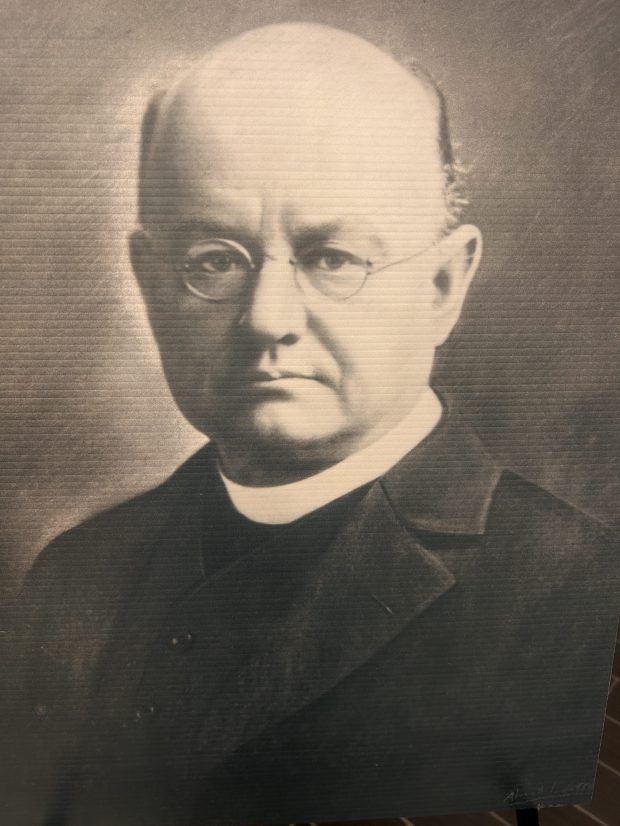
Rev. Jozef Murgas
(Bob Kalinowski / Staff Photographer)
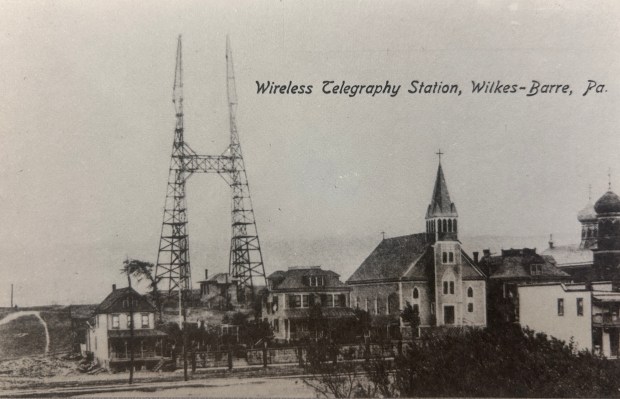
Rev. Jozef Murgas set up a large antenna outside Sacred Heart Church in Wilkes-Barre to transmit the first wireless messages via Morse code on Nov. 23, 1905.
(Submitted photo)
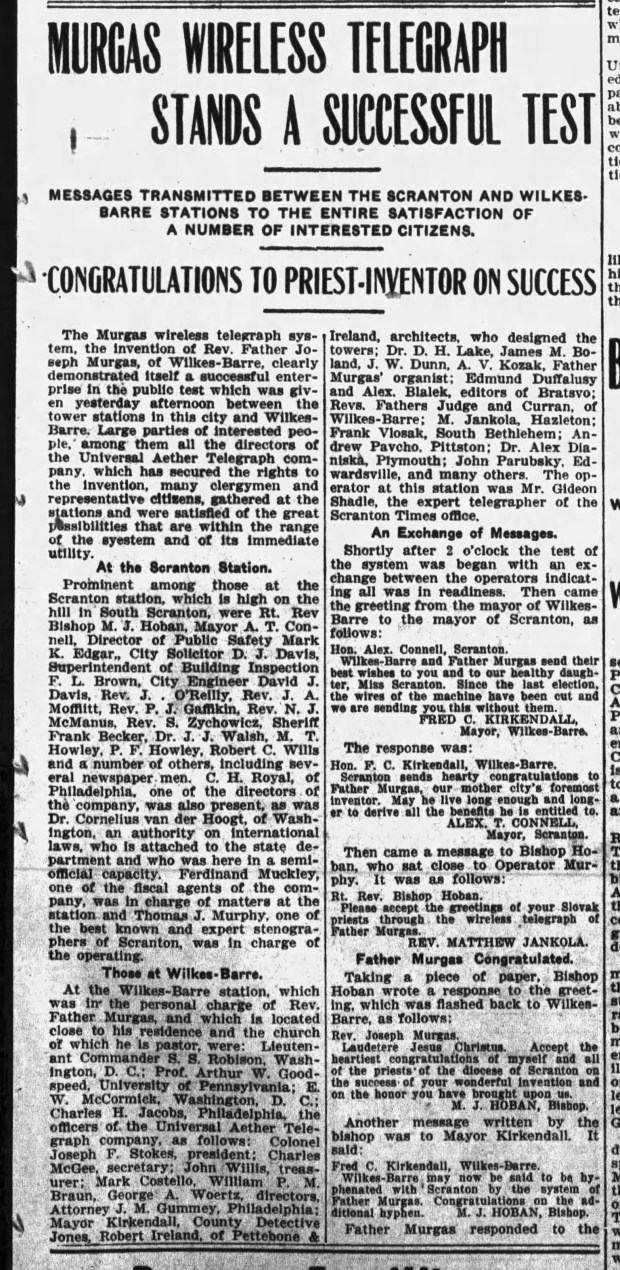
Newspaper story from Nov. 1905 about the world’s first wireless message transmission between the mayors of Wilkes-Barre and Scranton. ..(Times-Tribune archives)
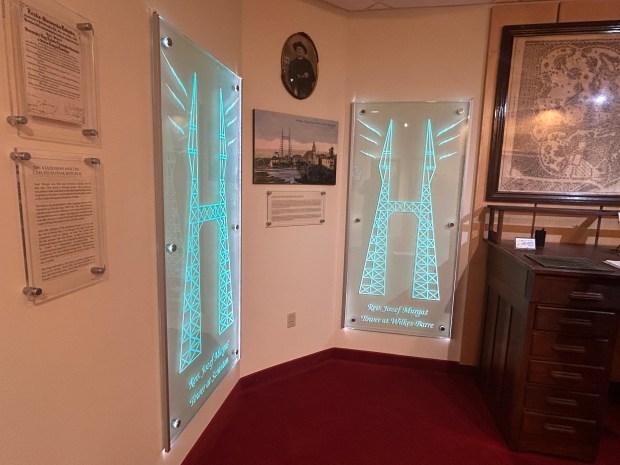
A replica of antenna towers used by Rev. Jozef Murgas for the first wireless message transmission in 1905 in the Father Jozef Murgas Room at King’s College
(Bob Kalinowski / Staff Photographer)
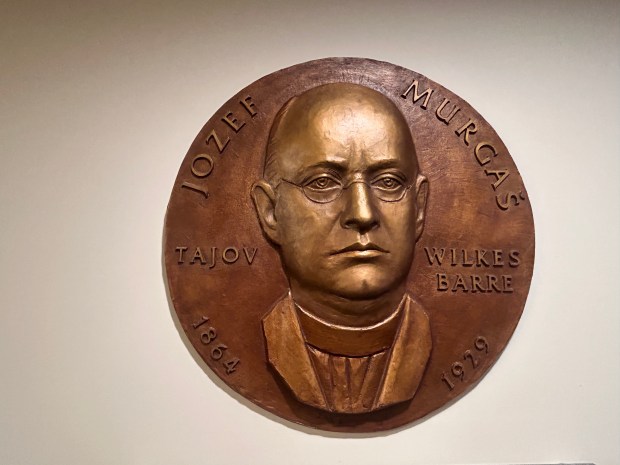
Rev. Jozef Murgas
(Bob Kalinowski / Staff Photographer)
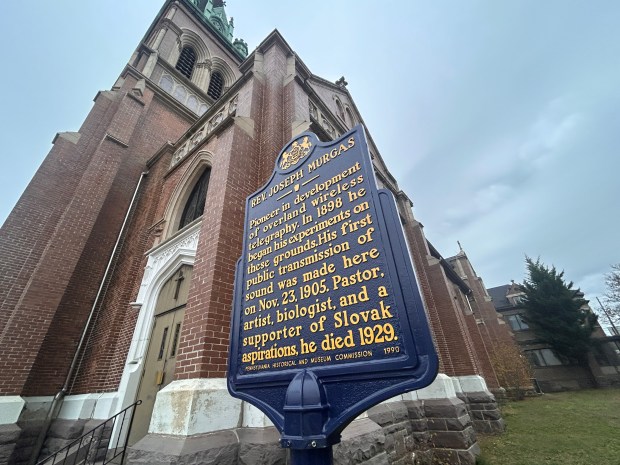
A historical marker outside the former Sacred Heart Church in Wilkes-Barre is dedicated to the Rev. Joseph Murgas. (Bob Kalinowski / Staff Photo)
Show Caption
1 of 7
Mayor Paige Cognetti recreates a radio transmission with King’s College president Rev. Thomas P. Looney. (COURTESY UNIVERSITY OF SCRANTON)
The event at King’s was held outside the Father Joseph Murgas Room in the Richard Abbas Alley Center for Health Sciences on Public Square, a few blocks from where Murgas created his invention that paved the way for modern radio and other communications.
While Italian inventor and engineer Guglielmo Marconi is often credited with developing the first practical radio wave-based wireless telegraph system and won a Nobel Prize for it, many consider Murgas the true inventor.
The two engaged in battles in patent court for years.
Speakers with knowledge of the history said Marconi had claimed wireless transmission on land was impossible and only would work over water. Murgas proved him wrong. They said Thomas Edison told Marconi to follow Murgas’ work during one of Marconi’s trips to the United States.
The Navy was interested too. President Theodore Roosevelt secretly visited Murgas’ church laboratory during a stop in Wilkes-Barre in August 1905 to speak to the United Mine Workers of America, said historian Michael Novroski, a social studies teacher at Lake-Lehman High School.
After years of research in the basement of the church and obtaining patents, Murgas and investors constructed two 200-foot antenna towers in Wilkes-Barre and Scranton to transmit messages.
Following the first successful transmission Nov. 23, 1905, the towers were severely damaged by a storm and some of the original investors died.
Murgas soon abandoned his experiments in wireless telegraphy and gave up patent fights because Marconi had more financial resources and had already gained government contracts.
The “radio priest,” as he was called, instead concentrated on his parish work. He was also a painter, architect, botanist and naturalist. He registered a patent on an early fly-fishing reel and amassed a collection of 9,000 butterflies, considered the largest in North America.
Saturday’s event was held in conjunction with the Murgas Amateur Radio Club and the Slovak Heritage Society of Northeastern Pennsylvania.
Murgas was born in Slovakia in 1864 and was ordained as a Catholic priest in 1888.
After being in contact with a Slovak priest from Pittston, he emigrated to the United States and helped to finish construction of Sacred Heart Church on North Main Street in Wilkes-Barre, a Slovak neighborhood.
Murgas died in Wilkes-Barre in May 1929. He was laid to rest in Sacred Heart Cemetery in Dallas, which he established while leading the congregation.