
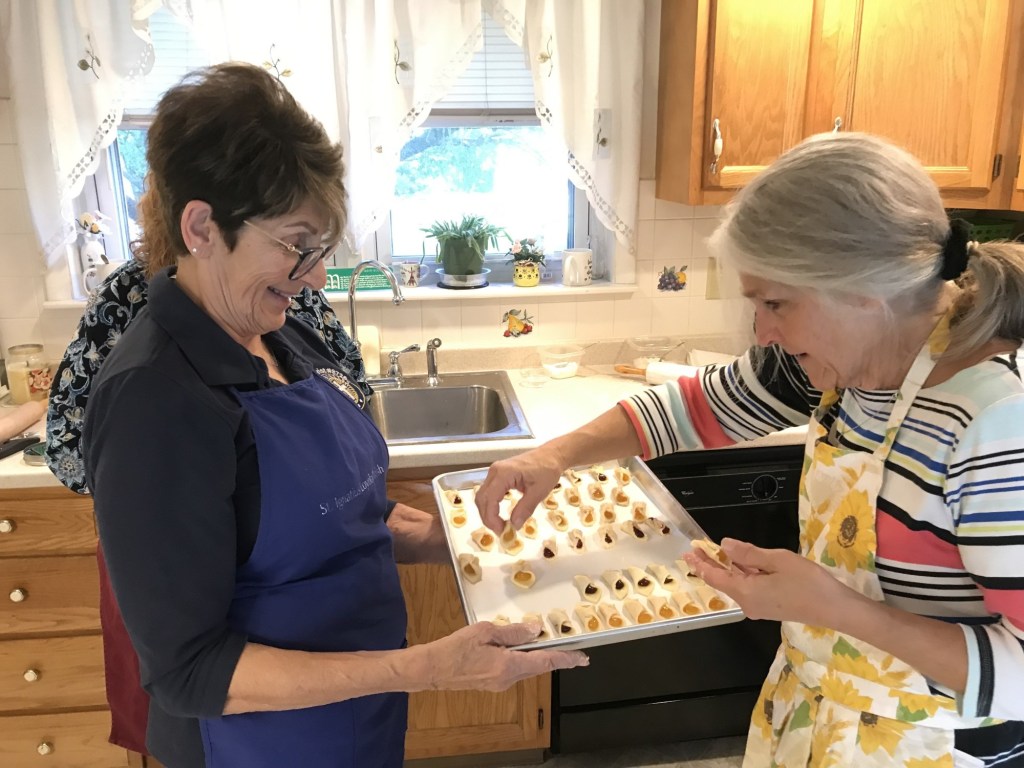
Sister Rose Bartnicki’s petite Polish cookies have long been a hit — perhaps even a source of envy — among some women at St. Ignatius Loyola Parish.
Some of the women who share her Polish heritage asked Bartnicki to teach them her time-tested way of making kolaczki, the flaky, filled pastry popular in Polish-American households, especially around Christmas.
Bartnicki said kolaczki were part of holiday festivities from Thanksgiving through Easter when she was growing up in Shenandoah, Schuylkill County.
At the request of several parishioners, Bartnicki, 87, of the School Sisters of St. Francis community recently hosted two small groups in the convent kitchen at St. Ignatius Loyola Parish in Spring Township.
She enjoyed the opportunity to share some of her knowledge and experience with others. Some of her students previously tried their hand at kolaczki using other recipes to varying degrees of success.
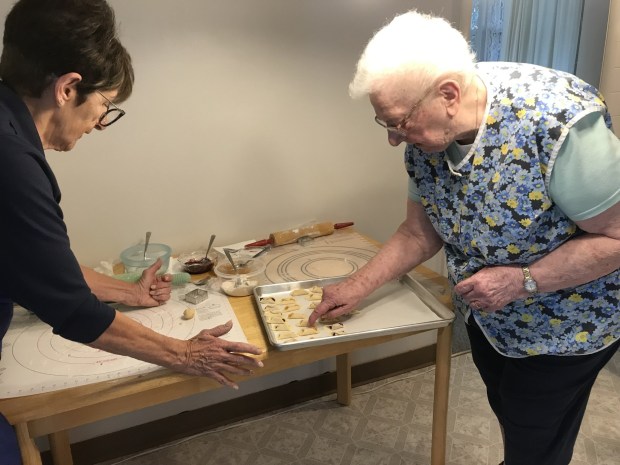
STEVEN HENSHAW – READING EAGLE
Sister Rose Bartnicki shows Carol Jablonski how to pinch the dough of freshly folded kolaczki before the tray of the Polish cookies is placed in the oven in the convent of St. Ignatius Loyola Parish in Spring Township. (STEVEN HENSHAW – READING EAGLE)
Bartnicki follows a simple recipe that shuns leavening agents like baking powder or baking soda. The small size of the pastry also sets them apart.
It requires patience and the right tools. She also uses a cookie cutter designed specifically for cutting strips of well-rolled-out dough.
“When you use a pizza cutter that doesn’t work out,” Bartnicki said.
The strips are folded inward after a dab of cream cheese or other filling is added to the middle. Wetting a finger and pinching the strips together so they don’t come apart in the oven is essential.
A common mistake is not allowing enough time to roll out the dough — which can be made ahead of time and frozen — to assemble the delicate pastry before putting it in the oven.
“It takes time and patience,” Bartnicki said. “You can’t rush it. It all depends on how you roll the dough.”
Rolling the doubt to less than one-quarter inch — preferably closer to one-eighth inch — is critical.
What Bartnicki enjoyed most about the sessions was seeing the women have a good time rolling and cutting dough together.
“Both groups really enjoyed it,” she said. “They had a marvelous time.”