
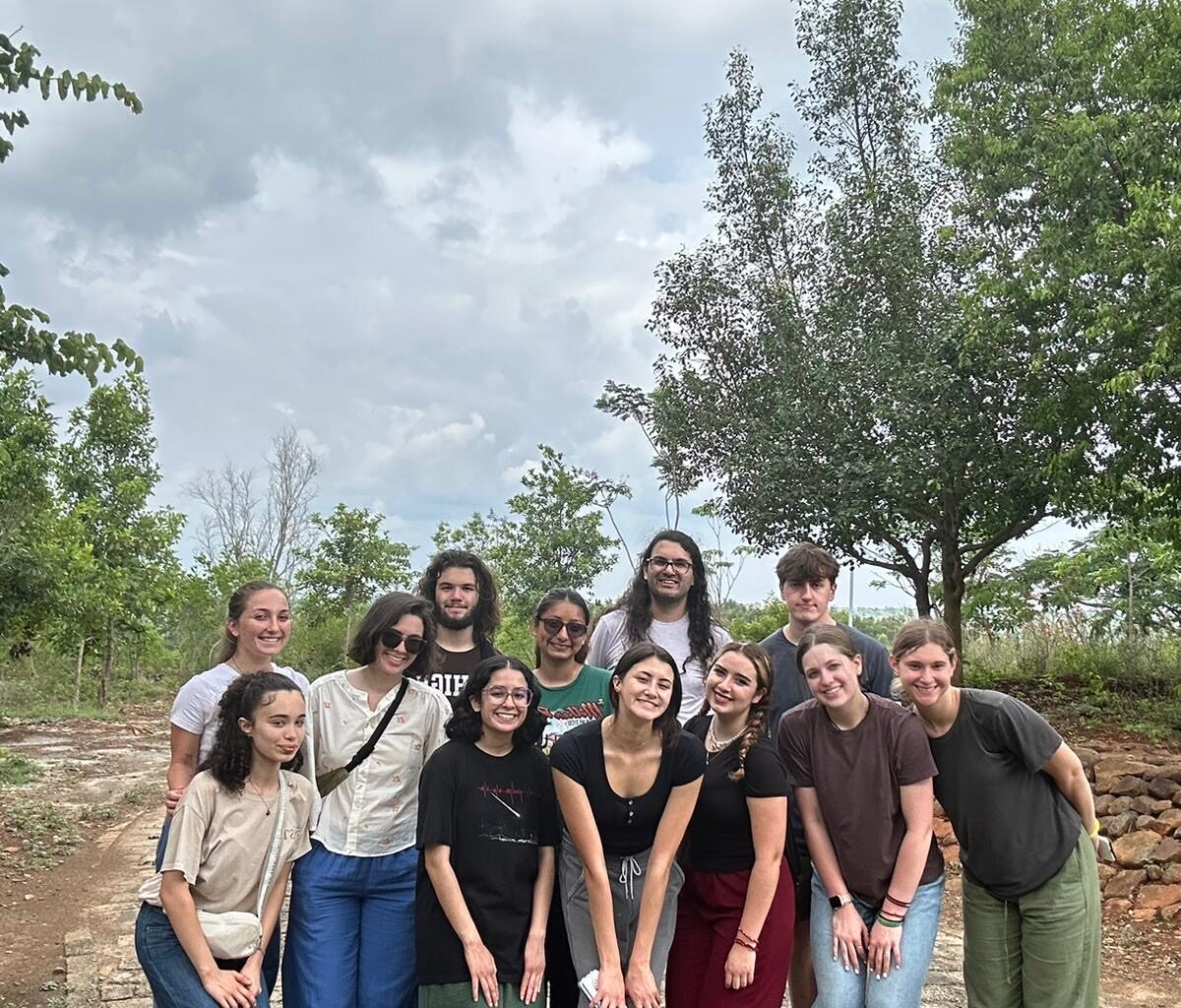
Jolie Goldstein, ’28, hurried through a New York City convenience store, clutching a Twix bar as she stepped up to the counter. The cashier glanced down at her feet, noticing she wasn’t wearing shoes, just a pair of worn white Adidas KeKsocks.
Suddenly realizing her mistake, Goldstein laughed. The habit had become hard to break after spending three weeks in India where it’s customary to remove shoes before entering temples and buildings. Going barefoot indoors felt normal to her.
Her work in Karnataka, India, was through Lehigh’s Global Social Impact Fellowship program that immerses students in community-based research projects.
Goldstein learned about the program during her freshman year. The project itself — developing and launching a chatbot — was what she said enticed her.
The idea of joining an impact project in India felt almost unreal at first, especially because finding time to study abroad as a computer science major is difficult.
Goldstein’s attraction to technology started early. Growing up in New Jersey, she remembers tagging along with her father on his trips to the office for “bring-your-kid-to-work day.” Her dad worked in tech consulting, and she started to gravitate toward the field.
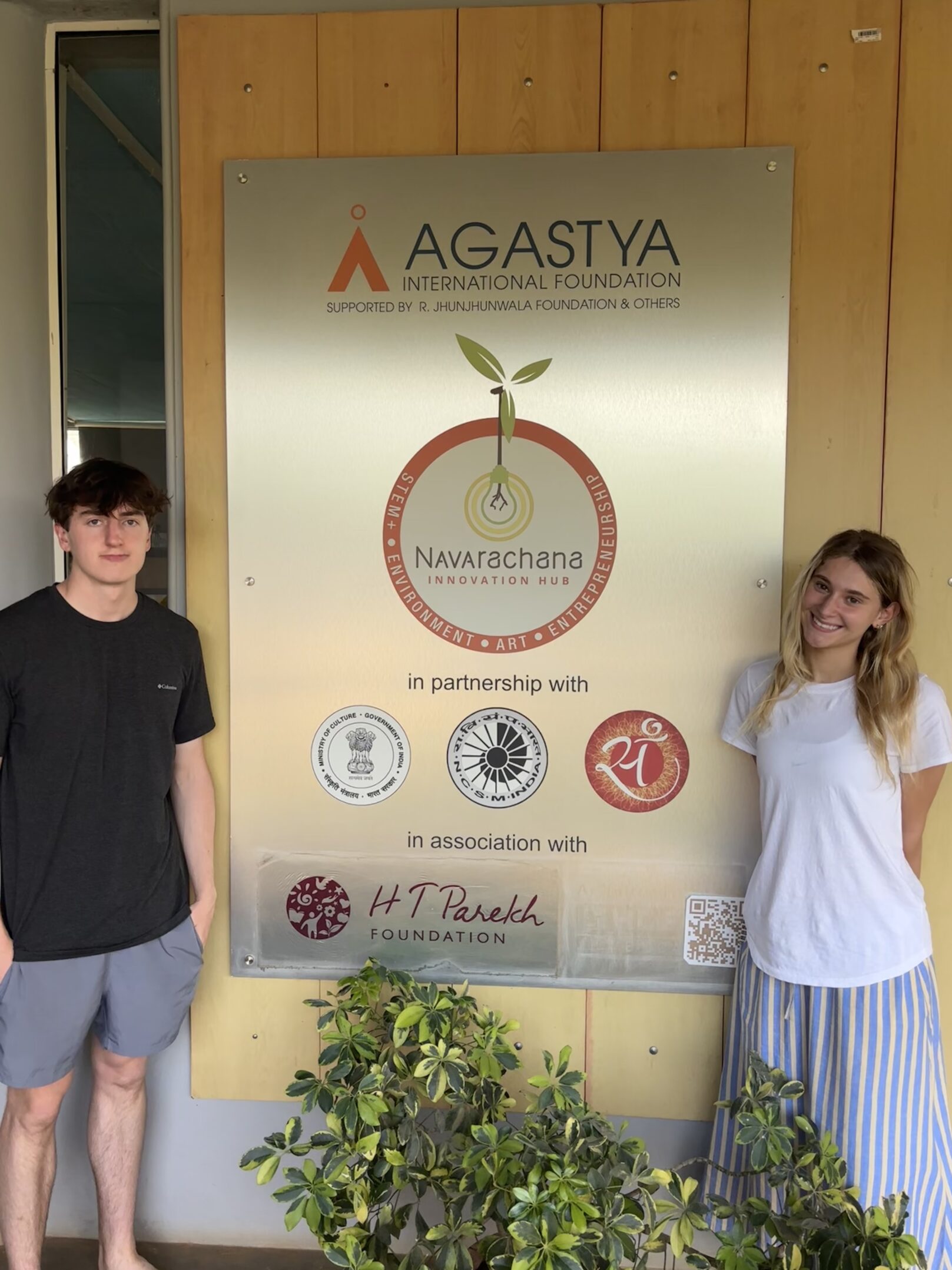 Two students stand outside the Agastya International Foundation’s Navarachana Innovation Hub in Karnataka, India. They spent three weeks working on a community-based research project through Lehigh’s Global Social Impact Fellowship. (Courtesy of Jolie Goldstein)

In her sophomore year at Livingston High School, she said she explored STEM-related clubs. Her first project “CoderGals” led her to teach basic coding techniques to elementary school girls. The experience sparked her curiosity and motivated her to take a coding class her junior year.
Goldstein was the only one in her friend group planning to pursue a STEM degree and often hesitated to attend coding events alone. But as she started recognizing familiar faces in her classes later on, she found a new community of peers who gave her the confidence to keep exploring.
She realized she was drawn to the process of solving problems — the satisfaction of finding solutions through logic and creativity made her want to keep learning.
That trait followed Goldstein to Lehigh, where she now feels at ease.
While her first campus visit was rainy and windy, and she was in the middle of bickering with her sister, she said she couldn’t think of a single thing wrong with the school.
Lehigh’s blend of interdisciplinary programs and its humanities-based approach to computer science sealed her decision to commit.
One of her first-year initiatives at Lehigh was an artificial intelligence conversational agent called MathPal, which allowed her to combine her computer science expertise with her interest in graphic design.
The idea for the project originated with Goldstein’s faculty adviser Zilong Pan, an assistant professor of teaching, learning and technology in the College of Education.
She said MathPal’s goal is to create an ethical chatbot to help students learn math online.
It evolved into ICodePal while she was in India.
Having only been out of the U.S. a few times, Goldstein prepared to immerse herself in the culture. That meant adapting to a world with limited access to computers which posed an immediate challenge.
Goldstein viewed that hurdle as an opportunity to understand why she wanted to be there. She thought back to when she first started exploring computer science and doubted her own intelligence.
That pushed her to begin creating tools and diving into research with one clear goal: making computer science feel less intimidating. She said she hopes to reach younger students encountering code for the first time, guiding them toward confidence instead of doubt.
“She’s very active and always open to learning new knowledge,” Pan said. “Not every collaborator on your team would want to donate more time to learn new skills, but she definitely is open to learning new skills.”
That willingness to keep learning was reinforced by another influential figure in her journey.
Her freshman year mentor was Michelle Levine, a former Columbia University professor whose research in human-computer interaction overlapped with her own interests. Levine not only helped her weigh the decision to take on the project in India but also became a model of the kind of computer scientist Goldstein hopes to be.
Once she set foot in the rural town in southern India in May, Goldstein, alongside her partner Ben Rainey, ‘27, headed straight to the Agastya International Foundation, the educational facility where they would be staying.
When approaching problems and conducting research, Goldstein and Rainey complemented each other. Rainey described himself as a person who waits to think about the best possible way to approach the problem.
“I saw her as someone who goes into it, and then once you make that first step, figure out what to do,” Rainey said.
Together, their preparation and teamwork allowed them to successfully develop a new project in India.
Her roommate in India, Jules Magarelli, saw determination in Goldstein. Magarelli said Goldstein was frustrated at first with how slowly the project started, but instead of backing down, she pushed herself to find a new idea.
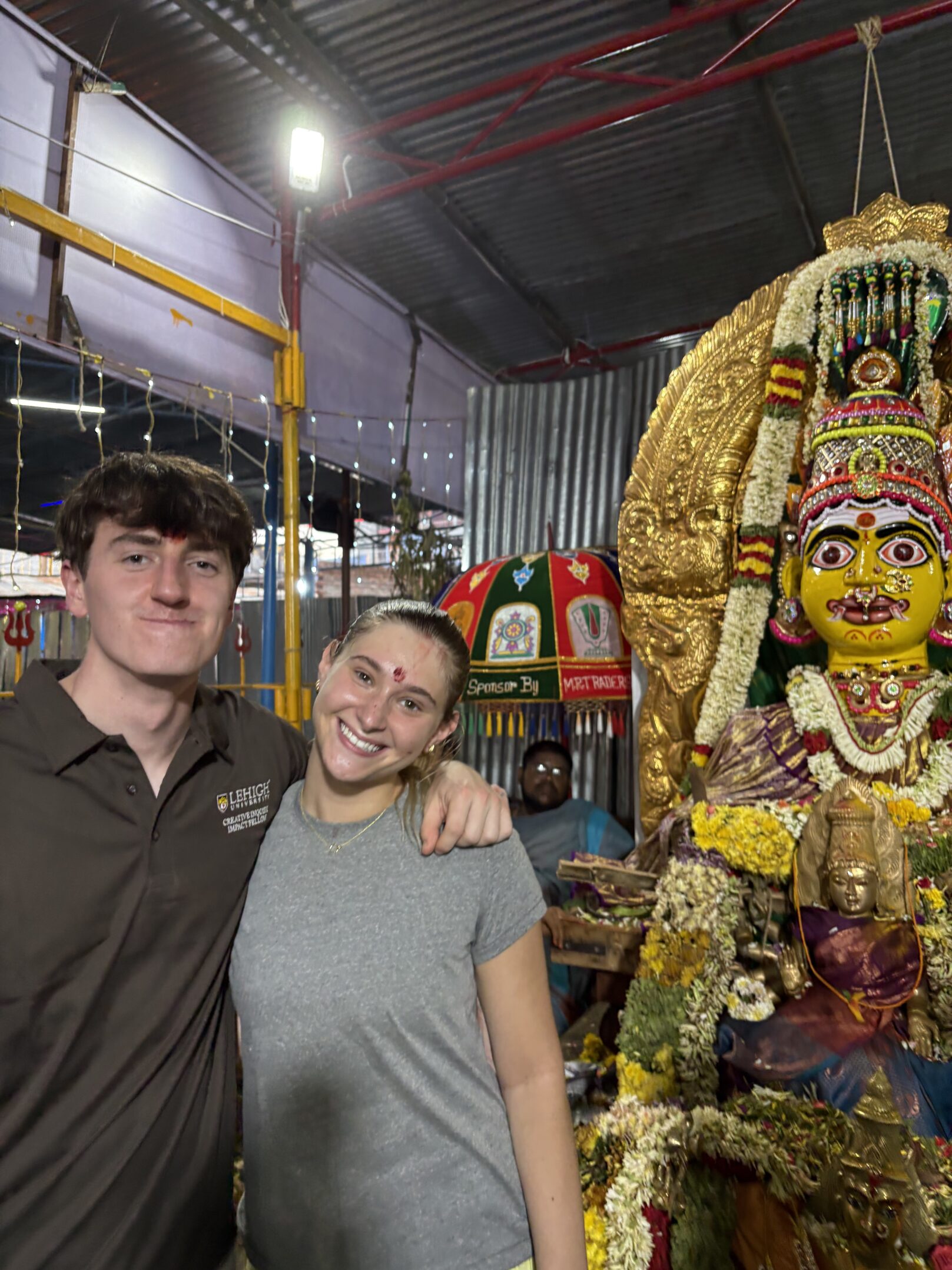 Jolie Goldstein and partner Ben Rainey are pictured in Karnataka, India beside a decorated temple statue during a cultural celebration. The two participated in the Global Social Impact Fellowship, which brought them to India for community-based research and technology development. (Courtesy of Jolie Goldstein)
“She basically wrote an entirely new program with her teammate in about a week, ran workshops and even got people in India to start implementing it,” Magarelli said. “She doesn’t half-do anything — once she sets her mind to it, she finishes it.”
Goldstein’s work ethic can be traced to how she was raised. Her parents never demanded perfection, but they always expected effort.
“(My parents) never expected 100% grade accuracy and precision,” she said. “They expected 100% effort. They wanted consistent effort, not necessarily consistent output, because that’s not how people are. Humans make mistakes.”
Goldstein said her father is someone she continues to look up to for inspiration.
She said whenever she’s doubting her own accomplishments, he tells her to look in the mirror and “get a reality check.”
Goldstein now hopes to pay forward the same confidence she gained from her dad. As a high school camp counselor, she discovered how much she loved helping children, and that experience sparked a vision for her future.
Looking ahead, her dream is to go to graduate school and become a professor. Goldstein hopes to combine research and teaching while mentoring students who share her passion for problem-solving and innovation.
Her goal is to help the next generation push boundaries and create change.