
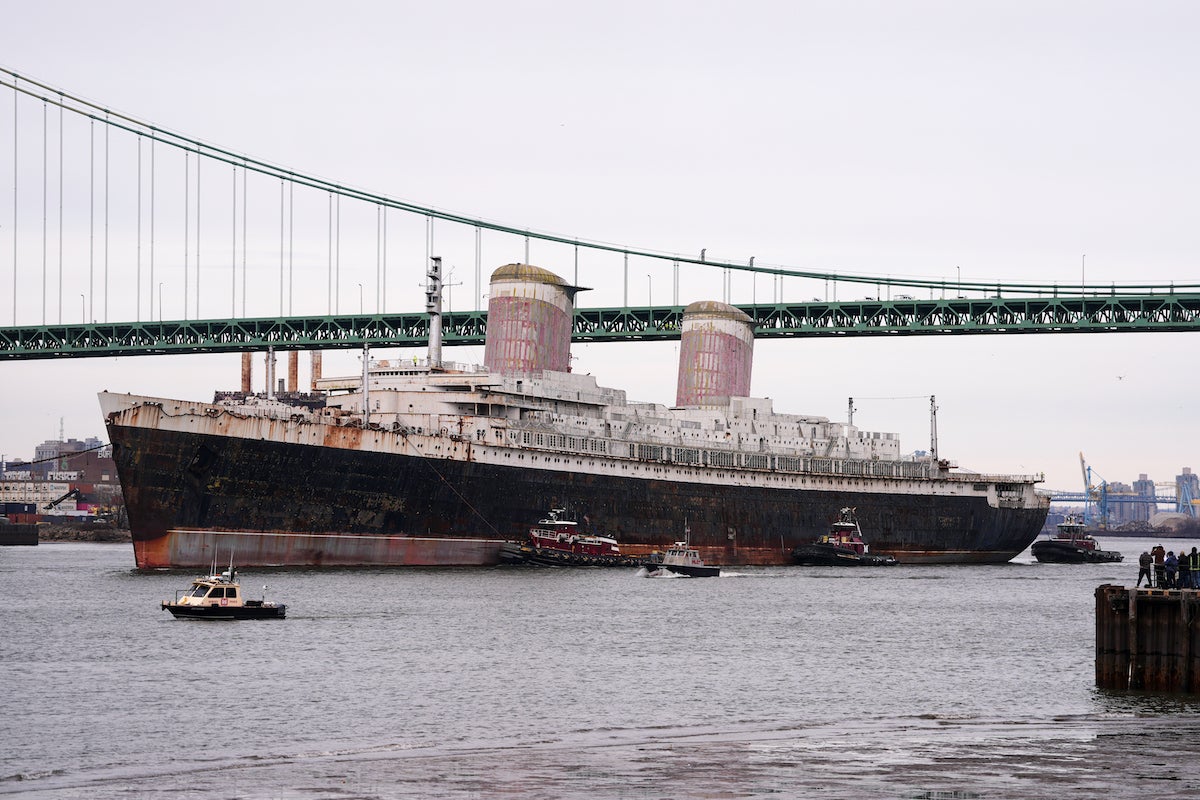
The SS United States is set to join Okaloosa County’s more than 500 artificial reefs, which include a dozen smaller ship wrecks.
“The transformation of the SS United States into the world’s largest artificial reef creates a rare opportunity to elevate our entire region on the global stage,” said Darien Schaefer, president and CEO of Visit Pensacola.
The new artificial reef will provide essential marine life habitat, which prompted Coastal Conservation Association Florida to make its largest donation in the organization’s 40-year history.
“It is truly a once-in-a-lifetime opportunity to contribute to the creation of the world’s largest artificial reef,” CCA Florida Executive Director Brian Gorski said in a statement.
Long Journey
The SS United States arrived in Alabama at the beginning of March following a 12-day tow from Philadelphia’s Delaware River, where it has spent nearly three decades. Okaloosa County took ownership after a years-old rent dispute was resolved last October between the conservancy that oversees the ship and its landlord.
Various groups have attempted to restore the SS United States over the years, but all plans were eventually abandoned because of the steep cost. Recently, increased media attention has generated more calls to preserve the ship, and a group called the New York Coalition sued in Pensacola federal court asking a judge to halt sinking such a historically significant vessel.
But Okaloosa County officials have said that preventing the SS United States from becoming a reef would only send it to the scrapyard.
The vessel, which is more than 100 feet (30 meters) longer than the RMS Titanic, was once considered a beacon of American thousands of troops. On its maiden voyage, the ship reached an average speed of 36 knots, or just over 41 mph (66 kph), The Associated Press reported from aboard.
The ship crossed the Atlantic Ocean in three days, 10 hours and 40 minutes, besting the RMS Queen Mary’s time by 10 hours. To this day, the SS United States holds the trans-Atlantic speed record for an ocean liner.