
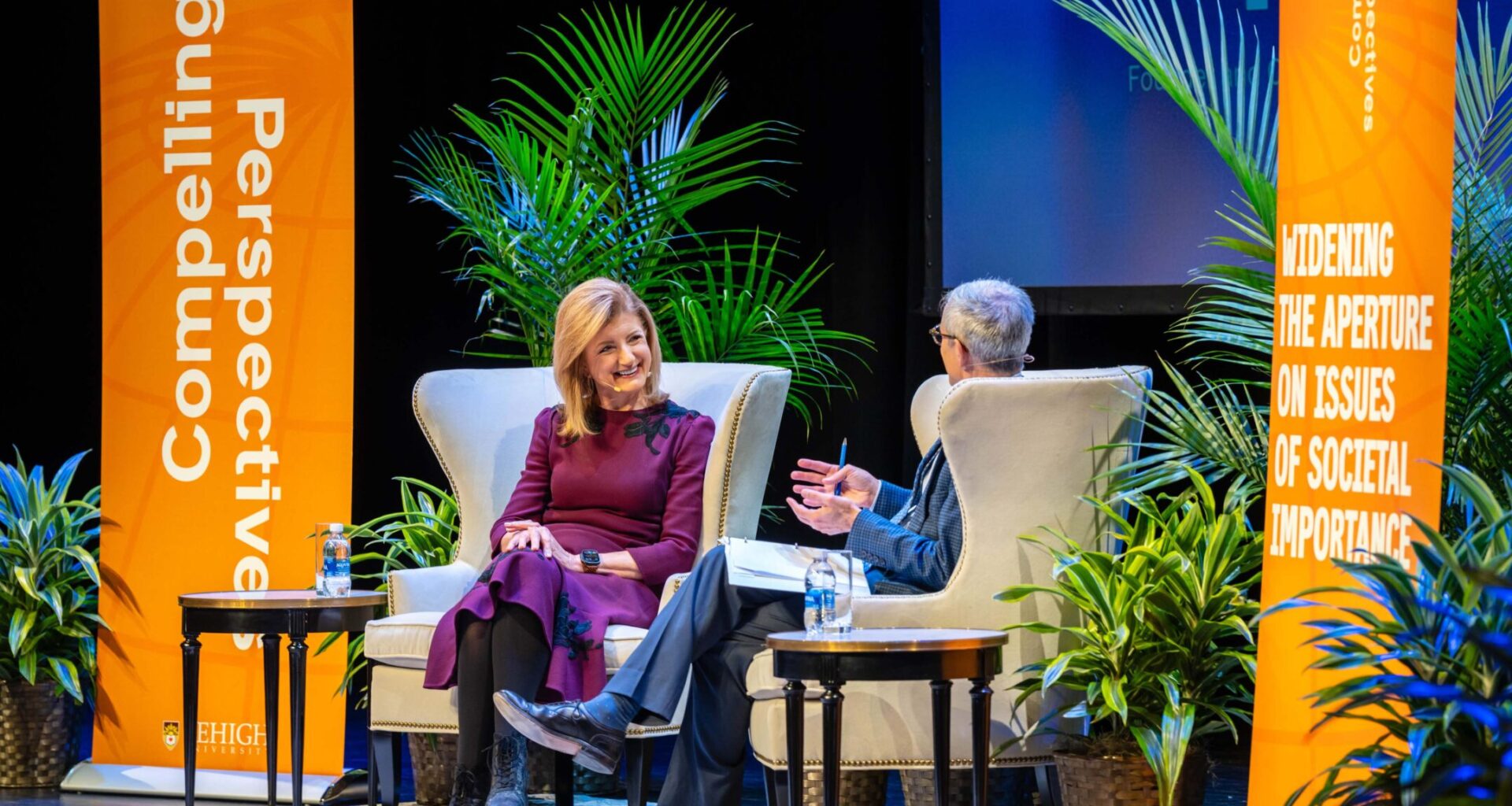
Amid the advancement of artificial intelligence, Arianna Huffington believes while AI can help people build better habits, it shouldn’t replace personal judgement or human experience. Finding the balance between AI being a tool — not a replacement — was the core idea in her conversation with President Joseph Helble Tuesday evening in Baker Hall.
Huffington was invited as part of the Compelling Perspectives Speaker Series, which brings guests to Lehigh to discuss issues of societal importance through respectful dialogue.
As the founder of The Huffington Post and the founder and CEO of Thrive Global, Huffington spoke about AI’s intersection with humanity in accordance with this year’s Compelling Perspectives theme, “AI: Innovation, Responsibility and the Future We Shape.” Helble said one of the reasons this theme was chosen was because it’s one of the most pressing topics alumni ask him about when he engages with the community.
Before delving into her views on AI, Huffington detailed her path to the U.S.
Born in Athens, Greece, and living in a one-bedroom apartment, she said at age 13 she saw a picture of the U.S. and knew she wanted to go there.
She said her mother helped her achieve her goals, supporting Huffington during her time learning English and taking her entrance exams to attend college. By age 16, she enrolled in the University of Cambridge and after graduation spent years writing in the United Kingdom.
In 1980, she moved to New York City as a published author and became a political commentator, which led her to run for governor of California in 2003.
Huffington said her campaign made her realize the power of online media and conversation. This inspired her to establish The Huffington Post in 2005.
While The Huffington Post had become an established media player, Huffington said she was neglecting to take care of herself while working. In 2007, she collapsed from exhaustion and broke her cheekbone. She joked that she was diagnosed with burnout.
She said this was a wake-up call to her to prioritize her personal health. In 2016, she left the Huffington Post and established Thrive Global, a behavior change technology company.
Huffington said the core mission of Thrive Global is to help people take “microsteps” toward healthier behaviors by changing small things every day to cumulatively build better habits.
She said AI has helped Thrive Global achieve that mission by scaling lifestyle coaching to a larger client base. What interest’s her most, she said, is how AI can help humans improve their habits.
Huffington discussed how AI has helped Thrive Global to coach people toward achieving their microsteps, which has proven to be more effective than undertaking large goals at once. Through hyper-personalization, she said AI helps to align these small steps with clients’ lives.
She said a key example of this is putting one’s phone away at least an hour before they go to bed and keeping it in a separate room while sleeping. Joking with Helble, she said that she would buy an alarm clock for him so he wouldn’t need his phone to wake up for his early morning runs.
While it’s a useful tool, she said AI shouldn’t replace human nature.
“If for every dollar and every moment we spend investing in AI we also spend the same amount of money and time investing in our humanity, we’d be OK,” Huffington said in reference to a statement made by philosopher Yuval Harari.
Helble then said Huffington has consistently used the term “dethronement” while writing about AI over the past year and asked her why she uses that particular word.
In response, Huffington said she believes the ultimate “dethronement” is AI dethroning human intelligence, as so many are now being taught that AI is smarter than people.
She said she thinks this is a positive development because it forces humans to have an important conversation about what defines them. Unconsciousness, soul and spirit, are what Huffington believes define the human experience.
“Acknowledging the mystery of the universe, and acknowledging that what we don’t understand is more important than what we do understand — it’s really a great moment for that conversation,” she said.
By rejecting the spiritual dimension of existence, Huffington said people tend to elevate politics to a place it doesn’t deserve.
She said this lets disagreements turn into hate, which is not a way to build a society. Rather, people should look for the moments where humans give one another the grace of redemption and forgiveness, even across the political spectrum.
“In the middle of breakdowns there are incredible breakthroughs, and I believe AI has the potential to accelerate that if it’s used in the right way,” Huffington said.
Once the discussion opened up to questions from the audience, one attendee asked Huffington to clarify if she was “anti-AI.”
Huffington said she is definitely not against AI, and rather sees its biggest power being tools for hyper-personalization and memory. She said it’s important, though, to not let it take precedence over human judgement.
Attendee Ashleigh Graf, the copy chief for the Huffington Post, said the publication has written about people using AI for medical diagnoses as opposed to their doctors. She asked what boundaries on AI should be in the medical field and who is responsible for creating them.
Huffington reiterated that this is a significant concern. She said she believes AI companies themselves should be responsible for creating guardrails, as the engineers who work for them are far more knowledgeable about the technology than politicians.
In response to a question about her biggest fears she has about AI, Huffington said there’s a disconnect between the leaders of AI companies and the public which creates a growing amount of anxiety about the loss of jobs.
She said companies should train their employees in not just technical skills, but also in resilience. She also said this will help people be better-educated and prepared for the future.
“I think it’s very important that we tell a better AI story based on how AI can help people in their everyday lives,” Huffington said. “That has to happen.”