
Whitney Downard/Pennsylvania Capital-Star
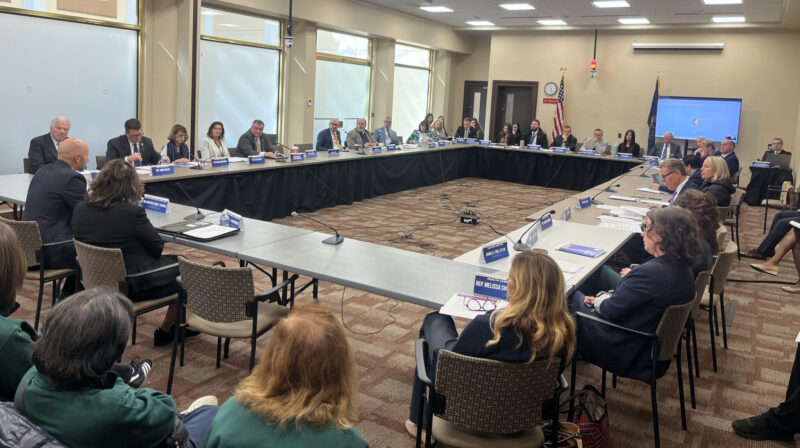
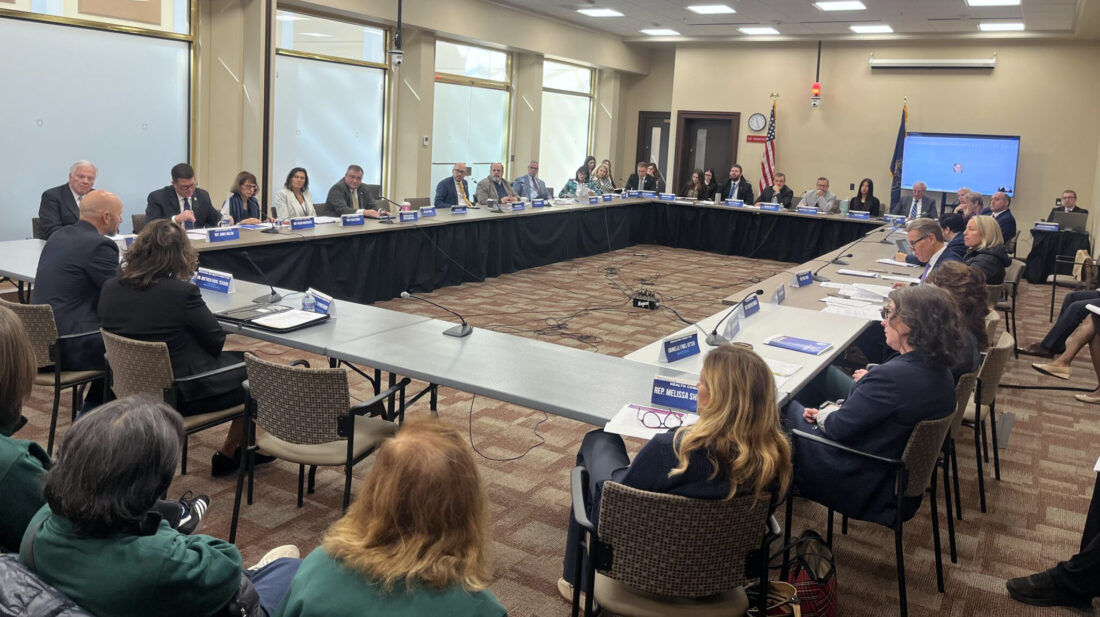
The House committees for education and health held a joint hearing to consider cellphones in schools on Nov. 17, but ultimately didn’t come to any conclusion.
The commonwealth’s school districts might soon need to consider policies related to silent alarms and cell phone use in their buildings.
The state House committees for education and health held a joint, two-hour hearing Monday for informational purposes, without considering any specific legislation. Lawmakers, however, didn’t appear to come to a consensus on either issue, instead stressing the need for parental involvement and parental rights.
Nearly a dozen parents from around the state urged lawmakers to support a “bell to bell” cellphone prohibition, part of a 3,000-member coalition dubbed “PA Unplugged.” The group seeks to implement phone-free policies statewide.
“Bell to bell,” as used in the committee meeting, indicated a policy ban from the day’s first morning bell to the last one in the afternoon — without any exceptions for study halls or lunch.
“If kids are so worried about contacting their parents, they’re not necessarily focused on the adult in the room who’s been trained to give information about what’s coming next and what kids should do to stay safe,” Katie Talarico, a mom from Allegheny County, told the Capital-Star. “We definitely think, even in the most extreme emergency, it’s best not to have a cellphone.”
Talarico said having dozens or even hundreds of children calling their parents can tie up phone lines, impeding the work of law enforcement. Additionally, she said, “it’s not good for emotional development either.”
“Kids need the opportunity to practice the skills of independence,” she said. “Sometimes I wish I could have contact with my kids and find out, ‘How did that test go?’ But at some point, we have to let kids learn to figure these things out on their own.”
House members who are parents, both Republican and Democratic, had a different take — with some evoking memories of the September 11th attacks and the relief a quick phone call from their children granted them.
“Unfortunately, as a person who experienced 9/11 as a young person and also as a parent who’s watched numerous school shootings unfold across this country, the idea that I may never be able to hear my child’s voice for the last time in a situation like that is something that weighs heavily upon me,” said Rep. Danielle Friel Otten, D-Chester.
On-the-ground impacts
Some of the teachers, administrators, researchers and security staff testifying before the committees detailed the negative consequences of cell phones in the classroom, including cyberbullying and orchestrating school fights for virality.
Beth Sanborn, the president of the Pennsylvania Association of School Resources Offices and a school safety coordinator in Montgomery County, said students even ordered food and allowed delivery drivers through secured doors with cellphones.
“Phone-free policies aren’t about punishment. They’re about protection,” said Sanborn.
As for parental safety concerns, Sanborn emphasized that “there is not an emergency plan anywhere that includes student use of a cell phone” to notify parents and said a lack of contact doesn’t indicate that a child is unsafe.
Mitch Prinstein, the chief of psychology with the American Psychological Association, said data suggest high school students spend one-third of each hour on their devices which “likely” obstructed learning.
“Not surprisingly, a child’s device in school leads to their poor academic achievement. But perhaps more surprisingly is that the child’s device use is also associated with poor academic achievement for the students sitting behind them,” said Prinstein.
He also spoke about concerns with AI misuse by young adults, specifically applications geared toward wellness or therapy. He said that some parents had given their child a smartwatch or simply used their school email for contact throughout the day — though such communications could be subject to disclosure laws.
Lisa Graham, a school counselor with the Seneca Valley School District in Butler County, said incidents of cyberbullying at her school had decreased following the implementation of a “bell to bell” cellphone ban at her school.
“Because students aren’t filling their downtime with their phones, they’re developing social and communication skills,” said Graham. “They’re making new friends and this increased connection fosters a better sense of belonging at school and is benefiting their mental health.”
Silent alarms
and emergency responses
Another group of House members also considered a bill Monday that would compel districts to “consider” whether or not to invest in a silent alarm system that can notify l law enforcement in an emergency.
Dubbed “Alyssa’s law,” House Bill 634 was inspired, in part, by the death of Alyssa Alhadeff at Marjory Stoneman Douglas High School in Parkland, Florida in 2018.
Silent alarms — including wearable versions or mobile apps — can be customized for different purposes, such as one push for behavioral assistance or multiple hits for an active shooter.
“When seconds matter, immediate notification can and will save lives,” said David Lash, the president of the Pennsylvania Chiefs Association and Chief of Police for the Northern York County Regional Police Department.
Two of the seven districts in his coverage area have such systems, but the “most sophisticated” was probably in Delaware County, Lash said. There, the Delaware County Panic Alarm School System (DelPASS) is incorporated throughout the county and integrates law enforcement agencies.
Such systems aren’t replacements, Lash added, and he still encouraged calls to 911 to share more details. But “pushing a button in a classroom going directly to a 911 center is going to get officers rolling toward that scene.”
An unknown number of districts have funded such alarms using school safety grants from the Pennsylvania Commission on Crime and Delinquency, said Heather Masshardt, the group’s deputy director of school safety and security.
Masshardt said she couldn’t share specifics, “because of safety precautions and data safety requirements under Pennsylvania public school code.” Up to $127 million was available to public, charter and non-public schools, which can also be used for cybersecurity and other purchases. The latest budget increased those dollars by an additional $120 million.
The grant’s current funding structure allows schools to fund silent alarms after meeting other security requirements, such as keeping exterior doors unpropped and closed or having a buzzer at public entrances.
The committees didn’t indicate next steps for either topic and adjourned without voting.
——
Pennsylvania Capital-Star is part of States Newsroom, a network of news bureaus supported by grants and a coalition of donors as a 501c(3) public charity. Pennsylvania Capital-Star maintains editorial independence. Contact Editor Tim Lambert for questions: info@penncapital-star.com. Follow Pennsylvania Capital-Star on Facebook and Twitter.
For at least the next dozen years, rural areas will continue to have only about two-thirds of the primary care …
MILL HALL — At its monthly meeting this week, Bald Eagle Township Board of Supervisors addressed potential …
LOCK HAVEN — Lock Haven City Council began reviewing its preliminary 2026 budget, which sees a total of …