
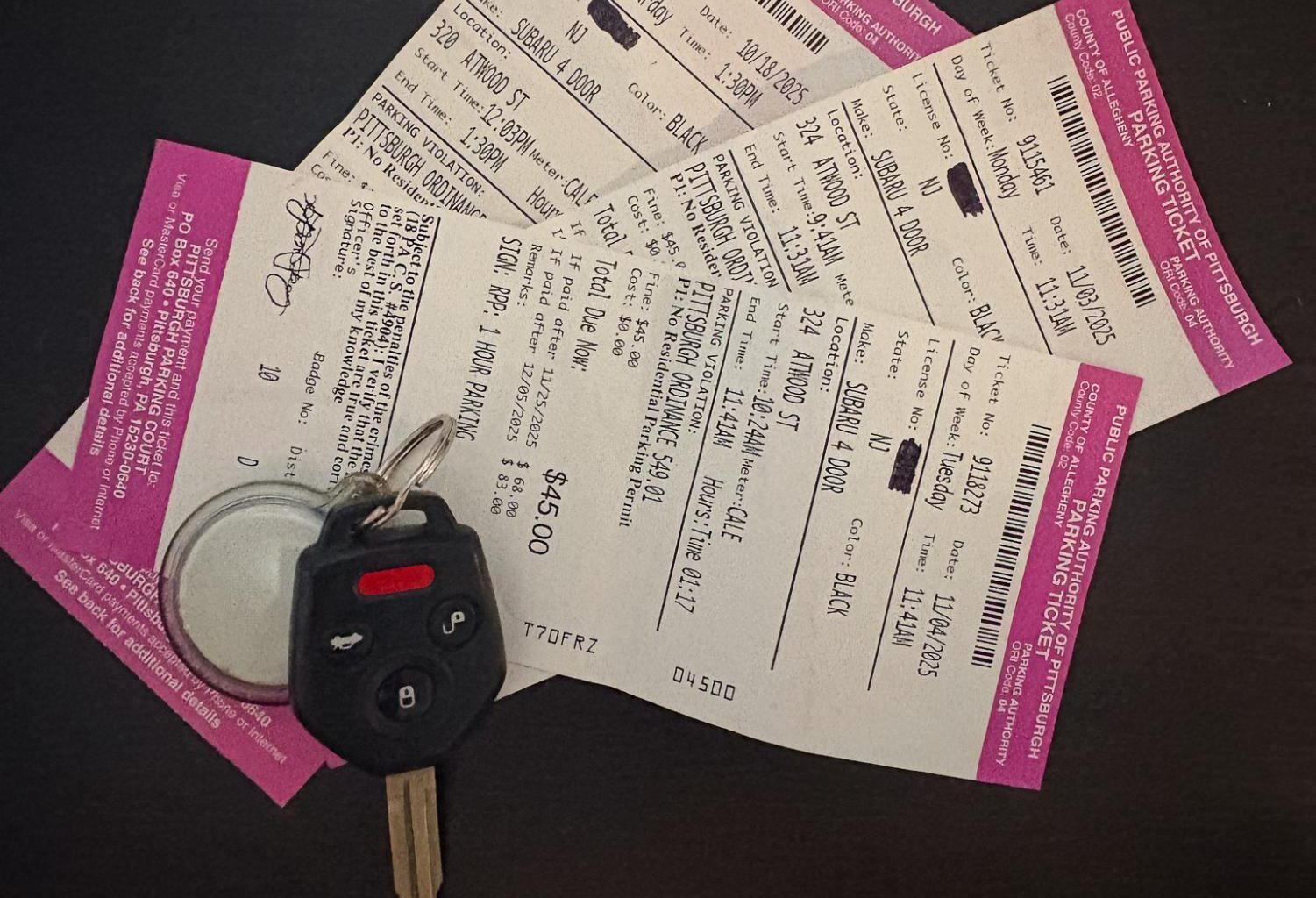
For students who drive on and around Pitt’s campus, parking is a daily struggle.
As Pitt student enrollment continuously increases, so does the challenge to find a parking spot on crowded Oakland streets, according to some students. While Oakland residents compete for permits and receive tickets for violations, students and professionals alike believe that current enforcement practices are not a long-term solution to parking scarcity.
Parking permits on Pitt’s campus are assigned on a lottery-based system, with rates subject to change annually depending on the parking spot’s location. Competition for permits is steep, with waitlists that can last up to a decade. In the city of Pittsburgh, residential permit fees doubled in July 2025 from $20 to $40.
In Pittsburgh, the Pittsburgh Parking Authority’s enforcement of parking violations and ticketing has sharply increased in recent months, according to PPA statistics. In November 2024, the Pittsburgh Parking Authority issued approximately 21,000 parking tickets, compared to 17,000 tickets in November 2023.
Katherine Sexton, a junior materials science and engineering student, has received three tickets at $30 each this year from the Pittsburgh Parking Authority. One ticket was for parking on a street during cleaning hours, and the other two were for unknowingly parking in a metered area overnight.
Sexton remarked on her confusion surrounding street cleaning hours, which operate from April 1 to Nov. 30. The schedule differs by individual street — even those located in the same parking zone. The type of service can also range from a sweeping once per week to two times in a year. Individual street cleaning schedules can be found on surrounding physical signage, depending on the street.
“I thought [the cleaning schedule] said the first Thursday, but it actually said the third, and it was blurry,” Sexton said.
Angela Boykowsycz, executive director of the Oakland Planning and Development Corporation and Oakland native, said finding parking has been an issue her entire life.
Despite decades of parking concerns, Boykowsycz said there are no easy solutions. Though parking is a frequent issue for students and Oakland residents, action has been slow to follow.
“We can be relied upon to complain. We have not seen, in 40 years, any innovative approach that’s gonna solve the problem through enforcement,” Boykowsycz said. “There’s no winning.”
Jack Wells, a graduate student in teacher education, also believes that while Pitt needs more room for parking, the solution is not as simple as dedicating more space to parking.
“I’m kind of stuck between advocating for more parking, [because] I also think building more parking garages is terrible,” Wells said. “I don’t know what the solution is.”
Boykowsycz connected parking scarcity to local issues, including Oakland’s lack of affordable housing for students and families and insufficient number of grocery stores accessible by foot.
She believes if students and faculty could afford to live close to campus and have reliable access to food, the need for a car would decrease and free up parking space.
“The only way to solve this is really to create more walkable neighborhoods — [to] increase density and diversify them,” Boykowsycz said.
Wells has received six parking tickets since coming to Pitt in 2019, including a $120 fine for parking on Western Avenue on a football gameday, which was reduced to $60 through an online appeal. He noted how quickly tickets are issued.
“I paid [to park] until probably 5:30 p.m.,” Wells said. “I got the ticket at 5:40-ish. That was infuriating.”
Matt Jendrzejewski, the Director of Enforcement and Meter Services at the Pittsburgh Parking Authority, said the increase in ticketing is attributable to the introduction of the Ticket by Mail system in March 2024 and efficiency of enforcement cameras.
According to Boykowsycz, current parking enforcement does not adequately address the deep-rooted issues of housing shortages that require students to live off-campus and potentially depend on car transportation.
“I can appreciate that enforcement is important — people feel betrayed and wronged if laws are not enforced,” Boykowsycz said. “And I get that. But enforcement is not the same as a solution to the problem.”
Aview Varghese, a senior biology student, said she received two tickets from the Pittsburgh Parking Authority. She said she has to arrive at campus early to find parking space in the Panther Hollow lot, which she said is the cheapest space at $5 per day.
“I wish there were more parking options,” Varghese said. “And if there were more options, I wish that they were more affordable and accessible.”
Joseph Moritz, a senior electrical engineering student, received two tickets this year from the Pittsburgh Parking Authority. One ticket was for a permit violation while Moritz was in the process of obtaining a permit.
Moritz said he applied for a permit around May, but the “headache of a process” to obtain the permit took until July, and his permit was not activated until the next month.
“I don’t think I should be paying a $40 ticket when I already paid the permit fee,” Moritz said.
KC Okoye, a junior economics student, finds it difficult to find parking while commuting to school. He said that he has received three tickets from the PPA recently and expressed frustration at the expenses of parking every day.
“If you’re here for six hours, that’s $18,” Okoye said. “Damn near $20 just for a day of parking. And a lot of people’s school days last longer [than six hours].”
Avery Sample, a senior in psychology, anthropology and English writing received her first parking ticket from the University after she left her car parked in a different lot than regularly assigned.
Sample said that she went in person to Pitt’s student parking office, and they voided the ticket almost immediately since it was her first violation.
“I paid for a permit, and now I’m getting a parking ticket,” Sample said. “I’m not paying for this.”
Boykowsycz believes that students will not see change until deep-rooted issues of affordable housing are addressed.
“Parking is intimately connected with and involved in the question about housing,” Boykowsycz said. “And you’re not going to solve the parking problem once and for all until you have solved the housing problem.”
The Oakland Plan, outlined by the city of Pittsburgh, outlines goals to reduce demand for parking by encouraging public transportation and transforming parking zones in Oakland to be more inclusive. However, Boykowsycz does not believe that these efforts are enacting actual change in the community.
“The problem is that nobody is acting on all the complaints,” Boykowsycz said. “Nobody is responding.”