
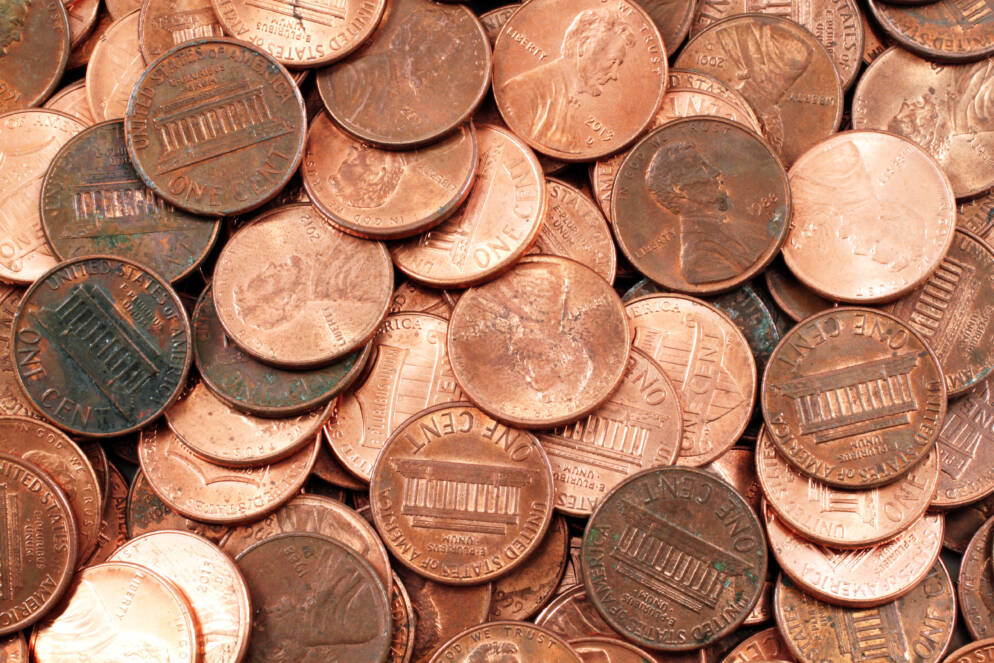
 Photo credit: Adobe Stock/tethysimagingllc
The American penny died on Nov. 12 in Philadelphia. It was 232.
The cause was irrelevance and expensiveness, the U.S. Treasury Department said. Nothing could be bought anymore with a penny — not even penny candy, which quietly disappeared years ago — and minting one had come to cost more than 3 cents. Financial absurdity finally overtook cultural nostalgia.
The last pennies rolled off the line at the Philadelphia Mint as Treasury officials looked on. No final words were recorded. Pennies were never much for speeches.
Yet they mattered more than economics ever admitted. They were the first coin many of us held, proof that money existed and that we had a tiny piece of it. They rattled in couch cushions, filled mason jars and weighed down pockets.
They bought gum, paid for parking meters and fueled the smallest acts of everyday commerce. A penny saved was a penny earned, long after that stopped being literally true.
But as we say goodbye, it’s worth remembering that the penny’s deepest imprint was moral rather than monetary — and nowhere was that more visible than in American Jewish life.
For generations, pennies were the gateway to tzedakah. They were the natural coin of the pushka, the little charity box on kitchen counters, in classrooms and near synagogue doors.
Children didn’t drop bills; they dropped pennies — slowly, one clink at a time. That small sound was often a child’s first lesson in responsibility, empathy and communal obligation.
Jewish educators built entire teaching moments around this. Give a child a small pile of pennies and ask them to divide it: one for giving, one for saving, one for spending.
The value wasn’t the point; the habit was. Pennies made generosity tangible before a child could understand philanthropy or budgets.
And in many Jewish homes, pennies became part of the weekly rhythm: a child slipping a coin into the pushka before Shabbat. Not a formal ritual, not universal, but a gentle domestic custom — a way to mark the transition to rest with a small act of care for someone else.
Modest, almost invisible, yet deeply formative.
Jews weren’t alone in elevating the smallest coin into a tool for moral education. Catholic and Protestant children dropped pennies into parish poor boxes; American public schools ran penny drives to teach civic duty; Muslim and Hindu families used their tiniest coins to train children in everyday charity.
Across cultures, copper coins were the building blocks of generosity. A penny may not have bought much, but it bought a habit.
Economically, the penny overstayed its welcome. It cost more to mint than it was worth. It slowed transactions. It cluttered drawers. But symbols often outlive their utility, and the penny was one of them. It democratized giving. It told even the youngest or the poorest child: you have something to offer.
Its disappearance won’t end charitable habits, Jewish or otherwise. But it does close a quietly beautiful chapter in how we learned them. Children will drop nickels, tap screens, or send digital dollars. They’ll learn the lesson — but something tactile and humble will be missing.
Let us thank the penny for its service. It bought little, but it taught much. Its memory deserves to be for a blessing — and for a lesson far richer than 1 cent.