
By Jack Tomczuk
Mayor Cherelle Parker this week scrapped longstanding provisions aimed at ensuring minority, women, and disabled-owned businesses are included in Philadelphia’s municipal contracts.
In its place, her administration will give a preference to companies that qualify as “small” and “local.” The change was made in response to a 2023 U.S. Supreme Court decision and resulting rulings across the country, officials said.
“There is a point where the risk becomes so high that we have to pivot, and that is the case here,” City Solicitor Renee Garcia told reporters at a news conference Tuesday afternoon.
Parker’s move away from race- and gender-based guidelines comes as President Donald Trump and his allies lead an effort to eradicate diversity, equity and inclusion, or DEI, initiatives, many of which were adopted in the wake of the 2020 racial justice demonstrations following the police killing of George Floyd.
The city government’s provision has been in place since the 1980s. City Hall spends about $4 billion annually on contracts through its operating and capital budgets, and, in recent years, there has been a goal of awarding at least 35% of the money to firms whose majority owners are minorities, women or people with disabilities.
“My advice would be the same no matter if it was Donald Trump or Kamala Harris in the White House because this is case law,” Garcia said.
She recalled approaching Parker after a series of recent cases that the city’s legal team felt undermined the basis for the diversity measure.
Two years ago, the Supreme Court ruled in a matter involving Harvard University that affirmative action in college admissions was unconstitutional, setting off additional lawsuits that successfully challenged race-based policies elsewhere, Garcia said.
Locally, a court found that the diversity terms in the city’s labor agreements for construction projects were discriminatory. That language mirrors the contracting guidelines, according to Garcia.
To defend the program in court, the city would have had to prove that the minority-, women-, and disabled-owned enterprise (M/W/DSBE) initiative was designed to directly remedy previous government discrimination and was as narrowly tailored as possible, Garcia stated.
The Parker administration hired an outside law firm specializing in constitutional law to review the policy and determine whether it would stand up to scrutiny, officials said.
“We came to the conclusion that we were at the end legally, that we had hit an obstacle that could not be overcome with the current program,” Garcia said. “We were not going to meet the legal standard.”
Parker, Garcia added, was “in anguish” after being briefed about the situation.
“But this is the way forward,” the solicitor said. “This is how we’re going to have a better program. We’re going to be legally compliant. We’re going to do it on our terms.”
The mayor and her deputies asserted that they were planning to overhaul the 40-year-old M/W/DSBE program, even before the legal risks became clear. Eighty percent of the businesses that became certified through the effort never received city contracts, officials said.
“To be quite honest, it was not working,” Chief Deputy Mayor Vanessa Garrett Harley said. “The overwhelming majority of the folks who were benefitting the most turned out to be white women, when we looked at the demographics.”
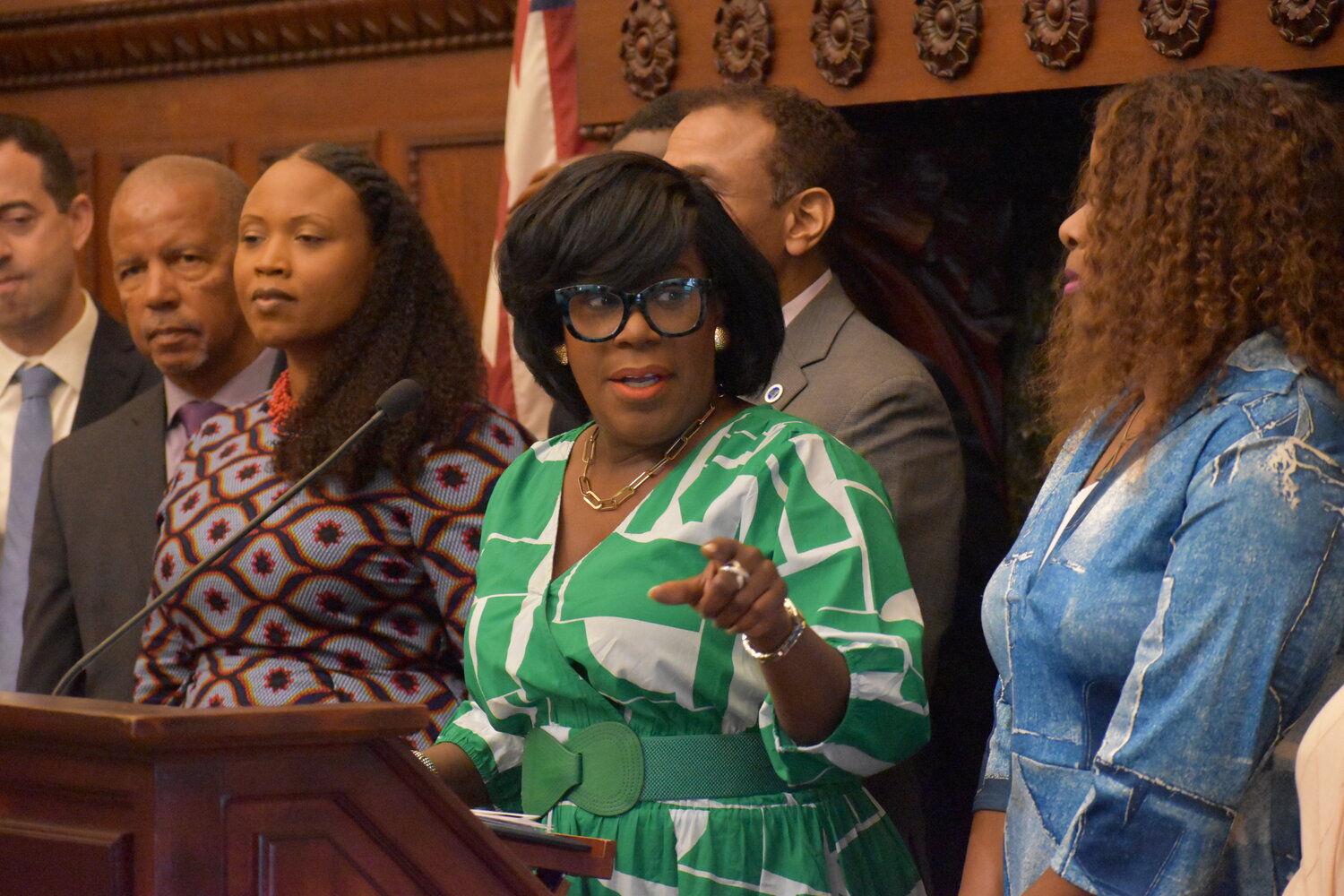
Parker signed an executive order Tuesday to set in motion the new program, in an attempt to “turn what has become a national crisis into an opportunity,” she said.
Companies that were M/W/DSBE certified will be grandfathered into certification as small and local businesses, according to Nadir Jones, director of the city’s Office of Business Impact and Economic Advancement.
To qualify as local, a firm must be headquartered in Philadelphia; 60% of its workers must live in the city; or half of its employees must work in the city at least 60% of the time, Jones said. Eligibility for small businesses varies across three tiers, though the maximum number of employees is set at 750.
Jones said the new setup will have more emphasis on business development. “This is not an eradication of a program,” he added. “This is an evolution.”
Administration representatives said they will watch data to track the demographics of those receiving contracts.
Parker met with business owners and chamber of commerce organizations Monday afternoon in East Mount Airy to explain the change.
The mayor told reporters she intentionally signed the order at the Center City headquarters of the African-American Chamber of Commerce of Pennsylvania, New Jersey and Delaware.
The African-American Chamber said it is launching a Special Task Force on Economic Access and Procurement.
“As we navigate these policy shifts, we will move forward with realistic pragmatism: hopeful that Philadelphia’s Black business community will benefit from these new policies, while remaining vigilant of the discriminatory practices that led to the creation of MWBE programs across the nation,” Regina Hairston, the group’s president and CEO, said in a statement.