
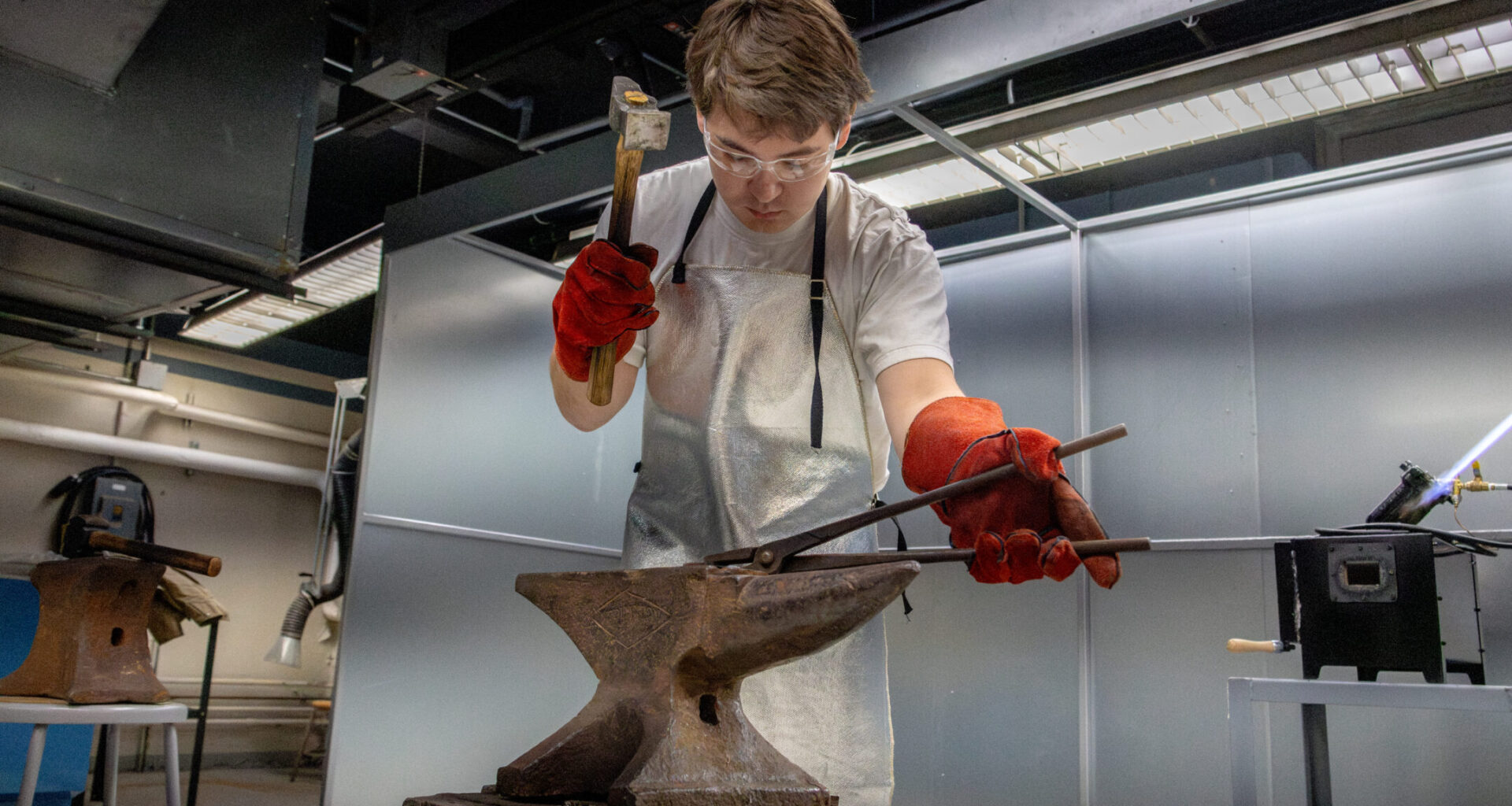
Lehigh’s Blacksmithing Club is preparing to move into its first dedicated lab space, marking a milestone for the university’s growing community of student metalworkers.
Laura Moyer, a professor in the department of Materials Science and Engineering, said the club has partnered with Historic Bethlehem Museums & Sites and Lehigh Heavy Forge to offer students hands-on experience with both traditional and modern metalworking.
She said construction on the new lab, which is located in Whitaker Laboratory, is expected to begin in the coming months.
Wojciech Misiolek is the director of The Loewy Institute, formerly the Institute for Metal Forming, that educates students in metal-forming technology, according to its website. He said students have been visiting the 1750 Smithy, a preserved blacksmith workshop on the North Side on Main Street, to work in a traditional forge environment and practice basic techniques.
Moyer said the team had discussed building a lab for years but wasn’t sure how to achieve it financially or where it would be located.
With student interest rising, Moyer said the idea for the blacksmithing club started to solidify two years ago when a student — now club president Josh Swavely, ‘26 — mentioned his passion for blacksmithing in one of Misiolek’s classes.
Under the guidance of Moyer and Misiolek, the group helped launch a one-credit blacksmithing elective offered each spring. Moyer said this course, now in its second year, is open to students of all majors, as is the club.
Moyer also said they are hoping to grow the one-credit course that is currently offered for half a semester into a full-semester three-credit elective for students.
“Within the course we are developing, the idea is to balance time between the laboratory and the lecture hall, between practice and theory,” Misiolek said. “It will be much more of an opportunity to design your own products, analyze the proposed processes, and learn while you are going through the process.”
Moyer said the new laboratory will allow students to complete every stage of the design cycle in one place — from heating and shaping metal at the forge to examining the microstructure of their finished work.
She said students will also be able to fabricate hooks, blades and small hardware entirely on campus supported by new ventilation hoods, anvils and space for larger tools.
Misiolek said the club’s growth has been driven by access to working forges across Bethlehem. Through its partnership with Historic Bethlehem Museums & Sites, students learn centuries-old techniques at the 1750 Smithy.
He also said their work with the Lehigh Heavy Forge in Bethlehem allows students to witness a modern industrial facility that provides advanced forgings to clients.
“We are connecting the historical aspects of forging technology with hands-on experience and current industrial practices,” Misiolek said.
He also said beyond traditional forging skills, the new lab will support lessons on heat treatments, controlled cooling and other methods that help students compare how different variables affect the strength and performance of their designs.
Nick Rockwell, a researcher at the Loewy Institute, said community partnerships have been essential in turning the club’s ideas into practice.
“With all the support we’ve received, it’s really helped us connect with Historic Bethlehem,” he said.
He also said Mike Rex, the shop and laboratory operations supervisor, has been instrumental in building facilities for the lab and giving advice on how to best use the space.
The club also gives students opportunities beyond the classroom. Members have participated in the Forging Industry Educational and Research Foundation’s annual competition and secured funding from the nonprofit organization to support their work.
“We pride ourselves in our hands-on approach,” Moyer said. “There are a lot of materials science and engineering departments across the country, but many don’t allow undergraduate students into labs or use highly specialized equipment.”