
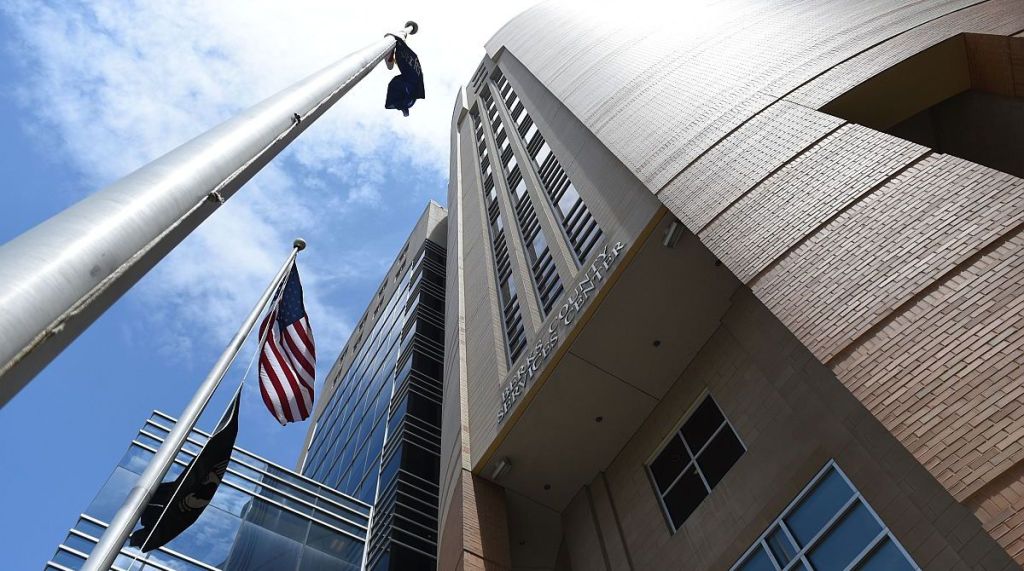
Berks County unveiled a 2026 budget proposal Thursday that would hold the line on taxes.
Despite the effects of inflation as it relates to contracted services, wages, facility maintenance and benefit costs, the $672.5 million plan manages to avoid a property tax increase and program cuts.
The county raised taxes each of the past two years, hiking the rate 9% in 2024 and 8% in 2025.
Interim Chief Financial Officer Laura Jones outlined the new proposed spending plan during the commissioners’ weekly board meeting, kicking off a public review period. She said the budget specifically meets the directive to present a budget without a tax increase.
The property tax rate will remain at 9.01 mills, meaning the owner of a property assessed at $100,000 will continue to pay $901.
The proposed budget represents a nearly $33 million decrease from the $705.8 million 2025 plan. Jones said this is primarily attributed to a $19.2 million reduction in general fund expenditures and a $18.5 million cut in capital projects.
The budget includes a $2.9 million surplus — primarily due to the anticipated revenue from a planned $25 million bond issuance in 2026.
Jones said her team has crafted a budget based on the best information they have on hand. She highlighted that the plan supports core services; maintains future financial stability; limits the growth of new discretionary spending; and funds capital expenses with reserves.
She added that the county will continue to maintain certain commitments, including $3.9 million for the library system; $3.8 million for the county park system; $3.25 million for Reading Area Community College; $1.2 million for the Council on Chemical Abuse; and $1 million for economic development.
Jones pointed out that the county will spend most of its money on public safety and the court system. The county spends nearly $80 million on public safety and $59 million on the court system, a combined total that represents nearly 65% of all county department spending.
Jones highlighted a few of the factors that impact the budget:
• While the county has had success in retaining employees, there is increasing pressure on wage growth resulting from collective bargaining labor negotiations.
• Due to the success in filling vacant positions, there is now higher enrollment in the county benefit plan that has resulted in more claims, costs and pension contributions.
This has been partially offset by implementing programs to control the growth of high-cost prescription drugs and asking employees to contribute a greater percentage of their pay to health care benefits.
• The growth of the tax base slowed, largely due to high interest rates on loans for commercial and residential real estate and a large number of tax assessment appeals.
Property values overall increased, but that has not created a boost in tax revenue because the ratio used by the state to equalize the assessments of homes assessed before and after the last countywide reassessment in 1994 continues to decline. That is expected to cause the county to lose $500,000 in tax revenue in 2026.
This was offset by implementing a countywide initiative in which departments were tasked with cutting spending and reducing operational expenditures.
• For the second year in a row, the county is using a portion of Berks Heim revenues to help offset some of the burden for taxpayers.
The commissioners commended the budget team for crafting a reasonable spending plan that highlights the priorities of the county.
“The people who really do the hard work day in and day often don’t get the credit that they deserve,” Commissioners Chairman Christian Leinbach said. “I can tell you that his board has been very clear in giving praise to the people who deserve it.”
Leinbach said the fact that the budget holds the line on taxes is particularly impressive given that inflation has risen about 54% since he first took office in 2008 while county spending has only increased by about 27%.
“We provide a lot of services for our community, for our veterans, for our seniors, for our most vulnerable residents, and I think we’re doing it at a price our taxpayers can afford,” Commissioner Dante Santoni Jr. said.
The commissioners are scheduled to adopt the final budget at their Dec. 18 meeting.