
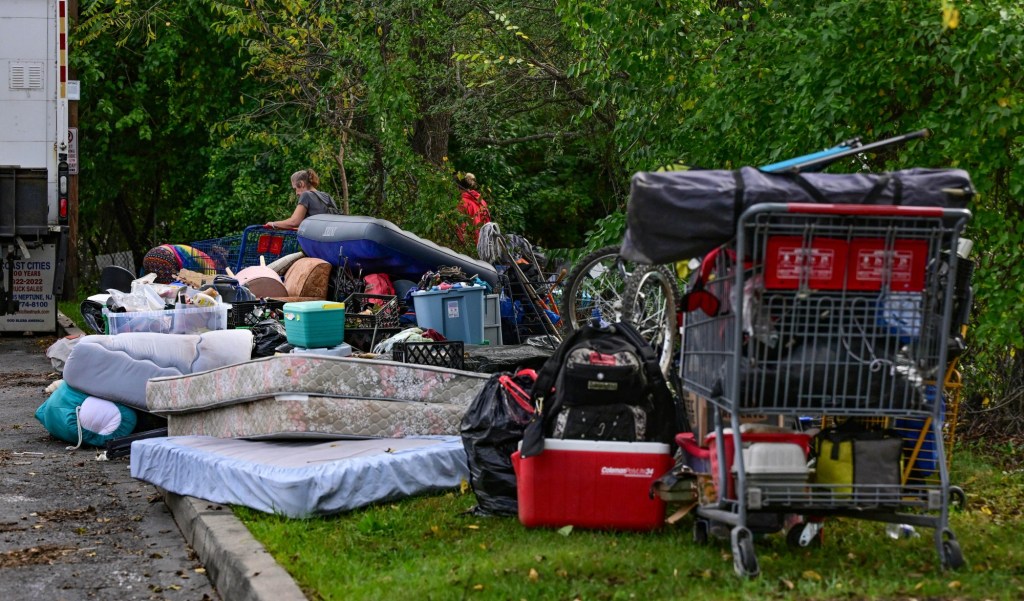
Swept out of encampments by municipal decree and carrying what they can of the jumbled belongings of a nomadic life, the homeless people of Allentown and Bethlehem move onward, but where they end up is — as with so many things in their lives — largely out of their control.
Some, with the help of community advocates, settle temporarily in shelters or motels. Others strike out for neighboring communities and set up camp again — but their chances of being tolerated in those places are growing slimmer.
That’s because some Lehigh Valley townships and boroughs, and the state itself, are considering legislation to ban camping on public property as a way to discourage encampments of the sort being dismantled in recent weeks in Allentown and Bethlehem.
Catasauqua is among the municipalities with a no-camping ordinance under review. Borough Manager Glenn Eckhart said the measure aims to prevent encampments like the one near the wastewater treatment plant of Race Street. It was a growing problem even before the cities started clearing encampments, he said.
Whitehall Township already has an ordinance banning overnight stays in parks. Mayor Joseph Marx said police and public works employees are usually the ones to come across encampments.
“We give them a reasonable time period to vacate and indicate whatever belongings they don’t take we’ll dispose of,” he said. “We’re very civil. We’ll give them a reference to [the Lehigh Conference of Churches] and I’ll reach out to the county or to social service agencies.”
“This is a Valley-wide problem,” Marx added. “When Allentown began cleaning up the encampments, I knew they would be coming north.”
Telling people without homes to move along is a difficult task, the mayor said. Many say they don’t want help.
“I’m very compassionate,” he said. “I know there are people who are challenged with mental health issues. Unfortunately the state and federal government have dropped the ball when it comes to mental health.”
Allentown announced its intention to clear an encampment along the Jordan Creek in August, citing the danger of flooding to the 80 to 100 people who typically congregated there.
The site was also the subject of a lawsuit by developer Nat Hyman, who said trespassing, garbage and nuisance behaviors by the residents were affecting his properties.
The city gave residents several weeks to vacate the area. It has since started clearing other encampments found along the creek.
Bethlehem is also clearing them. In August, Norfolk Southern Railroad asked the city to remove homeless people living on its property along the Lehigh River. An encampment on the grounds of the Burnside Plantation is also scheduled to be cleared.
Homeless people and advocates for the community have criticized the municipalities for essentially steamrolling the makeshift homes without finding sufficient alternatives for the residents.
Emergency shelters — including the warming shelter at the Allentown YMCA branch, which opened early this year in response to the clearances — are temporary solutions, and many homeless people are reluctant to stay in them in the first place.
Still, officials say they have to balance the lack of permanent solutions against the hazards of outdoor life.
Marx said flooding of encampments, so often set up near creeks and rivers, is not only a danger to the residents but to the first responders who might have to rescue them. Other problems include poor sanitation and fire hazards. These are the same reasons cited by Allentown.
In May, a half-dozen state senators, including Lehigh Valley Republican Jarrett Coleman, introduced Senate Bill 780. The measure would generally prohibit encampments unless they are authorized by a property owner, who would have to prevent nuisance conditions and adhere to health and safety regulations adopted by the municipality where the encampment is located.
It also empowers residents or property owners within 1,600 feet of encampments to petition municipalities to declare them a public nuisance.
The bill, which was referred to a House committee, also lays out regulations for clearing encampments: posting a written seven-day notice at the site, allowing reasonable opportunities for the residents to retrieve their belongings and referring the residents to programs that can help them.
All three senators from the Lehigh Valley — Coleman, and Democrats Lisa Boscola and Nick Miller — voted for the measure.
Christina DiPierro, co-chair of the Allentown Commission on Homelessness, said the bill is just one of many across the nation that lays the blame for encampments on homeless people instead of on the piecemeal system that pushes them from one place to another rather than creating solid sheltering and housing policies.
“Florida has a complete no-camp ban in the entire state,” DiPierro said after a commission meeting last week, when members debated how much budget money should be earmarked for dozens of urgent needs. “If you get caught sleeping outside, you can go to jail.”
That law, which took effect last year, generally prohibits anyone from regularly sleeping outdoors or camping on public property. It has narrow exceptions allowing municipalities to operate camps temporarily — less than a year — if they don’t have an adverse effect on safety or property values.
In an opinion piece published in The Morning Call, DiPierro laid out a number of proposals that would address some of the root causes behind homelessness, which affects some 800 people in the Valley, according to the most recent survey.
They include a year-round emergency shelter with programming for families with children; a safe camping site with bathrooms, showers, charging stations and a place to cook food; homeless prevention programs to help people before they become homeless; and more affordable housing.
It all costs money, of course. The bulk of the recent homeless commission meeting revolved around the group’s strategic budget request to Allentown City Council, a request for line-item funding of various programs that DiPierro said would make a “short-term impact on our unsheltered neighbors.”
It was here that the financial realities became apparent. Among the requests, for example, is $10,000 for Loads of Blessings, a weekly program at an Allentown laundromat where unhoused people can use washers and dryers for free and connect with doctors and representatives of assistance programs.
“They spend on average of about $900 a week for two hours, and it’s the only place in the entire Valley besides New Bethany that you can get a free wash of your clothes,” DiPierro said.
Another request is for money to house people who can’t use shelters in hotels — families with children, for example, or people with medical conditions.
The discussion branched off into other needs. What of pets? Many people won’t leave them behind to enter a shelter. Could money be earmarked for kennels or fostering? Perhaps the hotel money could be split.
The hierarchy of needs, it was clear, seems never-ending.
“Becoming homeless,” DiPierro said, “is probably the hardest thing to get out of.”
Morning Call reporter Daniel Patrick Sheehan can be reached at 610-820-6598 or dsheehan@mcall.com.