
Charlene Samuels fields the same sets of complaints from Philly residents every day in her role as the constituent services rep for At-large City Councilmember and Minority Leader Kendra Brooks.
Construction has started on a house next door, with no building permit. An apartment has broken air conditioning in the height of summer, or mice crawling around, or leaks in the ceiling. Landlords aren’t completing repairs in a timely manner.
By the time they call her, tenants have already tried reaching out to the property owners — often with contact forms on property-management websites — to no avail. They don’t have a phone number for their landlord and sometimes don’t even know their name.
Often, that’s because, technically, their landlord doesn’t have a name. Using Atlas, the City’s tool for searching property records, licenses and permit history, Samuels more and more often discovers that rental properties in Philadelphia are owned by a corporation or private equity firm, sometimes as far away as California or Connecticut.
“It’s a lot of work trying to track down these landlords,” says Samuels, who won a 2025 Integrity Icon award — which recognizes all-star public servants for their commitment to the citizens of Philadelphia — for her dedication to helping tenants. “You would have to be pretty savvy. Most tenants are not going to go through all of that.”
Philly has long prided itself on being a city of homeowners, outpacing other Northeast peer cities like New York City, Boston, Washington D.C., Pittsburgh, and Baltimore. But between 2006 and 2025, the city’s homeownership rate dwindled from a healthy 58.2 percent to 52 percent of residents, Pew Charitable Trust’s State of the City report.
Investors now buy one in four Philly homes, and then rent them out, according to a new report from the Reinvestment Fund and the Center for Law Inequality and Metropolitan Equity (CLiME), at Rutgers University Law School.
The presence of corporations in the housing market means there are fewer homes for sale to Philadelphians. Many of the renters struggling with absentee landlords might have the capacity to become homeowners, if only they had access to the affordable properties the big players are buying up.
As buyers, large corporations have advantages — all-cash offers, coming in over asking price — that aren’t realistic for regular citizens, especially first-time homebuyers and low-income Philadelphians.
All of which raises the question: Can Philly remain a city of homeowners?
Private homes matter
Owning a home doesn’t just provide people with stable housing. It’s long been the surest way for families to build wealth in America. Mortgage costs remain stable year-over-year, unlike rent which tends to increase, allowing families to save more of their money. Home values also appreciate, building wealth for families over the long-term. The median wealth gap between homeowners and renters was $390,000 in 2022.
Home ownership also contributes to a neighborhood’s stability. Owners tend to be more invested in things like building community amongst neighbors and taking care of parks and community gardens.
That’s why it matters that corporations are buying up so many Philadelphia homes.
The trend exploded after the 2008 bubble, fueled in large part by the bursting of the real estate bubble. Banks and even the federal government auctioned off large numbers of single-family homes in foreclosure sales around the country. The private equity firm Blackstone, for example, amassed nearly 400,000 single-family homes nationally between 2010 and 2021. Giant corporate landlords are associated with higher eviction rates and more code violations, while implementing massive rent hikes, but in some areas they’ve had a desegregating effect, allowing some lower-income, primarily non-White renters to move into areas where they couldn’t afford to own, some researchers have found.
Corporations didn’t buy a ton of homes in foreclosure after the recession in Philly, in part because of the City’s foreclosure diversion program, which required mortgage lenders to meet with homeowners facing foreclosure to try to work out an agreement. Even today, major private-equity firms in the single-family home rental space like Blackstone or the Blackstone-created Invitation Homes, have not yet moved into Philly.
“It’s not just about the housing market, it’s about generational wealth — and who gets to own in our city.” — City Councilmember Rue Landau
But corporate investment is still growing, driven by local investors who know the market and neighborhoods better. Between 2017 and 2019, the first period the Rutgers/Reinvestment fund report looked at, eight of the 10 largest corporate home buyers in Philly were local firms. The report also looked at homes purchased between 2020 and 2022, the most recent year for which data was available, and found local investors were scaling their operations and purchasing more homes.
“They’re still private equity, but they’re private equity that’s local or regional,” says Dr. Katharine Nelson, one of the authors of the report and the assistant director of Housing Studies, at CLiME. “This wasn’t the kind of market where the investors could just amass huge numbers of properties as quickly, and this is also a city where there’s a huge variation from block to block. So it’s a lot harder to go online and look at a map and just grab a property.”
But that dynamic, too, is slowly shifting. Investors who found success buying and renting single-family homes nationally are starting to look at growing in Philly, attracted by our relatively affordable housing stock. South Carolina-based JDJ Investment Properties, for instance, acquired 377 homes between 2017 and 2022. Lone Star Funds, based in Texas, bought 124 between 2017 and 2019.
Homes purchased by large investors like JDJ and Lone Star have higher eviction rates than those by investors who own less than 100 properties, the report found — 14 percent compared to four percent. They also have more violations, which can range from issues like unsafe living conditions to improper construction permitting. On the other hand, 42 percent of large investors took out permits to alter or improve their properties compared to 13 percent of individual home buyers. Given Philly’s aging housing stock, where some homes need so many repairs that they’re uninhabitable, this can help improve the overall housing stock.
In Philadelphia, many of these homes are located in middle- and low-income Black and Brown neighborhoods, particularly Germantown, Strawberry Mansion and Cobbs Creek. There’s not as much corporate investment in wealthier areas, like Center City or Rittenhouse, where an increasing number of renters could change the character of neighborhoods, says Philly realtor Sean Kaplan.
“I don’t think we’re a playground for the rich, like Manhattan,” Kaplan says, noting that Philly is one of the only large cities where it’s still affordable for low and middle-income residents to own homes. “But you can see how it would start to become that when ownership is only accessible to the wealthy.”
So far, corporate investment in Philly’s single-family homes is not necessarily displacing residents the way “classic gentrification” does, says Emily Dowdall, report author and president of policy solutions at the Reinvestment Fund. But it is perpetuating a cycle of financial precarity.
“People are now renting instead of owning,” Dowdall says, “and when they rent, they’re paying more.”
Is any city getting this “right”?
Other cities have been dealing with the same situation — somewhat ineffectively — for years.
Fueling the problem is a lack of transparency.
Investors tend to buy homes through limited liability corporations (LLCs), sometimes multiple ones, making it hard to tell how many properties any one investor owns. While LLCs are legally required to have a publicly listed address, many use P.O. boxes, virtual offices or registered agent services, making the actual owners difficult to reach. In one situation, Samuels encountered an LLC that listed a rental property itself as its mailing address.
Dowdall and Nelson were able to link investor activity across multiple LLCs by cross-referencing the mailing addresses, but even then they suspect they were undercounted.
“It really was sort of the proverbial peeling back of the onion, and you keep realizing there are more layers you need to dig down to really understand what’s happening,” Dowdall says. “Now is probably the time to come up with a strategy for how to better track who owns homes in Philadelphia and whether they’re responsible landlords.”
Some cities, like Pittsburgh and Rochester, NY, require landlords to file real contact information with the City and limit when they can substitute LLCs for their actual contact information. That could go a long way here, says Dowdall.
In the absence of transparency and effective policy nationwide, local activists have launched efforts, often borrowing ideas from labor organizers, to improve conditions for renters and advocate for better policy. They tend to focus on apartment buildings, rather than single-family homes, where it’s easy for tenants to meet and pressure their landlord.
Sosseh Prom, housing justice director for African Communities Together, a grassroots organization that fights for the rights of African Immigrants nationwide, tried a different strategy: Ask investors in real estate funds to divest from corporate landlords.
During a 2020 get-out-the vote, door-to-door canvassing effort in Alexandria, Virginia, she began hearing from residents in the CIM Group-owned Southern Towers apartment complex that they couldn’t reach their landlords about maintenance problems. So she worked with them to write letters to CIM’s investors — like university endowments and pension funds, including PA’s Public School Employees’ Retirement System (PSERS) — who were invested in the project. Then the residents started showing up at pension board hearings, where they described moldy apartments and issues with pests.
“[We] basically just laid out: ‘Look, this is what’s on the property. … You should have an interest in what’s happening, because this is your money that’s being used for this,’” says Prom.
The success of the divestment campaign “was a mixed bag,” for a variety of reasons, says Prom. Many PE firms operate real estate funds over a fixed-period of time, say 10 to 15 years, and it can be difficult for investors to withdraw their money before then.The funds are often opaque. Pensions don’t always know what projects or buildings they’re investing in when they enter.
Still, the residents meeting with the pension boards — and filing a complaint with Freddie Mac — did get CIM leaders to agree, at long last, to meet with Southern tower residents to hear their complaints.
Homes don’t come back
Much of the advocacy work surrounding institutional investment in housing has focused on renters, who bear the brunt of the immediate effects of corporate landlords.
But what about families who might be looking to buy their first home? Homeownership has long been a critical part of the American dream, not just a critical part of Philly’s identity. Again, it’s one of the most reliable ways to build wealth in America.
“Once [private equity investors] purchase a home, there’s a vanishingly slim chance that it’s actually going to go on the market again,” says Sam Garin, senior communications coordinator with nonprofit watchdog the Private Equity Stakeholder Project.
Then there’s the fact that many individuals can’t compete with corporate investors, who can make sellers all-cash offers, well over asking price. Mortgage lenders also tend to favor investors over individual applicants from low-income neighborhoods. And there’s those “cash for cribs” or “we buy homes” signs that investors post — often in poorer neighborhoods — to buy homes before they’re even listed, and usually well below market rate. “It can be more cash than a homeowner’s ever seen before at one time,” Dowdall says.
At the beginning of the year, New York Governor Kathy Hochul proposed a measure that would prevent institutional investors from making offers on properties the first 75 days they’re on the market — a way to give individuals and families an edge.
And nationally, U.S. Senators Mark Kelly and Jeff Merkley have proposed the HOPE (for Humans Over Private Equity) for Homeownership Act, that seeks to level the buying field when it comes to the purchase of single family homes.
“People are now renting instead of owning. And when they rent, they’re paying more.” — Emily Dowdall
The act would implement a tax penalty of $10,00 or 15 percent of the sale price (whichever is greater) for hedge funds buying single-family homes, removing depreciation and mortgage interest tax breaks, and adding a $5,000 per home tax on investors who fail to sell off 10 percent of the single-family homes they own over a 10-year period. The tax would apply each year, and homes must be sold to families who don’t own another property.
Pennsylvania is in the process of creating its first-ever, statewide housing affordability action plan. Solutions from other states and the federal government could work (and might be ideas worth stealing) if they become law.
But it’s a hard hill to climb. Hochul has faced opposition from the Real Estate Board of New York. And this is the second time Merkley has introduced legislation trying to limit hedge funds from buying up homes (his 2023 End Hedge Fund Control of American Homes Act didn’t pass).
Critics of these kinds of policy interventions say it is the shortage of housing — not investors — who are to blame for rising prices and crowding out homeowners. In Philly, Mayor Cherelle Parker’s H.O.M.E. plan — which promises to build or repair 30,000 homes — could be an effective solution. But many worry that the plan won’t actually build that many new homes. Advocates are also concerned that it doesn’t focus enough on deeply affordable single-family homes, which are especially vulnerable to being scooped up by corporations and turned into rentals, often with a rent hike.
A Philly solution to this problem
Council Minority Leader Kendra Brooks has seen the effect that a decline in homeownership and out-of-state, corporate landlords has had on her own neighborhood, where renters often struggle to reach a landlord when something goes wrong. She’s also seen people sell their houses and become renters because they can’t afford needed repairs on the homes they have.
“We had a very high ownership rate, and we’re at risk of losing that,” Brooks says. “We need to look at leveling the playing field. We could be making sure that we’re prioritizing individuals and families over corporations.”
She sees potential for a policy similar to the one already in place for the Land Bank, the public agency that acquires and repurposes vacant, underutilized and tax-delinquent properties, that would give families and nonprofits priority over corporate investors when it comes to bidding on properties that are up for sheriff sales.
There are a couple of ways such a policy could work:
One is simply to replicate the priority-bid process of The Philadelphia Land Bank to revitalize neighborhoods and return them to productive use. Currently, if the Land Bank is interested in a sheriff-sale property, it becomes the only bidder, ensuring the Bank get the home.
Another stipulation would be to set a time period that must pass before investors can bid on properties, similar to what Hochul proposed in New York. Brooks also thinks setting a higher real-estate-transfer tax for corporations vs. individual buyers could curb corporate investment (though increases to realty transfer taxes have traditionally garnered opposition from landlords, investors and area realtors.)
A policy targeting sheriff sales would also be particularly effective, Nelson says, because high-volume investors in Philly acquired one-third of their properties here before the pandemic halted the practice.
“I think it raises some real questions about who is going to be buying those properties, and what sort of playing field do we want to be able to encourage in a city of homeowners,” says CLiME’s Nelson.
In the meantime, Brooks and a number of councilmembers are looking at how to leverage the H.O.M.E. plan and existing City programs, like Turn the Key, which offers financial support to first time home buyers to support buyers and keep both rents and homeownership affordable.
Councilmember Jamie Gauthier of District 3 and At-Large Councilmember Rue Landau, who, respectively, chair and vice-chair the housing committee, sent a letter to Mayor Parker last month, urging her to use the first year of H.O.M.E. funds to focus on Philly’s lowest income families. They advise increasing assistance for low-income renters and for homeowners who need to make repairs, and creating more housing that is affordable for the lowest-income Philadelphians.
“The money in H.O.M.E. is a transformative opportunity for us, but we have to make sure that it prioritizes low-income Philadelphians,” Landau says. “It’s not just about the housing market, it’s about generational wealth — and who gets to own in our city.”
 MORE HOUSING SOLUTIONS FROM THE CITIZEN
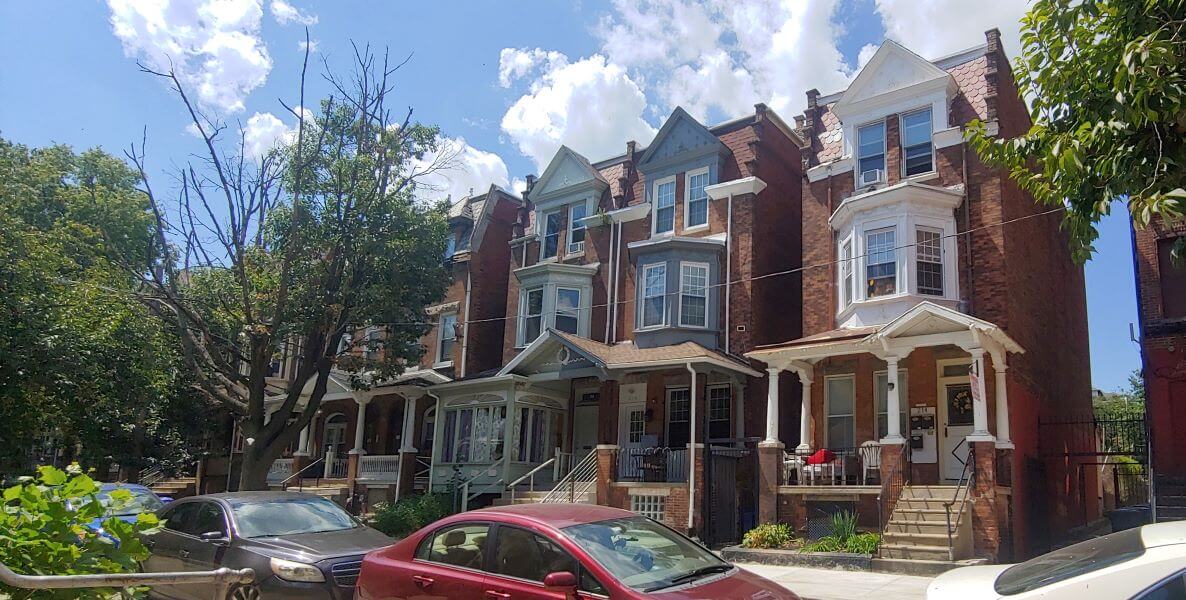
Rowhouses on Buckingham Place, West Philadelphia. Photo by Christina Griffith