
On a recent rainy afternoon in the back of an Allentown diner, Richard Wehr opened a large sack that was sitting on the chair next to him. Out of it he gradually lifted a large book, a very large book. From the book there were slips of paper attached, a lot of thin slips of paper. As Wehr gingerly balanced its shifting shape, he placed the book on its spine on the table.
Opening the front cover, it seems to fall to the front page that reads in large letters “The Wehr and the Mohr Book Illustrated.” Underneath the inscription it reads: “A Genealogy of 2 Pioneer Families and Their 16 American Revolutionary War Patriot Sons.” The name of the author underneath is given as Myron P. Wehr.

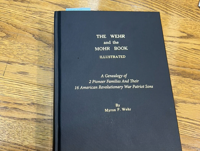
The Wehr and the Mohr Book Illustrated
WFMZ
Myron P. Wehr was born in Orefield. He was a sales representative and manager for the Trojan Powder and Giant Portland Cement companies as well as the Penn Allen Glass Company. Mohr was also very active with local Masonic organizations on a variety of levels.
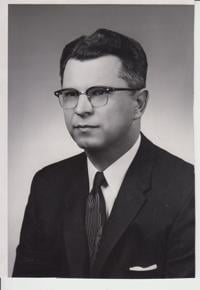
Myron P. Wehr
Photo provided by Richard Wehr
Richard Wehr explains that the book is a long-term project by his late uncle and was completed in 2020. He recalls talking over an idea that he had while discussing things with two relatives and co-authors, Linda Wehr Christy and Lynn Mohr Wehr, to write a book concentrating on the 16 various families who served in the Revolution under George Washington, “who were the nucleus of thirty-two American Patriot sons-who served our country in the American Revolution.”
They have titled it “Planters of Seeds: A True Story.”
“Planters of Seeds is not completed or released yet,” says Wehr. “It actually was contemplated as a separate spin-off project or documentary project with the Wehr and Mohr Illustrated completion.”
Wehr notes that the idea for a book followed two family events in 2018, a wedding and the birth. At the wedding reception the best man, while giving a toast, recalled the family history and how many had fought in the American Revolution with Washington. That was, writes Richard Wehr, “the catalyst for our family to update a search for our Wehr and family ancestors.” He adds that “at that time, none of us anticipated the journey into the past we were about to take.”
Richard Wehr
WFMZ
Like many Rhineland Germans in the 1740s, religion and land drew them to America, after the prince of a province where the Wehrs lived in the Holy Roman Empire declared Roman Catholicism the church that his subjects had to follow.
So, like many other Reformed and Lutheran believers, the Wehrs decided to join the exodus to Penn’s colony. There was also the possibility of having land and a farm of their own as was advertised by William Penn’s son, Thomas.
This led the German immigrants to Rotterdam, and then to Cowes, England to board any one of the many ships, most of them owned by one of many British companies, to America. These were arduous trips, to say the least, with a good crossing taking two months, and a bad one lasting nearly a year.
As many scholars point out, rough seas were common, and food often ran out. It was not unusual for a ship to leave the port of Cowes, England and never be heard from again. But the lure of land and the chance to practice their religion without harassment was enough in the 1730s and 40s to keep the harbors full.
Richard Wehr notes that Simon and Catharina Wehr left on the ship Loyal Judith in 1740, Johann and Susanna Mohr on the Phoenix in 1744, and Conrad and Anna Bloss on the Francis and Elizabeth in 1742. Others came over in 1739. Once in Philadelphia, Wehr points out that all males, fifteen or sixteen, had to take an oath of allegiance to His Majesty King George II or III.
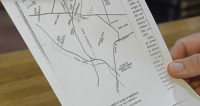
Richard Wehr shows some of the documentation his family has compiled over years of research.
WFMZ
“Before 1752,” Wehr writes, “the area now known as Heidelberg Township was known as the Heidelberg district, a part of Berks County. On June 6, 1752, a petition was received and endorsed by the first court, making Heidelberg a township as part of the newly formed Northampton County.” A church was one of the first structures built in 1745. It burned in the early 1750s, and a second church was built in 1756. “Members of the Wehr, Bloss, Peter, Lentz, and Riedy families” notes Wehr, “were among the 59 contributors to the new church and school.”
Along with their religious life the families were concerned with acquiring land for farming. Unfortunately, Thomas Penn was not like his father who respected the rights of the Native Americans. Alfred Franklin Berlin, a local early 20th scholar of Native American life who worked closely with scholar archaeologist Henry Mercer referred to Penn the younger as the “cheating land grabbing offspring of an illustrious father.”
For him Pennsylvania was a large real estate development designed to enable him to live in luxury in his 5,000-acre British estate with one of the finest rare book libraries in Europe. The infamous Walking Purchase of 1737 that cheated the Lenape out of huge amount of property led to fury along the frontier. Unfortunately for the German settlers who settled on the land they found themselves caught in the middle and subject to the anger of the Native Americans.
This would boil over into the French and Indian War of the 1750s and larger conflict between France and England known as the Seven Years War. “Our ancestors had left the old world to get away from incessant wars. The arrived in this new land and hardly settled down and found themselves in conflicts nearly as bad as from where they had left,” write the authors.
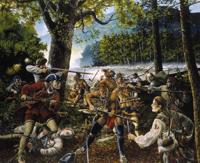
French and Indian War
They mention the various Indian attacks of the French and Indian war period. They mention Herman Moll provided horses and wagons in June 1758, and his brother enlisted in Captain Wolf’s Company because of a Whitehall massacre. They also mention several other struggles with the Indians some during the Revolution.
Johann Abraham Riedy was drafted as a drummer boy against the Indians in the Mahoning Valley in 1780. George Bloss Jr. served against the Indians, as did Nicholas Peter. The authors point out that during the Revolution several served with militia units. They note that many years later Jonas Mohr was killed on the frontier in Minnesota in conflicts with Native Americans.
Among those killed that served under George Washington were Conrad Bloss who died at the battle of Long Island.
Another was Corporal Nicholas Mohr. Mohr drowned at the battle of the Brandywine, while trying to guide a herd of horses he had collected from his uncle’s and his father’s farms over the body of water. Interestingly, the authors note, one of the horses showed up three weeks after the event in front of the Weisenberg Township barn of his uncle. The horse walked into the open barn and to his own stall.