
Sneaking an occasional peek out his office window at the Wilkes University Public Safety Center on South Main Street toward the hustle and bustle of everyday life in Wilkes-Barre is a bit of a pastime for Chief Mike Krzywicki.
Outside, he sees city residents walking along as cars traverse the busy thoroughfare. He notices the flashing lights directing traffic at a crosswalk, and students strolling toward their classes or back to their dorms in the nearby University Towers. Everyone in a hurry. Everyone, to a degree, distracted by the responsibilities of life.
More and more the past few years, Wilkes’ director of public safety also sees e-bikes, e-scooters and other forms of motorized transportation being driven on city sidewalks, or in roadways. When he does, he worries about the hazards he has seen come of it all.
“I’m sitting here in my office, looking out the window onto South Main Street, and I just saw another one go by,” Krzywicki said. “It’s crazy how fast they’re going, and you don’t hear them. I mean, what a danger.”
That crosswalk symbolizes a crossroads of sorts.
Spurred by their meteoric rise in popularity, bicycles and scooters assisted by electric motors have led to safety concerns surrounding their operation — along with a rising total of injuries — leading area authorities to experiment with ways to keep bike riders and others in the community happy.
That conundrum is often vexing for officers like Krzywicki who insist safer, more courteous driving, and not necessarily fewer people on bikes or scooters, is the remedy for the increased apprehensions.
They also grasp a less convenient truth that extends beyond any riding style: Some of the e-bikes and e-scooters on the road, not to mention the burgeoning number of e-bike riders under age 16, are operating afoul of Pennsylvania law.
They’re also leading to potentially dangerous safety scenarios, which is part of the reason Krzywicki championed the banning of e-bikes and e-scooters on the Wilkes-Barre school’s campus.
A 2024 study focused on micromobility injury trends found that about 3 million riders of e-bikes, e-scooters or other similar modes of transportation in the United States sought care for injuries in hospital emergency rooms over a six-year span from 2017 through 2022. Injuries suffered by e-bike riders treated in ERs rose from 751 recorded in 2017 to 23,493 in 2022. For e-scooter riders, it was a similar increase, from slightly more than 8,500 in 2017 to nearly 57,000 five years later.
“I just saw another one go by,” Krzywicki said a few minutes later, with a chuckle. “He’s riding on one wheel.”
What to buy
Bicycling is a major part of Allen Reinert’s life. Before becoming owner and head mechanic at Pottsville Cyclery in Schuylkill County, he navigated Chicago’s busy streets on two wheels, working as a bike messenger. Later, he managed several cycling shops in and around Portland, Oregon.
His career has coincided with a change in the activity few figured would be so dramatic.
“When I started at the shop that I worked at in Oregon, we basically sold no e-bikes. And if we did, it was sort of a one-off, an exotic type of thing that was pretty rare — and that’s in a city where bikes are a much bigger part of the culture than they are here,” Reinert said. “Since COVID, really, they’ve just completely dominated everything. We sell dramatically more e-bikes than manual bikes.”
These forms of electric micromobility aren’t particularly new. After all, the first patent for e-bikes was filed in the closing years of the 19th century. But for area bike shops, things started to change in the cycling world during the pandemic. Sales of e-bikes topped 1.1 million nationally in 2022, representing a more than 283% increase from 2019’s sales, according to U.S. Department of Energy data.
E-bikes have been a part of the inventory at Cedar Bike Shop in Scranton since 2015, giving Lackawanna County cyclists an environmentally safe way to tour area roads and trails without the physical strain of pedaling over the steep hills and rocky terrain that are a trademark of the area’s landscape.
But co-owner Kyle Brazen pointed out that the cost, availability and safety features of e-bikes can differ based on where they are purchased.
There are three different classes of e-bikes, he said: Class 1 bikes provide motorized pedal assist up to 20 mph before the engine cuts out. Class 2 e-bikes have the pedal assist to 20 mph, but also offer an optional throttle that enables riders to reach 20 mph without pedaling. Class 3 e-bikes have pedal assist to 28 mph, with an optional throttle that, depending on the manufacturer, can help operators reach from 20 to 28 mph without pedaling.
“They’re the three classes that pretty much all your bicycle shops sell,” Brazen said, noting his shop mostly deals with Class 1 bikes. “But there are other brands out there that are kind of doing their own thing. You have some nonbicycle brands — they weren’t bicycle companies at first; they just came out because of e-bikes (popularity) — and they’re the ones you see a lot of people riding around on that are, in my opinion, causing a lot of headaches for some people.”
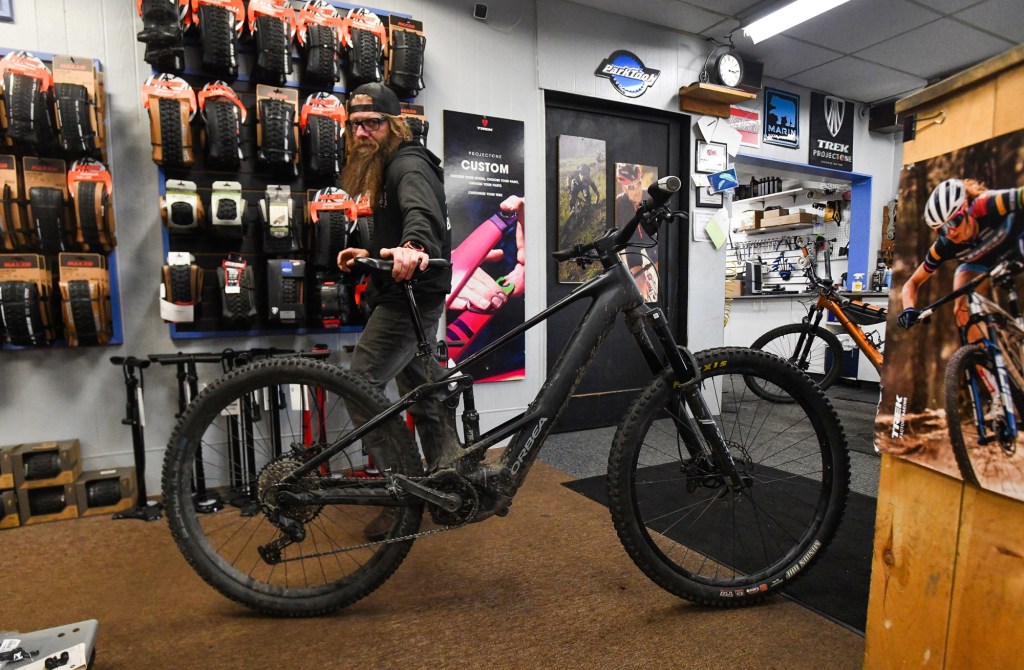
The battery and power meter is seen on an e-bike at Cedar Bicycle Wednesday. (SEAN MCKEAG / STAFF PHOTOGRAPHER)
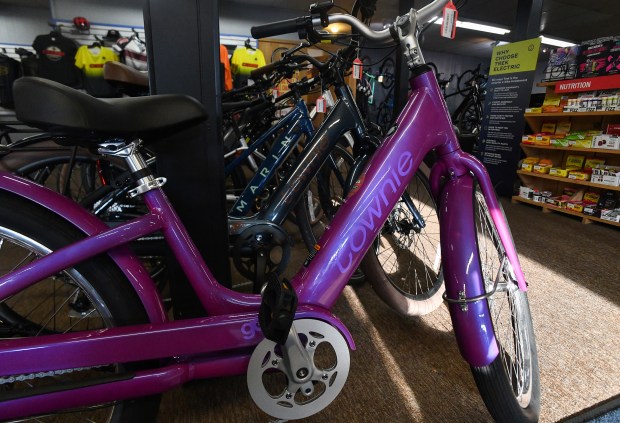
Electric Townie commuter bikes are for sale at Cedar Bicycle in Scranton Wednesday, November 19, 2025. (SEAN MCKEAG / STAFF PHOTOGRAPHER)
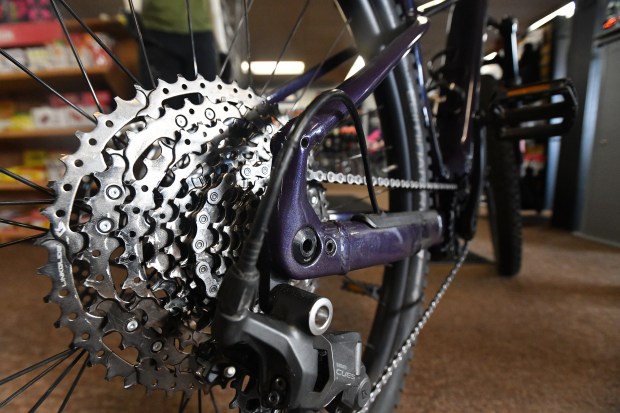
The chainset of an e-bike at Cedar Bicycle in Scranton Wednesday, November 19, 2025. (SEAN MCKEAG / STAFF PHOTOGRAPHER)
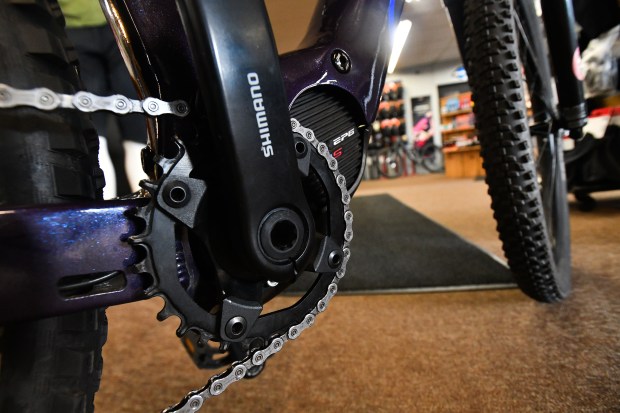
The components of an e-bike for sale at Cedar Bicycle in Scranton Wednesday, November 19, 2025. (SEAN MCKEAG / STAFF PHOTOGRAPHER)
Show Caption
1 of 4
The battery and power meter is seen on an e-bike at Cedar Bicycle Wednesday. (SEAN MCKEAG / STAFF PHOTOGRAPHER)
The differences between the classes can be confusing, but both Reinert and Brazen say understanding them is critical — not only for those purchasing an e-bike, but for operating them legally.
According to the Pennsylvania vehicle code, e-bikes are allowed to go no more than 20 mph on a flat surface when powered by the motor. They are not allowed to weigh more than 100 pounds, and the motor can not be rated for any more than 750 watts.
The minimum age for e-bike riders in the state is 16. Reinert and Brazen say they cannot, do not and would not sell an e-bike either to anyone under 16, or to someone who expresses an interest in buying it for so young a rider.
However, both admit a reputable bike shop turning away younger riders by no means stops anyone from ordering e-bikes from web-based businesses that sell them at a fraction of the cost.
That comes with potential issues. They don’t always come — as e-bikes purchased from bike shops typically do — with expert service, braking systems adequate enough for a vehicle that moves so quickly, or even an Underwriters Laboratories certification that provides assurance the bike’s battery underwent testing protocols designed to prevent fire risks.
Nor do many cheaper models necessarily strive to meet state standards.
“For instance, the maximum power a bike can have is 750 watts,” Reinert said. “You or I could go online today and order a bike that is twice that. Technically, that has to be licensed as an electric motorcycle. It needs a license plate, and a motorcycle license to ride. None of that information is provided on the website. So, people end up with bikes that can go 40, 45 mph.
“I would say 99% of people that come in have never heard that stuff before. I think that’s a failure on a lot of the e-bike brands to provide that education to their customers up front.”
What to do
Just before Route 11 snakes up a hill leading into Clarks Summit’s charming, small-business-lined downtown, a digital billboard flashes advertisements and messages to the community.
One has been a staple in the rotation for the last several months. It is from the borough’s Police Department, reminding riders of those motorized, micromobility vehicles not to ride on the roadway.
In Clarks Summit and surrounding towns in the Abingtons, e-bikes and e-scooters are an everyday sight. They prove a fun way for youngsters to navigate around the sprawling community quickly, to meet with friends on another side of town or at popular State Street haunts for pizza, hoagies or ice cream.
They have also proved to be a target of criticism and concern for drivers and pedestrians. During the summer months, Clarks Summit Police Chief Chris Yarns said the department averaged as many as five complaints per month about young e-bike riders riding aggressively or in prohibited areas. When he sees one blow through a stop sign, ride in the roadway, go against traffic or fail to yield to it, he gets worried.
He understands those concerns. He also tries to understand kids — even the ones he knows are too young to legally operate e-bikes to begin with.
“Here’s my dilemma,” Yarns said. “I’m the police chief, and I’m getting complaints about people riding a bike on a roadway where, yes, it is illegal to ride on the roadway. But I’m also not a fun-sucker. Sometimes you’ve got to put yourself in their shoes, and if I was a kid, I’d get one of those.
“I just wish this wasn’t a police problem. I wish it was a parent problem. I wish parents would, when they get these bikes for them, be more educated on knowing what the laws are.”
Pennsylvania law prohibits e-scooters from operating on public roads or sidewalks, while e-bikes can be allowed in bike lines and on sidewalks outside of business districts. In a statement released by a department spokesperson, PennDOT Engineering District 4, which covers most of Northeast Pennsylvania, encouraged riders to prioritize safety while riding e-bikes and e-scooters, adding that following traffic regulations is “essential” to reducing the risk of injury for all who use sidewalks and the road.
“These are enforcement matters,” the statement went on, “and violations may result in penalties under applicable traffic laws,”
Yarns says he and his officers try their best to opt for education, as a first warning. After all, he and others in his position prefer kids being outside, getting exercise with their friends, to sitting inside playing video games.
As long as riders aren’t carelessly operating where they can’t be, speeding around parking lots or posing a threat to pedestrians who often don’t hear the silent electric motors approaching them even at higher speeds, they’ll likely get a frank discussion about responsibility and safety.
Citations can come with repeated offenses, though.
“I don’t want to do that, because they’re 12, 13 years old, and that’s crazy,” Yarns said. “But what else can I do? What other tools are available as a police officer or a police chief to see if I can get their attention?”
Krzywicki felt Wilkes had to take a different approach altogether.
Last December, he began to hear “a minimum of one complaint per week” from people insisting they nearly got hit by an e-scooter actually operating inside a school building.
That, combined with the fire hazard posed by cheaper batteries that are overcharged and poorly maintained, led to his decision to propose a university policy prohibiting their use on campus property. He said the university’s Cabinet unanimously approved the proposal in January. It went into effect this fall.
“There were times where I’d walk into our student center, and there’d be 15 or 20 of them, in the hallway, blocking the walkway,” Krzywicki said. “You couldn’t even walk around. They would just park them there. That’s when I was like, we can’t have this.”
Pottsville Cyclery owner Allen Reinert inspects an e-bike at his shop, Thursday, Nov. 20, 2025, in Pottsville. (MATTHEW PERSCHALL/MULTIMEDIA EDITOR)
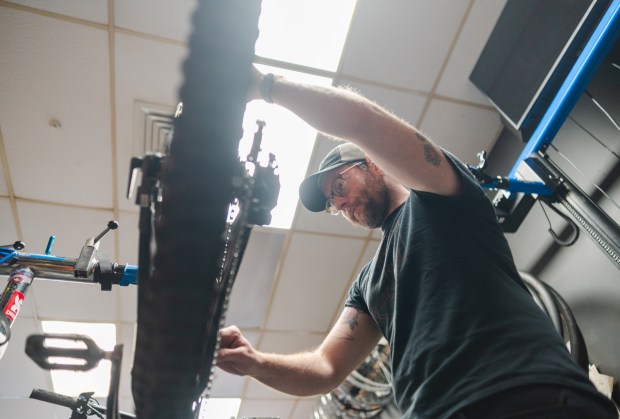
Pottsville Cyclery owner Allen Reinert inspects an e-bike at his shop, Thursday, Nov. 20, 2025, in Pottsville. (MATTHEW PERSCHALL/MULTIMEDIA EDITOR)
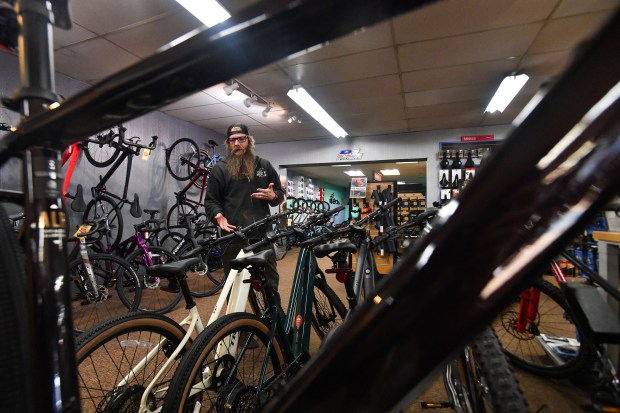
Co-owner of Cedar Bicycle Kyle Brazen shows off some of the e-bikes for sale at his shop in Scranton Wednesday, November 19, 2025. (SEAN MCKEAG / STAFF PHOTOGRAPHER)
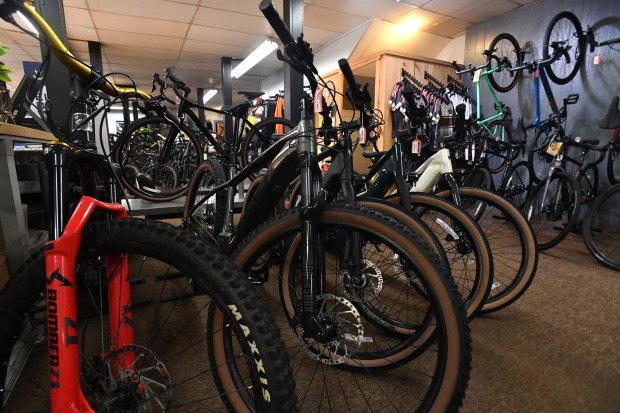
A line of Trek commuter e-bikes sit on the floor for sale at Cedar Bicycle in Scranton Wednesday, November 19, 2025. (SEAN MCKEAG / STAFF PHOTOGRAPHER)
Show Caption
1 of 4
Pottsville Cyclery owner Allen Reinert inspects an e-bike at his shop, Thursday, Nov. 20, 2025, in Pottsville. (MATTHEW PERSCHALL/MULTIMEDIA EDITOR)
Expand
What to expect
For Krzywicki and Yarns, the answer centers on education, respect for and knowledge of the rules on the books, and simple courtesy.
For the bike shop owners, it’s a little bit of everything: Better awareness from automobile drivers, the construction of more bike lanes around the area, greater understanding of the vehicles themselves from buyers and, maybe, some more strict enforcement of state law when rules are broken in a dangerous way.
But the question of what to do about e-bikes and e-scooters is complicated by their reality: They aren’t going away.
As they make being active and outdoors more attractive, nobody particularly wants them to, either.
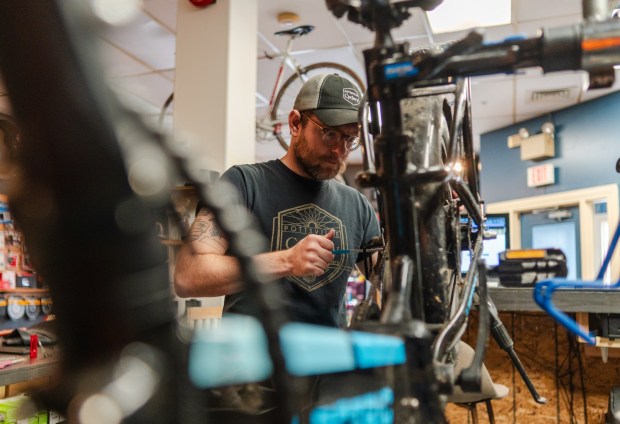 Pottsville Cyclery owner Allen Reinert inspects an e-bike at his shop, Thursday, Nov. 20, 2025, in Pottsville. (MATTHEW PERSCHALL/MULTIMEDIA EDITOR)
“It opens up the door for you to get out there more, to get people who are less likely to get outside to ride,” Brazen said. “Some people may not be able to ride 2 or 3 miles on a regular bike, but they can ride 7, 8 miles now on these and be able to get home safely and not be out of breath. So they’re more likely to ride the next day and the day after that.”
Reinert sees a society stuck in a micromobility purgatory, where some riders either don’t know about or understand laws, and busy law enforcement officers are trying to figure out the best way to enforce them in the meantime.
Still, hope exists that through knowledge and experience gained through their continued growth, e-bikes and e-scooters ultimately will be accepted for what they can be — an environmentally friendly, alternative form of transportation that can be safe and will make citizens more active and healthier in the process.
“There are a lot of growing pains,” Reinert said. “We’re in this middle ground still, where we’re trying to figure out the systems to make e-bikes integrate better in the infrastructure systems that we have.”