
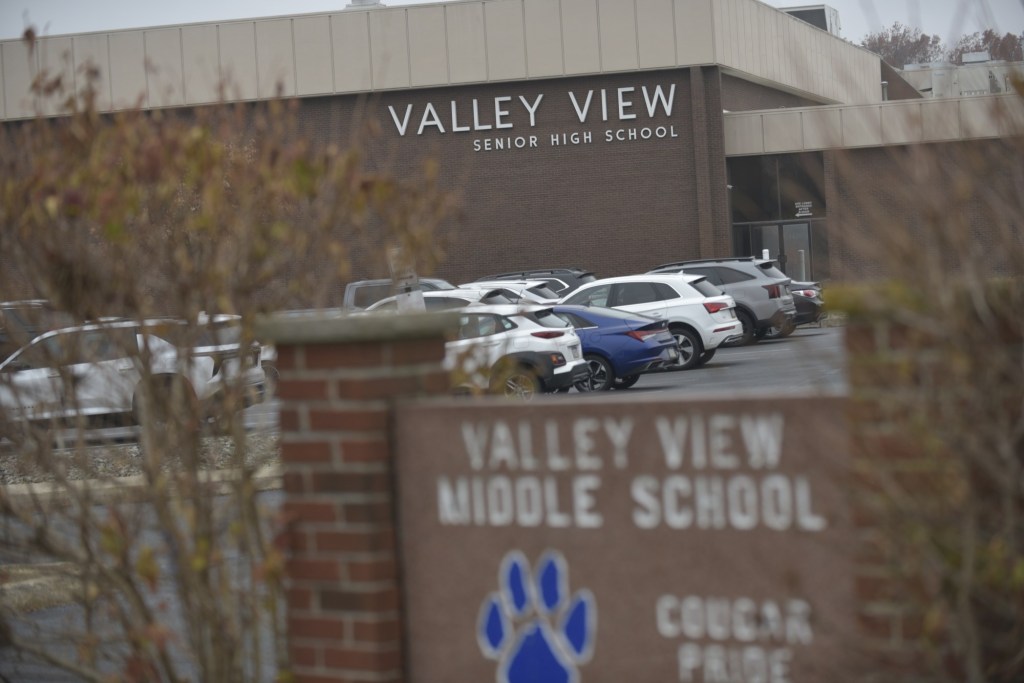
Although the Valley View School District has no control over proposed data centers within its borders, school administrators hope to capitalize on host agreements and tax revenue from the rapidly growing industry in the Midvalley.
District Solicitor Larry Moran Jr. spoke at an Archbald council meeting Wednesday to emphasize the impact that revenue from data centers could have on the financially struggling school district. He also sent the borough a letter on behalf of the district requesting that the borough rezone the entirety of Valley View’s property on Columbus Drive from residential to light industrial, according to a recording of the meeting uploaded to the “Stop Archbald Data Centers” Facebook page and reviewed by The Times-Tribune.
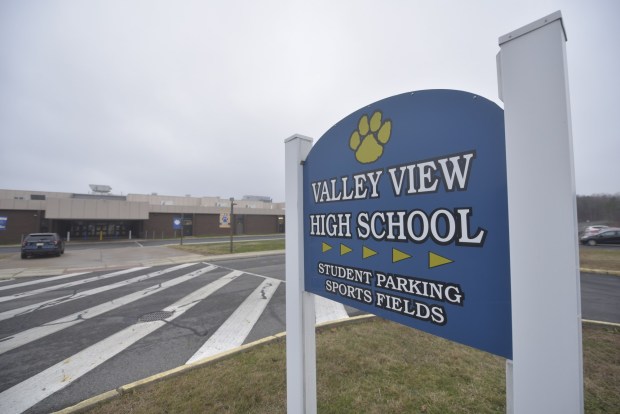 A sign welcomes visitors to Valley View High School on Friday, Nov. 21, 2025. The district sees opportunity for additional revenue as Archbald deals with the potential influx of data centers in the area. The district sent Archbald a letter requesting that the borough rezone the entirety of Valley View’s property on Columbus Drive from residential to light industrial. (CHAD SEBRING/STAFF PHOTO)
The Valley View School District is home to all but one of the eight proposed data center campuses in Lackawanna County, with five campuses proposed in Archbald and two in Jessup. A developer involved with two Archbald data center projects also applied for and subsequently withdrew a request for zoning relief to build up to four data center buildings in Blakely.
The county’s only other data center proposal is a large campus in Clifton and Covington townships.
Out of Archbald’s five proposed data center campuses, four campuses totaling 29 buildings are planned for Eynon Jermyn Road close to Valley View’s intermediate, middle and high schools, attended by students from third through 12th grades. Those four are principally permitted under Archbald’s current zoning, giving developers the most straightforward path toward construction.
Archbald attempted to regulate data centers during a special meeting Oct. 3 when council was supposed to consider a zoning ordinance that defined data centers, designated where they can be built across four “data center overlays” throughout the town and regulated them by establishing conditions they must meet for approval. Council did not vote on the ordinance after a motion to vote failed to receive a second following significant opposition from residents, who urged the borough to further limit where they allow data centers by keeping them across the Casey Highway from homes while also applying even more restrictions.
Council will reconsider its original ordinance during a special meeting Monday at 5 p.m. at the Borough Building, 400 Church St.
‘We don’t have the money’
During his remarks Wednesday, Moran told borough officials that the Valley View School Board asked him to attend the meeting. He asked council to pass the data center zoning ordinance, though he acknowledged he had not yet reviewed it.
“My hope is that it is adopted. My hope is that it is reasonable. My hope is that if I look at it and I agree with it, it is not going to chase development away,” Moran said. “I’m here simply to urge caution, slowing down and avoiding contempt prior to investigation.”
Moran touted his own experience with data centers, including representing the Philadelphia Building & Construction Trades Council and its 42 construction unions, which built two large data centers nearly a decade ago in Montgomery County.
“I had the opportunity in the last six months to look at the tax benefit to the taxing districts in Montgomery County. Those two buildings that we erected, that we haven’t had a single complaint about, that we are proud of, and it’s in the millions of dollars,” Moran said. “So I did the same with the two proposals that are moving forward in Archbald, and then I asked the developer to meet with me, our school district superintendent and our business manager in his office, and I asked him to confirm my understanding of my belief that each of those buildings will produce … close to $5 million for the school district alone, and it was accurate.”
Receiving $10 million from two projects alone would be “desperately needed money” for a district with a structural deficit, Moran said.
“We don’t have the money,” he said. “We have just enough money in our checking account to pay payroll and keep the lights on, but every month we have a debate about canceling or suspending music or art.”
Moran said he also represents a property owner in Covington Twp. who sold 800 acres for data centers and spoke with the developer behind that project. Developers propose to build more than two dozen data centers in a sprawling campus along Interstate 380 in Clifton and Covington townships.
“The tax benefit to the North Pocono School District from that one project will be $62 million a year,” Moran said. “That is more than Valley View’s entire budget.”
In a phone interview Thursday, Valley View Business Manager Corey Castellani repeatedly emphasized that Valley View has no part in the decision making process for data centers — it is up to the boroughs. The district wants to put itself in a better financial situation if the data centers are already permitted, he said.
“If they are principally permitted already, and if they are coming, all we’re trying to do is take advantage and try to get as much money as we could for the district and for the taxpayers,” Castellani said. “If we’re getting an influx of revenue, up to $5 million per data center (campus), that could help us by not raising taxes more or possibly even giving taxpayers real estate tax cuts if we could.”
Castellani said he wants to avoid a situation like the host agreement with Chicago-based Invenergy LLC’s Lackawanna Energy Center natural gas-fired power plant in Jessup, which gave the district $100,000 per year for five years.
“Everybody was fighting against Invenergy,” Castellani said. “In the end, they ended up coming anyway, regardless of all the opposition and everything else, and the school basically got pretty much nothing out of that deal.”
In March 2016, Jessup entered into a community host agreement with the Lackawanna Energy Center. Among the financial incentives, the energy center agreed to pay Jessup a total of $500,000 during the construction period, $1 million annually with 10% increases every decade once the plant commenced commercial operations, and during its first five years of commercial operations, the power plant would pay $400,000 annually as a government services fee, with a minimum of $100,000 during each of those five years going to Valley View.
The funds from data centers would help Valley View’s students, taxpayers and buildings, Castellani said.
“We are struggling financially,” he said. “Every year, our budget goes up, we raise taxes, and we still can’t pretty much break even because our expenses are so high.”
Castellani pointed to costs associated with health care, charter schools, special education and retirement. Valley View brings in about $17 million annually in real estate taxes with a roughly $45 million budget, he said. Other schools in the area have budgets of $50 million to $60 million that bring in $40 million-plus in taxes.
“A windfall of that nature … would drastically change the financial situation of the school district,” Castellani said. “By bringing in more money, it’s going to change the whole structure of Valley View School District.”
Revenue from data centers would give Valley View more money for its contracts with teachers and employees, services, students and programs, Castellani said, explaining the district’s top priorities are safety and education.
Superintendent Brian Durkin echoed Castellani in a phone interview, saying Valley View was left out of negotiations with the power plant and received a “less-than-fair host agreement.” Durkin was not superintendent at the time.
“As the superintendent, I want to make sure that if they are coming, which my understanding is they are, we want to make sure that we try the best we can to get a seat at the table, to make sure that we get the best agreement for our students and faculty as we can,” Durkin said.
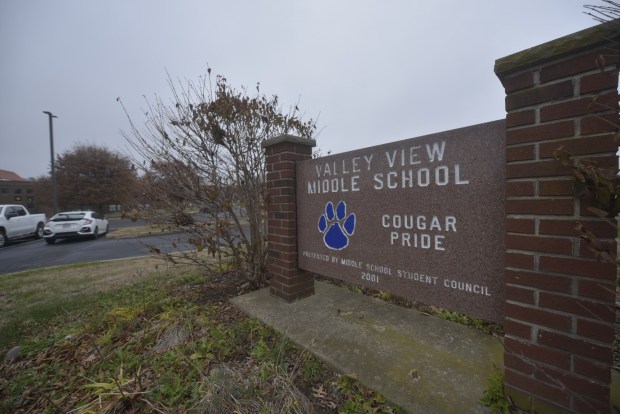 A sign welcomes visitors to Valley View Middle School on Friday, Nov. 21, 2025. The district sees opportunity for additional revenue as Archbald deals with the potential influx of data centers in the area. The district sent Archbald a letter requesting that the borough rezone the entirety of Valley View’s property on Columbus Drive from residential to light industrial. (CHAD SEBRING/STAFF PHOTO)
‘Make the school district more valuable’
In a letter submitted to Archbald, which borough Manager Dan Markey read during Wednesday’s meeting, Moran wrote he was formally requesting a zoning map amendment for Valley View’s property in Archbald to rezone it from a medium density residential district to a light industrial district.
“The Valley View School District strives to provide safe, modern and adaptable facilities that meet the educational needs of our students and the broader Archbald community,” Moran wrote. “As we continue to plan for the improvement and long-term sustainability of our campuses, it has become clear that the current zoning designation does not accurately reflect how this property is used, nor does it support our mission as an educational institution.”
The district’s property is institutional in nature, and labeling it as a medium density residential district is a mischaracterization, he wrote. Valley View’s land also adjoins Lockheed Martin’s property, which is zoned for light industrial, according to the letter.
“As the district continues to modernize and improve its educational facilities, rezoning this property to (light industrial) will more accurately reflect its institutional and campus-style use while allowing the district to pursue improvements that best serve our students and community,” Moran wrote.
Archbald’s March 2023 zoning ordinance defines light industrial zoning as, “To provide for a variety of industrial development, while not allowing for heavy industrial uses that are likely to result in hazards or nuisances. To also allow for complementary commercial uses.”
Permitted uses in light industrial zones include amusement parks, arenas, bakeries, car washes, data centers, hotels, lumber yards, offices, plant nurseries, veterinarian offices, manufacturing uses, hospitals and warehousing. Schools are not permitted in light industrial zones, though Valley View’s buildings would be grandfathered in under their existing zoning. If council adopts its data center ordinance Monday, data centers will no longer be permitted in light industrial zones.
The zoning request stems from a recent Valley View School Board meeting where Moran explained to the board that the market value of Valley View’s properties is based on zoning, Castellani said. Moran told the board that if their property was rezoned for industrial uses, the market value of the property would increase drastically, Castellani said. A majority of school directors asked Moran to move forward with the request, he said.
“The main purpose of that whole thing was to make the school district more valuable,” Castellani said. “We’re not talking about selling anything at this point.”
If Valley View gets a higher market value from light industrial zoning, it will help the district when it takes out loans, such as tax anticipation loans, he said.
“It just makes you worth that much more money overall, which is a positive thing,” he said.
The district is looking to rezone the entirety of its land in Archbald, totaling 170-plus acres, Durkin said.
Asked whether Valley View has had any discussions to sell any of its property in light of seeking a higher valuation, Durkin said there have been no discussions.
Markey was unsure how the borough will address Valley View’s request. He anticipates council will wait until January when its new members take their seats.
To rezone the land, Archbald would have to once again amend its zoning ordinance and map, which involves sending it to the borough and county planning commissions with up to 30 days for comment, followed by scheduling a public hearing and posting affected properties with a 30-day notice prior to holding the hearing. Council could then vote after the hearing, Markey said.
“Aggressively speaking, you’re looking at at least a three- to four-month timeline, and that’s without any potential ordinance review,” Markey said.