
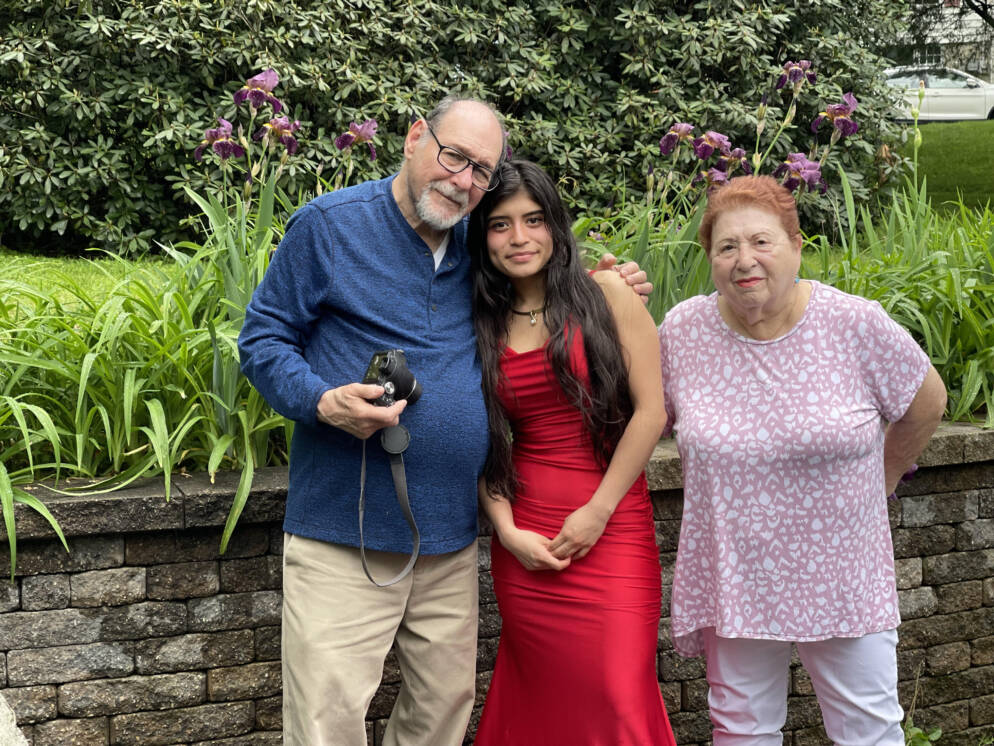
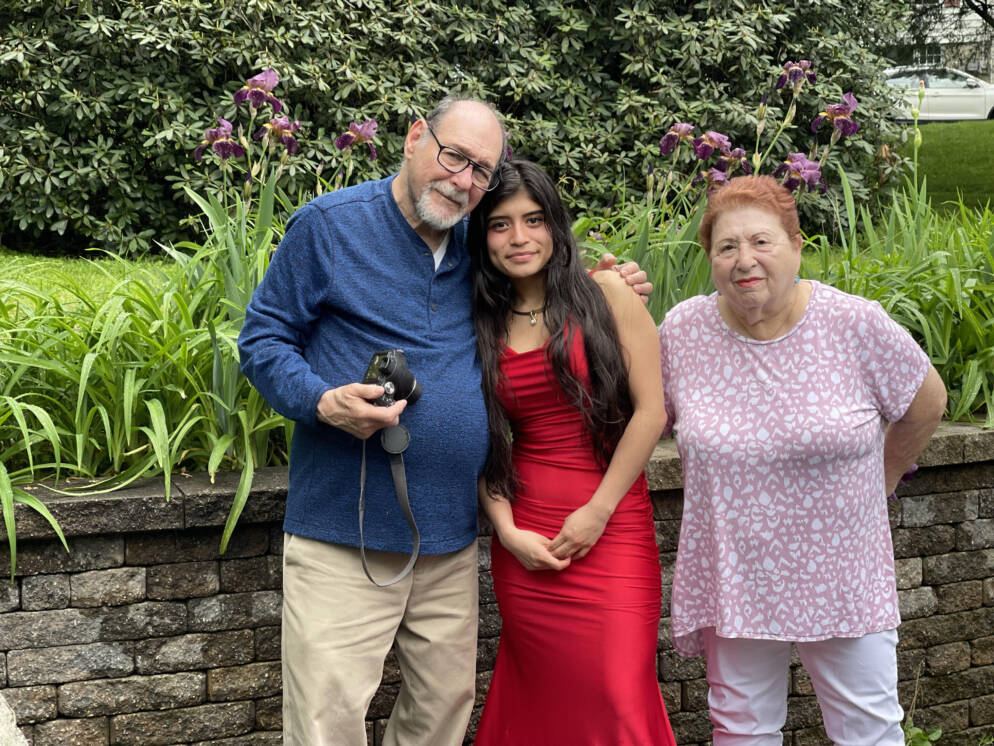
 Irv Schwartz with granddaughter Kathryn and wife Jeannie (Photo credit: Cindy Marselis-Lundeen)
The women in Fox Chase used to say that if you sat in Irv Schwartz’s chair long enough, you’d walk out looking better and feeling lighter. At Curl Cage Beauty Salon — the neighborhood shop he ran for 48 years — customers found more than a hairstylist. They found a listener, a storyteller and a man who made every person who walked through the door feel seen.
“He just genuinely liked people,” said his daughter Wendi Schwartz. “He could talk to anybody.” Friends and family said that instinct to connect — rooted in the Jewish values he grew up with — shaped every part of his life.
Schwartz, a beloved hairdresser, devoted family man, animal rescuer and dedicated Philadelphia sports fan, died on Nov. 12 at age 88.
Born on Jan. 17, 1937, in Asbury Park, New Jersey, Irwin “Irv” Schwartz grew up in a family that moved often. His parents, Abe and Kathryn, bought and sold a series of neighborhood stores. The constant uprooting made school difficult — compounded by undiagnosed dyslexia — but he remained anchored by a large, loving extended family.
When Schwartz was 17, his parents moved to Northeast Philadelphia, where he transferred to Olney High School and met 16-year-old classmate Jeannie Greenblatt. They started dating in 1953, married in 1958 and spent 67 years together. “We were always together,” Jeannie said. “We’ve known each other for 72 years.”
Schwartz began at Temple University’s Tyler School of Art, hoping to become an art teacher. But eager to start earning a living, he shifted to cosmetology, a choice that blended creativity with practicality. In 1966, he opened Curl Cage Beauty Salon in Fox Chase, which quickly became a bustling neighborhood fixture. His wife worked beside him for years, and later their daughter Lisa Fritz joined them before eventually taking over.
“He was a very good hairstylist,” Jeannie said. “But more than that, the customers loved him.” He drove clients home when needed, opened the shop on Sundays for special occasions and nurtured relationships that lasted decades. Some families were with him through three generations. “He loved that shop,” she said. “He loved talking to people.”
At home, Schwartz and his wife raised their three daughters in an atmosphere filled with conversation, humor and constant activity. From a young age, the girls spent time at the salon, washing curlers, brushes and eventually pitching in wherever they were needed. At home, he showed them how to fix things, use tools and play sports. “My father was really ahead of his time,” daughter Cindy Marselis-Lundeen said. “He taught his daughters everything people thought only boys learned.”
Animals were woven into daily family life. Early on they had cockatiels (Australian parrots), cats and dogs; later came rescued greyhounds, including Honey, who was inseparable from Schwartz. Marselis-Lundeen now cares for 42 rescued animals on her farm outside Philadelphia and says the impulse began with her parents. “That started with my father,” she said.
Though not religiously observant, Schwartz identified deeply as a Jew. Jeannie taught Hebrew school at Congregation Beth Chaim and other schools for 35 years, and the couple emphasized Jewish values, holiday traditions and family unity. They visited cemeteries before the High Holidays, passed down stories of their ancestors and traveled twice to Israel, once driving across the country on their own. “He was a staunch cultural Jew and a rabid Zionist,” Marselis-Lundeen said. “Israel was very important to him.”
Those values shaped how he treated people. He had a multicultural family, and Schwartz embraced them wholeheartedly. When Wendi Schwartz came out as gay, he welcomed her without hesitation. “It wasn’t a very open time,” she said. “But he accepted me immediately — and he defended me.”
He followed politics closely, cared deeply about fairness and believed in standing up for others. He canvassed, protested and was delighted to meet Gloria Steinem and Bill and Hillary Clinton. Marselis-Lundeen called him “a social justice warrior who believed your worth was in what you did for others.”
He delighted in storytelling — recounting how he saw Harry Truman and John F. Kennedy campaign in Philadelphia and how he once spotted Muhammad Ali.
Schwartz also filled his life with hands-on creativity. He built a four-story Victorian dollhouse for his granddaughter Samantha, wiring the tiny rooms for lights and furnishing every floor. The basement held his extensive model train layout, a hobby he began at age 10.
His greatest joy was his family. He and Jeannie helped care for many of their grandchildren — Ayanna, Samantha, Chad, Dean and Katie — and doted on their great-grandchildren, Olivia, Violet, Bennett, Emilia and Miles. He took particular pride in Katie’s decision to attend Tyler School of Art, following his early path as an artist.
Those who knew Schwartz remember a man who made people feel valued — neighbors, customers, relatives and strangers alike. He greeted new families on the block, struck up conversations in stores and checked in regularly with people across the country.
“He was very outgoing, very kind, very gentle,” Wendi Schwartz said. “He really was a mensch.”
Ellen Braunstein is a freelance writer.