
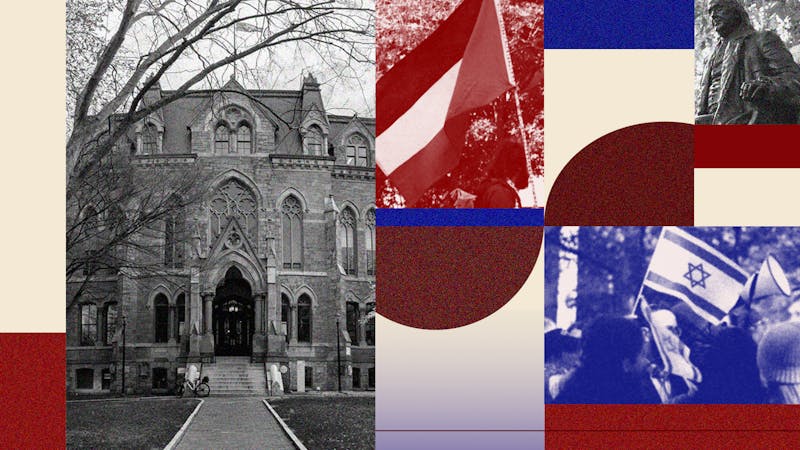
The Arab-Israeli conflict has been a significant campus issue since the state of Israel’s founding in 1948, but the intensity of the discourse has risen alongside a nationwide surge in pro-Palestinian and pro-Israel activism, according to an analysis of Daily Pennsylvanian archives.
Discussions surrounding Israel and Palestine have shaped student activism, administrative responses, and discussion about academic freedom on campus for over seven decades. From early conversations surrounding Israel’s founding to modern disputes over University divestment, the DP found that campus engagement with the conflict has evolved alongside events in the Middle East and shifting national attitudes.
Response to Israel’s founding
The State of Israel was founded in 1948 following decades of Zionist activism that intensified in the wake of World War II, after which the United Nations authorized the creation of a Jewish state in the formerly British territory of Palestine.
Discussions surrounding the new state were already beginning on Penn’s campus. At the time, student panels on “the tense Palestine situation” prompted significant engagement from the Penn community. Students wrote to members of Congress on the issue, and many attended events hosted by Penn Hillel — Penn’s primary Jewish life organization — to discuss politics, culture, and society in the new state, according to DP archival coverage.
Violence in the region increased with the Suez Crisis and diplomatic tensions between Israel and neighboring Arab states.
During the early years of Israel’s history, multiple controversies arose on Penn’s campus.
An International Affairs Association event in 1962 featured then-Israeli Embassy Press Director Uri Ra’anan. Ra’anan was initially scheduled to speak alongside a United Arab Republic representative who later backed out of the event after discovering Ra’anan was scheduled to speak.
In 1966, Houston Hall featured an Arab World exhibit that labeled Israel as the “Israeli-occupied territory of Palestine” as part of its International Week show. Then-Hillel director Samuel Berkowitz called the exhibit “an affront to the Jewish community at the University.” At that same event, an Israeli display featured an “Arab Shepherd,” which showed an “unbathed figure tending to a flock of sickly sheep” and was classified by some Arab students as “affront[ing] their dignity”
“The result was an international shoving and shouting match in the West Lounge,” a 1967 DP article stated.
Student activist organizations began on campus during the same period. The first record of a “Students for Israel” group appeared at Penn in 1969. A year later, the Organization of Arab Students sponsored Penn’s first recorded “Palestine Week,” which coincided with an event on Arab-Israeli “coexistence” hosted by another Penn group, Students for Peace in the Middle East.
University partnerships
1973 marked the start of the Yom Kippur War, a month-long conflict in which Israel fought against Egypt and Syria over territorial disputes. As pro-Israel Penn community members rallied for Israel’s success, then-Penn President Martin Meyerson announced an exchange and research program between Penn and “the seven universities in Israel.”
According to 1973 DP coverage, the program was a “result of two years of work by a faculty study group” chaired by then-mathematics professor Norman Oler.
Exchange programs with Israel continued throughout the 1970s. In 1975, Penn and the Israeli consortium exchanged faculty members for the academic year, with Israeli professors teaching at Penn and Penn professors teaching at Israeli universities. The University also planned a 10-day seminar in Israel for faculty in 1976.
In reviewing archival coverage, the DP did not find evidence of any Palestinian exchange programs during this period. Then-Middle East Center director Thomas Naff did travel to Libya in 1978 to explore the establishment of “student training and research projects” between Penn and the Arab Development Board — which consisted of several Arab states — but no further record in the DP exists regarding the development of this project.
Campus discourse on Arab-Israeli relations continued at Penn as issues of Israeli state legitimacy and whether Zionism qualified as racism were being debated by international organizations. In 1976, an ad in the DP offered to transport students to a protest at the United Nations while it voted on a resolution equating Zionism to racism.
In 1977, Hillel declined to send a representative to an event hosted by the Organization of Arab Students with an Arab League representative to debate whether Zionism was racist. Then-Hillel rabbi Michael Monson called the Arab League speaker sponsored by the OAS a “propagandist” and said Hillel wanted “no part in it.” Hillel similarly protested a Palestinian Liberation Organization speaker sponsored by the Middle East Center the same year.
Then-Middle East Center Director and associate professor of history Thomas Naff said at the time that his group brought a PLO speaker to campus to allow representatives of all parties concerned with the region to air their views.
Heightened conflict
Conflicts involving Israel in the 1980s and 1990s brought increased attention to the region from Penn’s administrators and the broader University community. In one of the earliest recorded public statements from an administrator about conflict in Israel, then-Penn President Sheldon Hackney spoke at a vigil following Iraq’s bombings of Israel during the Gulf War, stating that “Israel had survived war before and would again.”
Hackney also affirmed that Penn would provide “an open forum for the expression of ideas” during the war.
Benjamin Netanyahu — then the former prime minister of the country — spoke at Irvine Auditorium in October 1999, prompting interest from several campus groups. The then-chairperson of Hillel’s Israel Committee described this visit as a cause for “mixed feelings,” while the then-president of the Penn Arab Students Society said the visit was “not a bad thing,” but that “the Arab community would also like to see Arab speakers to give another approach to what is going on in Israel and Palestine.”
The 1995 assassination of Israeli Prime Minister Yitzhak Rabin prompted a peace vigil on campus.
When the Second Intifada began in 2000, the outbreak of violence prompted Penn to impose restrictions on study abroad to Israel, which were renewed in 2002 and 2008. According to DP coverage, several students protested these bans and petitioned for study abroad programs in the region to resume.
During this period, records of engagement with Palestine remained limited, according to the DP’s archival review. In 1996, Penn Abroad began advertising study abroad opportunities in Palestine. While an advertisement in the DP from 1998 specifically mentioned study abroad opportunities at Birzeit University in the West Bank near Ramallah, the DP did not find later mentions of this partnership.
Modern-day student activism
In 2002, Penn community members circulated the first petition for Penn’s divestment from Israel. The appeal called for Penn to divest from defense corporations involved with Israel and garnered around 200 signatures. In contrast, an anti-divestment petition distributed by the Penn Pro-Israel Activism Committee received 8,000 signatures.
Then-Penn President Judith Rodin said that she was proud to facilitate “peaceful and civil discourse” on campus but that she opposed divestment, calling it “much too blunt an instrument for influencing behavior except in extreme cases.”
Her successor, Amy Gutmann, echoed this sentiment in a 2007 statement opposing the boycott of Israeli academics, saying it represented “a direct assault on a core principle of academic freedom.”
By the 2010s, pro-Palestinian activism on campus had significantly increased — aligning with general increased sympathy among young adults in America for the Palestinian cause.
The National Boycott, Divestment, and Sanctions Conference was held on Penn’s campus in February 2012. The conference — which was not sponsored by the University — prompted a surge in pro-Israel activity on campus, including a lecture about Israel by Harvard Law professor Alan Dershowitz and a student discussion initiative called “Israel Across Penn.”
At the time, a Penn spokesperson maintained that the University “laud[ed] freedom of expression” but did not support divestment from Israel.
“I know it’s controversial but I think it’s a really great opportunity,” then-College sophomore Sarah Shihadah, co-president of Penn for Palestine told the DP at the time. “I hope people use this opportunity for constructive dialogue and that they’re not afraid to speak to people they disagree with on the topic.”
Intensifying discourse after Oct. 7, 2023
In 2023, the Palestine Writes Literature Festival — which was not University-sponsored — took place on Penn’s campus in Irvine Auditorium. Penn students and national Jewish groups had pushed for the event to be moved off campus, accusing some speakers of previous antisemitic remarks and saying the event threatened the safety of Jewish students.
More than 2,000 alumni, including several trustees, signed an open letter calling for the University to take additional steps to distance itself from the festival.
Then-Penn President Liz Magill and other administrators declined to move the conference off-campus. In a joint statement, they “unequivocally — and emphatically — condemn[ed]” antisemitism as “antithetical to our institutional values” and that they “fiercely support[ed] the free exchange of ideas as central to our educational mission.”
On Oct. 7, 2023, Hamas militants launched a coordinated attack in multiple areas across Israel, which was followed by a large-scale Israeli military response.
Following the attacks, Wharton School Board of Advisors Chair Marc Rowan publicly called on Magill and then-Board of Trustees Chair Scott Bok to resign due to dissatisfaction with their response to antisemitism, encouraging alumni to terminate donations to Penn.
Later that year, Magill was summoned to speak before the U.S. House Committee on Education and the Workforce regarding allegations of antisemitism at Penn. Her testimony, in which she stated that qualifying calls for the genocide of Jews as hate speech was “context-dependent,” led to widespread condemnation from politicians — including Pennsylvania Governor Josh Shapiro — and Penn community members.
Magill resigned four days after her testimony.
In January 2024, 30 Penn faculty members participated in a “solidarity mission” to Israel, where they met Israeli President Isaac Herzog.
On April 19, 2024, administrators revoked the student group registration of Penn Students Against the Occupation of Palestine, citing noncompliance with University policies.
Less than one week later, pro-Palestinian students and community members erected an encampment on College Green. Echoing past calls for divestment, the demonstration called on Penn to disclose its financial holdings, divest from corporations linked to Israel’s military actions in Gaza and occupation of Palestinian territories, and defend Palestinian students and their allies on campus.
After multiple rounds of failed negotiations and calls for the encampment to end, the demonstration was forcibly disbanded by Penn and Philadelphia police 16 days after it began. Officers in riot gear arrested 33 protesters, including nine Penn students.
In a statement at the time of the encampment’s disbanding, then-interim Penn President Larry Jameson acknowledged attempts at dialogue but said that the University “could not allow further disruption of our academic mission.” Jameson added that divestment from Israeli entities would be “unlawful” given that Penn receives funding from the Commonwealth of Pennsylvania.
“We proposed, and still hope to deploy, Penn’s academic resources to support rebuilding and scholarly programs in Gaza, Israel, and other areas of the Middle East,” Jameson added.
Penn has since created multiple new programs and initiatives in response to campus protest, including Penn Global’s Middle East Distinguished Visiting Scholar Initiative and an Office of Religious and Ethnic Inclusion focused on ensuring Penn can continue to “fulfill its obligations under Title VI of the Civil Rights Act of 1964.”
Staff reporters Rachel Erhag, Skylar Fan, and Ariel Zhang contributed reporting.