
Sign up for the Slatest to get the most insightful analysis, criticism, and advice out there, delivered to your inbox daily.
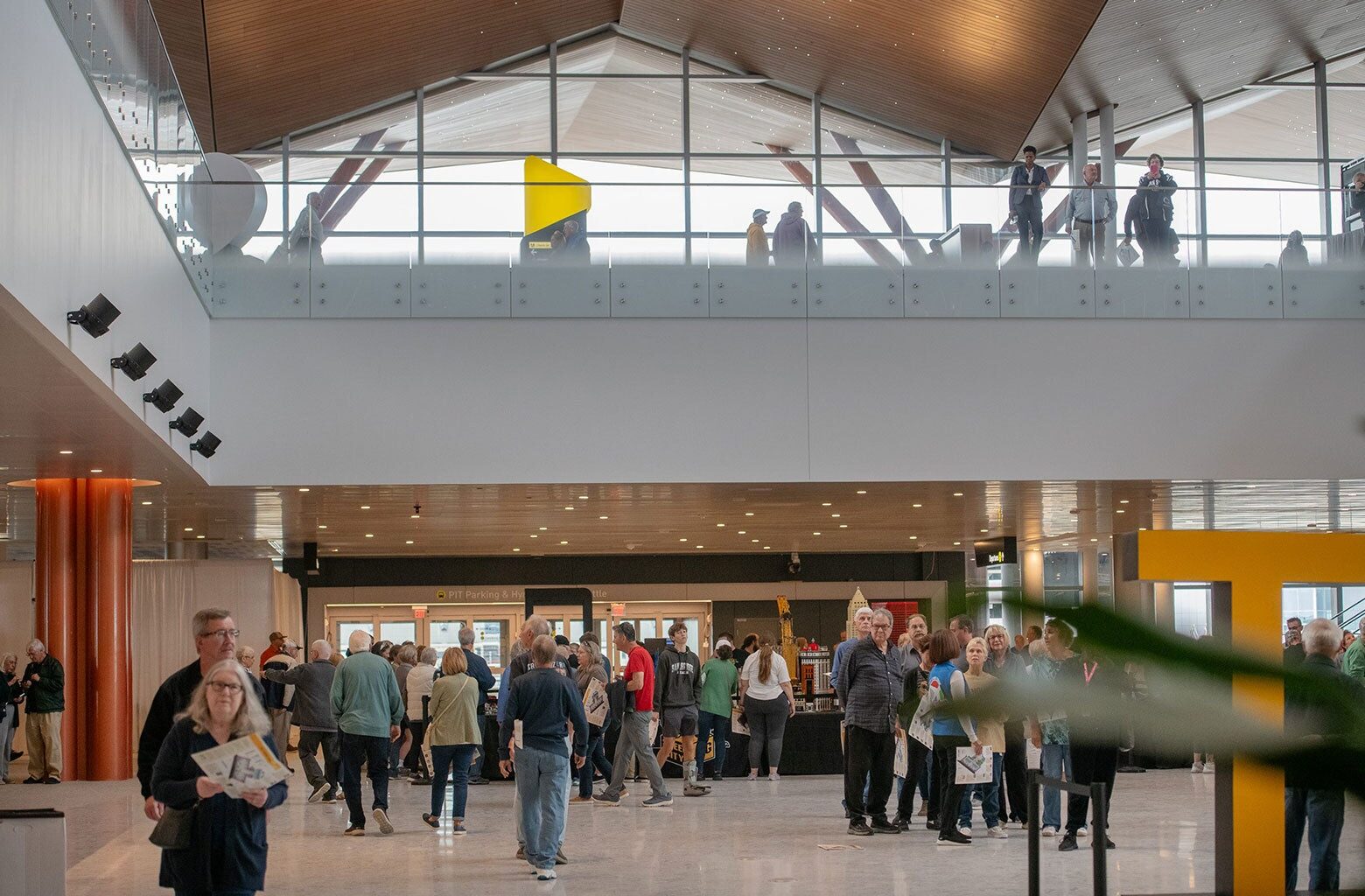
Pittsburgh International Airport opened a new, all-in-one terminal last week, just in time for Thanksgiving. The airport needed it for infrastructure reasons, sure. Its parking situation was inconvenient, bordering on inaccessible, and the journey from curb to gate and vice versa was the airport version of backpacking the Appalachian Trail. But just as much as for convenience and accessibility, Pittsburgh needed a new terminal for pride. It was time for the city and its airport to turn the page on one of the most vile corporate backstabbings in American history.
Pittsburgh International opened in the 1950s, but in 1992, it underwent a transformation. Pittsburgh was a bit more than a decade removed from the collapse of the steel industry, which immediately began to drain the city’s population. As the airport was getting its big renovation in the early 1990s, the New York Times called it “the airport of the future,” a label that adorned signage in the airport for decades afterward.
The airport was to be a driver and symbol of the whole region’s evolution. “Planners hope the terminal, with its vaulted ceilings and driverless underground trains, will complete an image transformation begun decades ago,” the Times story said. “Once known as a gritty old steel town of blue-collar workers, Pittsburgh has become a commercial center of office towers and high-technology industries.” That reinvention has continued apace in the 33 years since the terminal opened. But even as a tech, robotics, and health care hub, the area has three-fourths the population that it did in 1970. And no place was a worse reminder of what Pittsburgh had lost than this airport 20 minutes west of downtown.
A big part of the problem was that Pittsburgh built that airport with one client in mind: US Airways, a major carrier that two of the du Pont brothers founded in Pittsburgh in 1939. The airline based its operations in Pittsburgh until 1988, when it acquired an airline with a hub in Charlotte, North Carolina. But the new airport brought USAir home, and the city regained its former status as the airline’s largest hub. “We built it for USAir,” Allegheny County executive Rich Fitzgerald said many years later, “hoping that they would grow jobs here, putting their hub and their headquarters here.” Allegheny County put $42.5 million into the build. Pennsylvania put in $85 million, and the Federal Aviation Administration chipped in $101 million. But the airport’s biggest funding source, by orders of magnitude, was $600 million in county bonds, which the county would, of course, have to pay back. The plan was that USAir fees would cover the bulk of those payments over the next few decades. Everyone felt pretty good about this arrangement at the time. The Times story that bestowed the “airport of the future” label quoted an economic development specialist who called the airport “the single greatest economic generator this area has seen.”
As a major airline’s biggest hub, Pittsburgh would be taking a piece out of millions of travelers who weren’t even staying in Pittsburgh, and it would also get a tourist boom from people who suddenly had an ultra-easy way of visiting. Before Sept. 11, 2001, the Pittsburgh Post-Gazette reported, USAir was running 542 daily flights in or out of Pittsburgh. As airline-airport relationships go, this was a huge one. (Today, for example, Delta peaks with about 330 daily flights leaving Minneapolis, its No. 2 city.)
Then, US Airways fucked over Pittsburgh very, very badly.
For a while around the turn of the century, USAir’s business was struggling. The company’s routing and fleet management were inefficient, and rising competition had squeezed its revenues. It lost $2 billion in 2001, with the vast majority of its problems predating the Sept. 11 attacks. The Justice Department quashed a planned merger with United in the summer of 2001, a few months before the attacks sent the entire airline industry reeling.
USAir’s crisis continued through the decade and shaped its dealings with Pittsburgh. Repeatedly, USAir sought perks and incentives from local government and the airport. The airline didn’t pay much mind to the hundreds of millions of dollars in county bonds that depended on it. In 2003, Gov. Ed Rendell offered up a $264 million incentive package designed to placate USAir by improving facilities in both Philadelphia and Pittsburgh, but the airline didn’t bite, at least not exactly. USAir filed for bankruptcy in both 2002 and 2004, and as it survived in a reduced form, it continually distanced itself from Pittsburgh. Though Rendell got USAir to put a flight operations center in nearby Moon a few years later, the airline was still broadly pulling back from Pittsburgh. The airport was downgraded to a USAir secondary hub, then a “focus city,” then, eventually, nothing special at all. In 2015, US Airways ceased to exist on its own and merged into American Airlines.
USAir’s betrayal was a particular nightmare given how the airport’s facelift had been funded. Of the $62 million in debt service payments the public had to make each year, $50 million had been coming from USAir, the Pittsburgh Tribune-Review reported in 2003. The county executive explained the options: default, or refinance the bonds at a cost of $400 million to Allegheny County. Taxpayers were suddenly holding the bag. Local officials tried all sorts of things to revive the airport. In 2010, the airport spent $300,000 on a marketing campaign to persuade Ohioans to cross the state line and fly in and out of Pittsburgh. The airport also explored an approach that had worked wonders for Dallas Fort Worth International Airport: allowing natural gas exploration on airport property.
The airport’s location on the Marcellus Shale turned out to be a lifeline. In 2013, western Pennsylvania–based Consol Energy paid a $45 million signing bonus to the airport for the right to hunt for gas on its property. The airport’s plan was to get an additional $450 million in royalties over the next 20 years. That deal prevented a default on the bonds, but has not been nearly as lucrative as hoped. The airport has also diversified, moving away from being USAir’s pet and toward getting as many flights from as many airlines as it can. Earlier this year, American—which, ironically enough, absorbed USAir—added a daily route between Pittsburgh and Los Angeles, something I’ve appreciated since moving out West. (Previously, I had to take a red-eye on Spirit, a harrowing experience.) My English cousins-in-law can now go direct between Pittsburgh and London Heathrow. That route had been gone for 20 years.
One problem has been hard to escape, though: The airport being too goddamn big. Pittsburgh’s one X-shaped terminal had 75 gates and was meant to accommodate 35 million passengers per year, rather than the roughly 10 million it has been getting in a post-USAir world. The oversized terminal had its benefits: Long stretches of empty gates were great if you were flying with a small child and wanted to let them sprint down a wide, empty hallway and use vacant gate chairs as a jungle gym to tire them out.
But the oversized airport was a bleak metaphor for a city that was once more bustling and then got let down—first by the shriveling of the steel business, then by USAir itself. The cavernous, quiet terminal created a bad feeling upon landing at home, like you had just entered a place that wasn’t what it used to be. It wasn’t a good way to be welcomed to a city, whether you lived there or not.
It can’t be overstated how much the point of the new airport is to simply move Pittsburgh past this corporate pantsing by US Airways. Yeah, there are practical logistics reasons for an update. As the airport authority chairman said in announcing the project back in 2017, airlines would face lower costs, and the facility would be “very efficient and modern.” But then he got to the point: “And, finally, this is most important for me, the people of Pittsburgh finally get an airport that is built for them, and not USAir.”
The old terminal’s fate is uncertain. It might be repurposed into something, or maybe not.
The new terminal—it’s really a new airport, because there is just one terminal—is right-sized. It has 55 gates, a reduction of 27 percent. Its $1.7 billion cost is again being mostly financed by bonds (as well as some federal money), but this time it’s got three anchor airlines and three separate bond rating companies saying that everything looks to be on the up-and-up. The county piggy bank is not being raided, although public bonds still represent a subsidy and the assumption of some public risk.
Though the state and region tout plenty of benefits to this project, the pitch for the new airport is not as sweeping as the 1992 renovation. Yes, it’s about putting the city’s best foot forward when big events, like the 2026 NFL draft, come to town. But it’s also about giving Pittsburghers a more pleasant traveling experience and, implicitly, moving on from the husk of an airport that US Airways left behind.
The new airport will not be like the once named airport of the future. The old Pittsburgh International had a truly hilarious process to get people from their cars to their planes. What it lacked in a rail option to get people to the airport, it for some reason had as a requirement for getting people from the TSA line to the actual terminal. The airport’s underground train was an anomaly for a place that had 40 percent as many gates as, for example, Hartsfield-Jackson in Atlanta.

N.C. Stevens
Restaurants in Boston and Philly Have Finally Gotten Some Michelin Stars. The Reason Why Should Give You a Stomach Ache.
Read More
I was terrified of this train and its dark tunnel as a kid, and though I came to like it as a quirk in adulthood, I cannot argue with the new airport not requiring such an ordeal. The new terminal has a much bigger and better security-lane setup, which should alleviate the legendary bottlenecks caused by a cramped space at the bottom of an escalator in the old venue.
Every Year, We Get Gifts From Clients for “the Whole Office to Enjoy.” Get a Load of What My Boss Does With Them.
A Controversial Technology Makes Moms Like Me Possible. Some Scientists Aren’t So Sure if We Should Exist.
It Turns Out Lindsey Halligan Was a Fake Prosecutor All Along
Dear JAG: What Do I Do if I Get Unlawful Orders to Blow Up Civilian Boats
It will lack some of the old terminal’s soul, unfortunately. While I appreciate that the airport has relocated its famous statue of Franco Harris’ Immaculate Reception to the new digs, my understanding is that the old terminal’s T. Rex skeleton did not make the trip. The new build will probably be just a little bit too nice to create the same nostalgic, us-against-the-world feelings inspired by the old one. I haven’t flown into it yet, but I was relieved to meet an architect on the project at a wedding this summer. She informed me that she spent weeks sourcing a specific shade of yellow paint to use on the trim of a walking bridge in the new terminal, designed to match downtown Pittsburgh’s bridges.
The bridge will be a less time-consuming, less claustrophobic way of moving about the airport. That ridiculous train is gone, but long may it live in our hearts. And long may US Airways be dead, even as it now exists in a reduced form within American Airlines. May none of the ghouls from that disgraceful company get to enjoy so much as a single nice breeze on the new airport’s two acres of outdoor terraces.

Sign up for Slate’s evening newsletter.