
By Jack Tomczuk
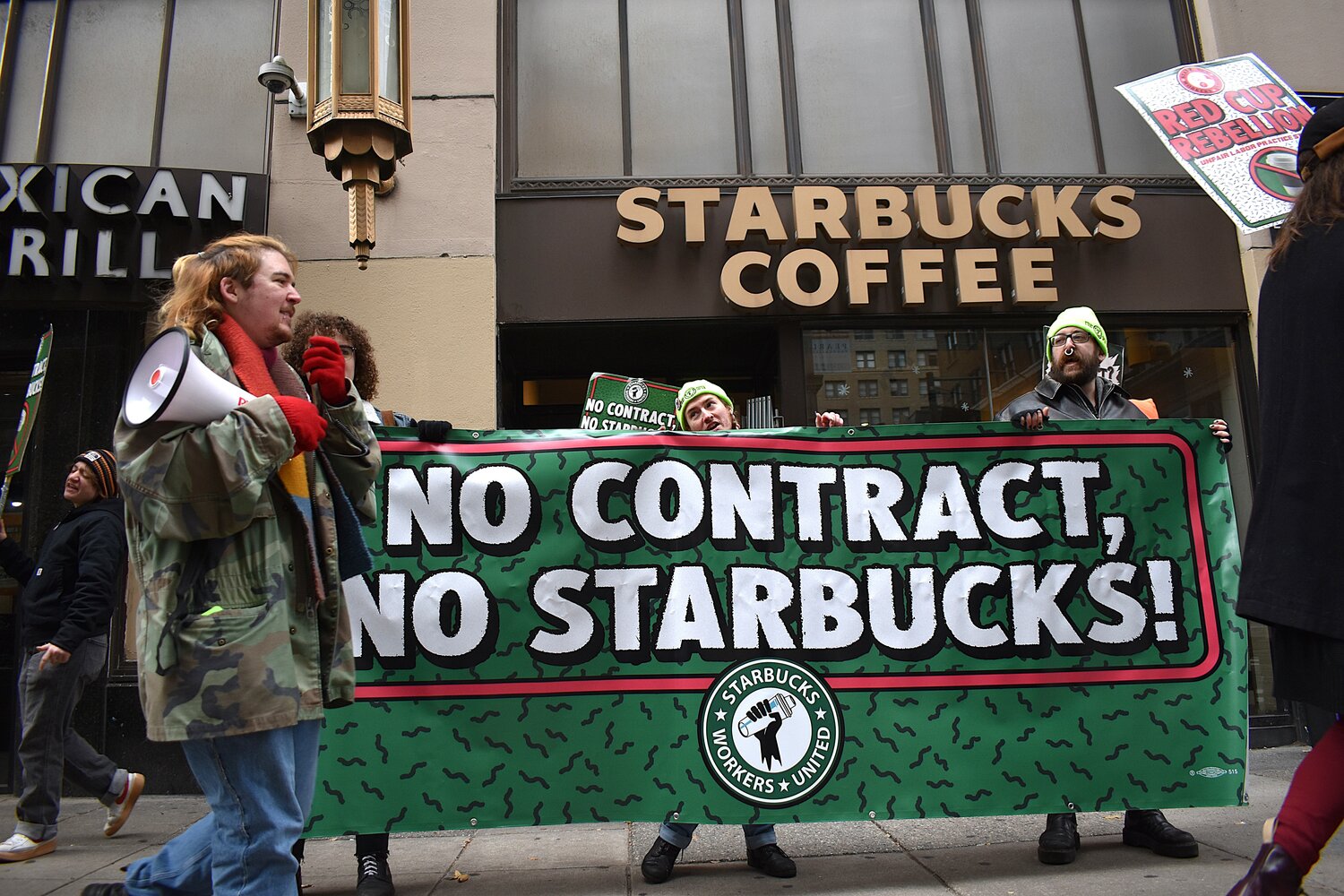
Striking baristas at Starbucks locations in Philadelphia are vowing to remain on the picket line for as long as necessary, as a nationwide Workers United work stoppage nears the end of its second week.
“It is strictly up to the company to come back to the table, and we’ll end our strike,” said Tony Schultz, a shift supervisor at the coffee chain’s Chestnut Hill location. “We want to be at work. We want to be back working.”
Starbucks Workers United launched the strike on Nov. 13 to coincide with the corporation’s Red Cup Day, a promotion designed to draw in customers at the start of the holiday season. Union representatives said 2,000 baristas from 95 stores in 65 cities have joined the demonstrations. There is no set end date.
Jaci Anderson, a company spokesperson, said 99% of the 17,000 Starbucks shops in the United States remain open.
“Regardless of the union’s plans, we do not anticipate any meaningful disruption,” she added, in a statement. “When the union is ready to return to the bargaining table, we’re ready to talk.”
Economic concerns appear to be the sticking point. Management says Workers United has proposed a 65% immediate salary increase and 77% over three years; however, the union said that is a mischaracterization.
Average pay nationwide for hourly staff is more than $19 an hour, according to Starbucks. That number rises to $30 when accounting for health benefits, tuition coverage, paid leave and other perks, officials said.
Saoirse Shields, a barista and trainer at a Starbucks in Center City, said those benefits, which the company touts as the best available in retail, are only for employees who work at least 20 hours a week. But she told Metro that baristas are often scheduled at 19 hours to duck that threshold.
Workers United also wants Starbucks to resolve the hundreds of outstanding unfair labor practice cases that it has filed in recent years accusing the company of retaliating against employees for organizing and other alleged union-busting tactics.
The union has been pushing for its first contract with Starbucks since it began representing baristas at some locations four years ago. Last year, negotiators for the sides were able to reach an agreement on 33 issues, though talks later broke down – leading to a 2024 Christmastime walkout – and have not occurred since April.
Officials from Workers United said the organization represents 11,000 Starbucks staff at more than 550 stores, though the company contends the union has about 9,500 members.
Seven locations in Philadelphia are unionized, a number that has dropped due to recent closings. Starbucks operates more than 40 shops within city limits, including counters inside larger stores, such as Giant and Target.
“We’re fighting for everyone, regardless of whether or not they’re out here – every worker, union, non-union stores, service workers all over,” Shields, who has worked at Starbucks for nearly seven years, said. “We’re interested in raising the bar for the entire industry.”
Though the strike has disrupted operations at some unionized stores, the Starbucks at 16th and Walnut streets in Center City remained open Tuesday morning as Shields and others marched outside. They tried to discourage customers from entering the establishment, handing out leaflets with QR codes for a pledge to boycott the chain until a contract materializes.
Several passing drivers beeped their horns, including those operating a pair of SEPTA buses. Transport Workers Union Local 234, which represents the authority’s drivers, recently voted to authorize a strike.
“People in Philly, a majority, (are) very pro-union, and it’s been fantastic to hear the support,” Shields said.