
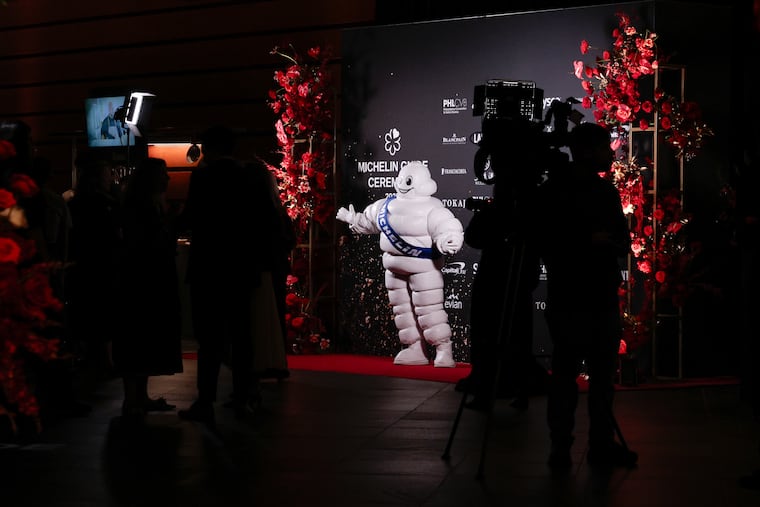
Last week was a busy one for our food desk: Michelin announced its first-ever stars and honorees in Philadelphia’s food scene, a much-anticipated reveal sandwiched between The Inquirer’s inaugural food festival and Thanksgiving week. To cap it all off, we solicited subscribers’ questions on our site. No surprise, there were lots of Michelin questions, along with a slew of requests for restaurant recommendations.
Our team had answers. Read on for our musings on Michelin, where Philly’s restaurant scene is going, and staff picks for red gravy joints, BYOBs, and Philly’s best roasted duck.
Michelin machinations
Can you give us an idea how much the [Philadelphia Convention and] Visitors Bureau had to pay Michelin to come to Philadelphia? It was shocking to find out these awards are “pay to play,” but now I understand why decades of world-class dining in Philadelphia have never garnered a Michelin star until now. Is it possible James Beard awards are more highly regarded, which I doubt, since they are not pay to play.
Michael Klein, food & dining reporter: We don’t have any idea how much Michelin was paid. As a private nonprofit, the Philadelphia Convention & Visitors Bureau does not have to release that. It’s rolled into its budget, and it likely will be rolled into unspecified marketing fees. Its most recent tax return, which covered July 1, 2023, to June 30, 2024, was filed in February 2025. The deal for this year’s other new Michelin city, Boston, also was not made public; one report pegged it as over $1 million for the three-year partnership. Typically, small markets and individual cities pay $70,000 to $300,000 per year, typically in three-year deals. For the 2025 American South regional guide that came out Nov. 3, cities and states across the South collectively are contributing $1.65 million per year for three years (about $4.95 million total).
Why wasn’t Mawn recognized by the Michelin Guide? Are you surprised by fact there was no recognition for Mawn?
Jenn Ladd, deputy food editor: Michelin’s decision-making is famously secretive, but we are operating with an informed assumption that an inspector could not get a table/reservation there (or perhaps couldn’t get more than one, since they are supposed to make repeated visits) and so did not include it. You can find more thoughts in our writers’ reactions to the Michelin picks.
As a team, we definitely were surprised by that choice. While it’s understandable (to at least some on the food desk) that Royal Sushi’s omakase wasn’t considered due to how difficult it is to get a reservation there, Mawn’s lunch is walk-ins only. Will you have to arrive early and wait in line? Yes, but it’s not impossible to dine there without connections. Hopefully next year, Michelin’s inspectors have a longer timeline during which to consider our city’s food scene.
Is there a general concern that higher-end restaurants will get even more expensive and perhaps “one-dimensional” in a way in striving to impress Michelin with more tasting menus and the like? What do we not want to see in prospective changes?
JL: This is a concern we share. As Craig wrote earlier, “My only hope is that restaurateurs keep cooking from the heart, and that they don’t alter what they do simply in pursuit of a star.”
We were heartened by the fact that Michelin gave such a spotlight to Her Place Supper Club, which had a characteristically Philly start (from Penn dorm room to BYOB pop-up residency to full-fledged restaurant). I also think there are plenty of restaurant chefs and owners in Philadelphia who aren’t aspiring to Michelin-star status, who just want to cook good food for people. I’m an admitted Michelin skeptic, but even I would have to say, I don’t think Philly will lose its restaurant-scene identity anytime soon, even if we do see more awards-bait menus.
If each of you could pick your top 5 restaurants that didn’t make any of the Michelin Philly selections, what would they be?
Bea Forman, food & dining reporter: First off: There’s a lot more than five restaurants I wish Michelin would’ve selected. All the honorees are so deserving, but I couldn’t help but feel like the Bib Gourmand selection especially painted a white-washed version of Philly’s dining scene. They hit up at least three cheesesteak places but couldn’t find it in their hearts (or stomachs) to find a gem in Chinatown? Or a Vietnamese restaurant? Or more restaurants that speak to Philly’s rich tradition of excellent Mexican, Latino, and African food? Lame. Tomato. Tomato. My five picks for Bibs or recommendations would be:
Hira Qureshi, food & dining reporter: I’d love to have seen these five/six restaurants get a Bib or Recommended: Amsale Cafe for their beautiful injera-lined platters with kitfo and gomen wat; Samson Kabob House for their insane chapli kababs alone; and Kabobeesh for their mutton karahi that’s just as good as my mom’s. Apricot Stone or Al-Baik Shawarma & Grill have the best hummus and falafels in Philly. And Black Dragon Takeout really does nail personality like no one else in the city.
A saturated restaurant scene?
There are so many good and great restaurants in the city — many moving into neighborhoods that are still deep into renovation/gentrification (i.e. near the York/Dauphin station for example), and there are quite a few empty seats especially on non-prime evenings. Is the Philly restaurant scene reaching a point of saturation?
JL: Hard to speak for our entire team on this one, but my best guess — from years on the food beat here and from reading my colleagues’ work very closely over the past 7 years — is not a chance. Year after year, there have been more restaurant openings than the last, even post-pandemic. There IS more out-of-town interest in opening in Philadelphia (a theme that’s been building all year and is sure to play out more in 2026), which could affect our restaurant scene in all sorts of ways.
We are seeing fewer BYOBs open and more capacious, expensive restaurants, but there are plenty of neighborhoods left in Philadelphia — I live in one! — that could use more restaurants. I for one hope that as the rents go up in the saturated neighborhoods, the scrappy entrepreneurs and chefs that have defined our culinary scene start to consider properties in those pockets of town.
Craig LaBan, restaurant critic: I think only time will tell on this question. There is a lot of new construction going up in these very neighborhoods, and some extremely ambitious restaurants to match. I’m thinking of Fleur’s, for example, which is farther north than many of the earlier Fishtown hits. It was quite the midweek night I visited, but that is totally normal for a new restaurant. Once it starts to get press and social media buzz, if it is positive, that will change. They have to be well-capitalized to weather the storm of early months as they build their audience. If they do a good job, Philly diners will come. Restaurant-goers’ enthusiasm for excellent new places, in fact, almost always helps boost gentrification.
Helm, for example, was one of the few destinations on its block, save for a good neighboring taqueria, when it opened there… Now it is completely surrounded by new development. Same for Que Chula es Puebla at Second and Master. The new Honeysuckle is dealing with the same dynamic on North Broad Street. It is very much a residential neighborhood in progress of being built. It’s all about timing, capitalization, and performance. So far the quality the food is there for Honeysuckle. Hopefully the business will follow.
Restaurant recommendations
As an old-timer, I go back to the days of the great Django with BYOs. Are there some underrated BYOBs that didn’t make your 76 list?
JL: There are quite a few — 76 spots gets awful tight when you’re considering the full range of the Philly region’s restaurants! Illata in Grad Hospital, Little Fish in Queen Village, Helm in Kensington, and Elwood in Fishtown, not to mention a slew of suburban gems like Spring Mill Cafe in Conshy, Maize in Perkasie, Charcoal in Yardley, for starters.
In addition to Dante and Luigi’s, what other old school “red gravy” joints have best survived the passage of time?
MK: Ralph’s, Victor Cafe, Villa di Roma. You might also count Ristorante Pesto, whose owner Giovanni Varallo had the long-ago Io E Tu on Passyunk. (Craig LaBan adds: “Scannicchio’s! But technically a ‘post-red gravy’ generation restaurant, not unlike Pesto.”)
Where are the best places in Philly for college students to eat at? (Besides food trucks)
BF: Penn class of ’22 grad here, so I would be silly to not shout out our campus bar Smokey Joe’s for having sneakily excellent and oversized pizza and burgers. If you go for lunch or dinner early in the evening, it’s kind of the platonic ideal of a dive bar.
Otherwise, you and your friends should be taking advantage of happy hour deals throughout Philly and far, far away from your campuses. Food is cheaper that way. My faves:
Rosy’s Taco Bar: Happy hour is 3 – 5 p.m so it’s always been mostly other college students. Everything is $5, and deeply reliable.
Sampan: Very yum pan-Asian small bites all under $10. Split a scorpion bowl with your friends if everyone is of drinking age.
La Chinesca: This is for when you want to feel classy and cool and adult, eating tacos from a retrofitted mechanic’s shop.
Harp & Crown, Giuseppe & Sons, and Bud & Marilyn’s all felt the right amount of fancy for a college student for happy hour. Very solid small bites, lots of young people.
If you are actually looking for places to to eat and not experiences with good enough food like I wanted in college, I would recommend just exploring Reading Terminal Market and a lot of the mom-and-pop or hole-in-the wall restaurants in Chinatown and the Italian Market. You’ll feel like you actually live here.
Is it fair to say that the very best roasted duck in Philly is sold at Ting Wong on 11th Street in Chinatown??
CL: Ting Wong reopened earlier this year after a short closing and everyone rejoiced because it’s such a neighborhood standby for Hong Kong-style noodles, soups, and BBQ meats — including a stellar roast duck. It’s still very good, but I’ve long been a bigger fan of two others in Chinatown: Siu Kee, the takeout-only duck shop just across 10th Street from Ting Wong, which supplies many of the best restaurants in Chinatown with their ducks (including Tai Lake, which I revisited this year), but also Lau Kee, a cozy little storefront on the 900 block of Race Street owned by the longtime former duck chef of Sang Kee. It’s great!
One more: While these previously mentioned shops are examples of the savory, marinated Hong Kong duck style, a newer entry called Beijing Peking Duck and Seafood Restaurant on Arch Street makes one of the best Peking-style ducks I’ve had — with a cracker-crispy golden skin that gets carved dramatically tableside. You have to order a whole duck, but it is an event worth the splurge.
I miss Gigi Pizza and Nomad Pizza so much. Are there any casual pie spots with great sides and salads like them in Center City or in the works? Vetri Pizza is missing something lately and Pietro’s is good but Rittenhouse gets SO crowded anymore…
MK: Gigi and Nomad had a good thing going. A little fancier is Sally at 23rd and Spruce Streets, which just was awarded a Bib Gourmand by the Michelins. Charcuterie boards, fab meatballs, really nice salads (the green salad with miso and pickled shallot), and crispy pies, like the Loud Red, whose arrabbiata sauce is perfect for the spice fans… Wilder at 20th and Sansom has a raw bar, a few salads, and seasonal wood-fired pies, like the lamb bacon…. Clarkville at 43rd and Baltimore has a warm cauliflower salad that supplements the pizza list… I’m also really fond of the new-ish Corio at 37th and Market, not only for the pizza, pasta, and salads, but the inviting vibe.
When I lived and worked in Philly in the ’90s, Caribou was near the top of my dining list. The menu still looks fine. What is your take on this restaurant?
CL: Caribou is still kicking! This Center City standby — going on 33 years in its current Walnut Street location — had a change of ownership over a year ago, with chef Townsend Wentz’s group taking it over. I’ve not been since a solid lunch in the early weeks of Wentz’s takeover, but here’s a few basic observations: They’ve largely kept the classic brasserie vibe intact, including that fantastic long bar with its art deco statuettes, and they’ve simply made an effort to update and improve some of the classic French bistro fare. Wentz is good at that, and I loved the initial French onion soup I tasted there. But I’d like to return for a check-in. As the weather gets cold, a good stewy plate of boeuf bourguignon or a hearty choucroute garnie sounds good to me. But you never know until you go. With the unfortunate closing of Bistrot La Minette last year, Center City needs all the great French bistros it can hold onto.