
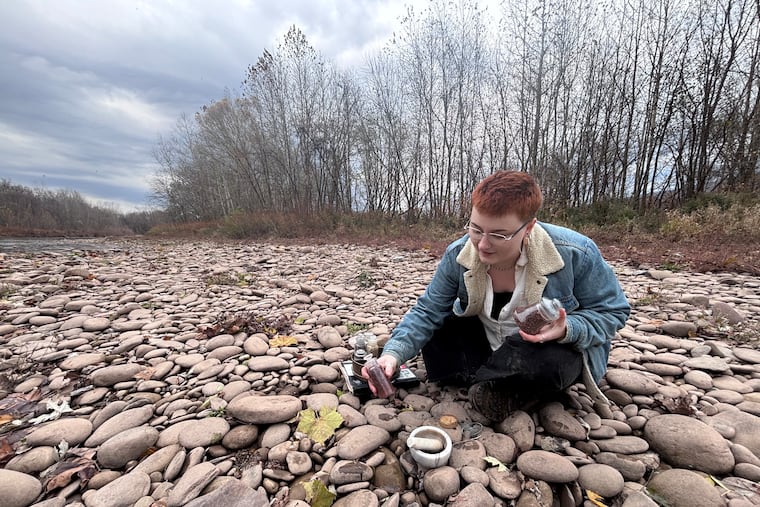
Montoursville, Pa. — The rocky shores of Loyalsock Creek looked a bit drab to the untrained eye on a blustery, overcast November afternoon.
There were browns and grays, along with flurries of yellow and orange leaves across the turbid water when the wind whipped through the trees.
Sierra Weir, an artist from Pittsburgh, stepped gingerly across the mud and rocks. When she got to the water’s edge, Weir saw the landscape in a completely different way, through an artist’s eyes.
“It’s not as visually stunning as synthetic colors, but I would say the depth and variation within one tiny spectra is so much deeper,” she said. “I’ve gained such an appreciation for all the different ways brown can be brown.”
Weir, who has a background in biochemistry, is a pigment artist and community outreach coordinator for the Three Rivers Waterkeeper, a nonprofit organization in Pittsburgh that advocates and protects the Monongahela, Allegheny, and Ohio Rivers.
In June, the Pennsylvania Environmental Council, selected Weir and two others for its new artist-in-residency program, “Reflections through Art: Inclusive Access on Water Trails in the Susquehanna Basin.”
“It’s a new way to get people to engage with the environment,” Weir said.
Painter Spencer Verney of Coatesville was also chosen as a resident by the PEC. He focuses on preserved lands and protected waterways in historic settings. Meg Lemieur, of Port Richmond, was chosen to illustrate a map for the Swatara Creek Watershed.
“My art celebrates the diversity and amazing features of the natural world,” Lemieur told The Inquirer. “I’m definitely drawn to all the living animals, including animals of the watershed like turtles, owls, and gophers, but lately I’ve been getting more into flora and understanding plants.“
Tali MacArthur, a senior program manager for the PEC, said the residency program was created as another way to get the public involved in watershed conservation.
“There are people who don’t really see themselves as scientists or fishermen, but maybe they see themselves as artists, as musicians, or visual learners,” MacArthur said. “I’ve kind of been chasing this approach for some time now.”
The residency program was funded by the National Park Service’s Chesapeake Gateways Grant Program and the Pennsylvania Department of Conservation and Natural Resources Community Conservation Partnership Program.
When Weir was in college, in Ohio, she spent a year studying the pigments of Betta fish and contributed a sculpture based on the majesty of jeweled beetles. She’s also created various paintings made with natural pigments like goldenrod, black walnut, and pokeberry, which fade quickly.
“It’s in opposition to synthetic pigments which are made from petrochemicals and I do a lot of work to reduce pollutants,” she said. “This was a natural fit.”
Weir, 28, said her goal of combining art and waterways was to help people hone their “noticing skills” and provide new ways to engage with the environment and, perhaps, repair broken connections to the natural world.
“What I do is help people notice the relationship between water, earth, plants, and themselves and how inherently connected we are to this place,” Weir said. “We’re made of this same stuff, biologically and chemically.”