
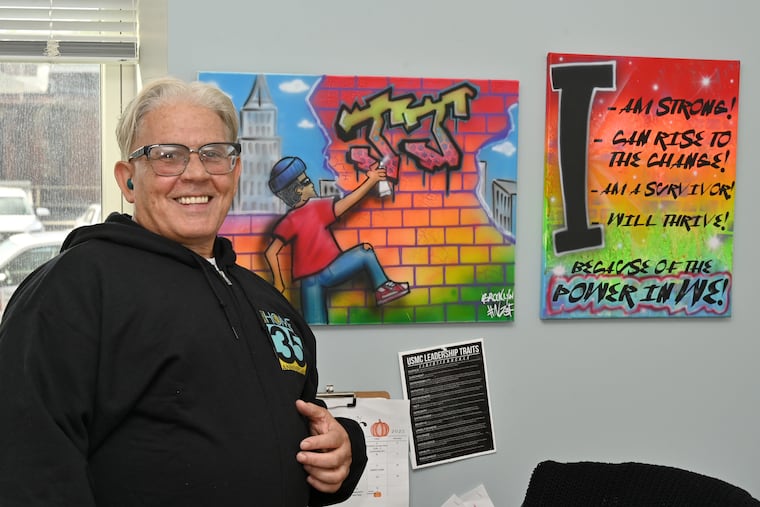
As charming and ebullient as Nephtali Andujar is (lots of hugs, compliments, and gifts of his homemade pottery), the 61-year-old is also pretty blunt about why people should give to Project HOME, one of the city’s largest nonprofit housing agencies.
Because of Project HOME, said Andujar, who spent years living on the streets, he is no longer desperate — desperate to get money to feed a heroin addiction, desperate to scrape $5 together to pay someone to let him drag a discarded mattress into an abandoned house for a night’s sleep out of the rain.
“It’s not just giving someone an apartment,” said Andujar, who sheepishly described a past that included stealing cars and selling drugs. “It’s the snowball effect.
“You are not just helping the homeless,” he said. “You are helping the city. You are helping humanity.”
In the agency’s name, the letters HOME are capitalized, because each letter stands for part of the multipronged approach that Project HOME takes in addressing homelessness and combating poverty for the 15,000-plus people it serves each year.
There’s H, for Housing — not only housing in the literal sense, but also in the teams of outreach workers who comb through the city’s neighborhoods looking for people like Andujar. One outreach worker found Andujar in 2021 at a critical moment in his life — clean, just out of the hospital for liver treatment, and back on the streets of Kensington ready to begin anew.
For Andujar, it was a race. What would find him first?
Would it be heroin, as it had so often been in the past? It was tempting. It’s painful being on the street — cold, hungry and dirty, ashamed and alone. “When you do heroin, you don’t feel the cold. It kills the hunger,” he said. “When you use the drugs, you don’t have to suffer for hours. Heroin numbs you.”
Instead, though, it was the outreach worker — someone who had been through Project HOME’s recovery program — who plucked Andujar off the street in the nick of time and took him to a shelter.
A year later, that same outreach worker helped Andujar move to his own room at Project HOME’s Hope Haven shelter in North Philadelphia.
“You get tired of the streets. They were killing me,” Andujar said.
Next Andujar found Project HOME manager JJ Fox, who helped him get a birth certificate and other documents, and arranged for him to stay. But he needed more than a warm bed.
The problem with getting straight after a heroin addiction, Andujar explained, is finding a new purpose and direction. For so long, life was focused on a repeat cycle of getting the next fix and then becoming numb to pain while it was working.
So when he got to Project HOME, he needed a new direction, which is where both the O and E in HOME came in for Andujar.
“JJ Fox gave me direction,” he said, and so did Project HOME employment specialist Jamie Deni.
The “O” in HOME has to do with Opportunities for employment. Certificates cover one wall in Andujar’s studio apartment in Project HOME’s Inn of Amazing Mercy, a 62-unit apartment building and offices in a former nursing school dormitory in Kensington. He can point to his accomplishments in computer skills, barbering, and training as a peer specialist to help others the way the outreach worker helped him.
But Andujar is not in good health, as vigorous as he appears. His addictions will someday exact their price, even though with cirrhosis of the liver, he is already living years beyond what his doctor predicted.
Full-time work is not an option. So Andujar is part of the “E,” as in Education. Deni helped him get a grant to take art classes at Community College of Philadelphia. She helped him understand CCP’s education software so he could turn in his homework.
Project HOME offers classes in graphic design, music production training, ServSafe food handling, forklift and powered industrial trucks certification, and website building, among other courses.
The M stands for Medical. Project HOME doctors, nurses, and other health practitioners treat 5,000 people a year, both in a fully equipped health center and by sending medical teams into the streets, caring for people, literally, where they live.
Project HOME offers classes in graphic design, music production training, ServSafe food handling, forklift and powered industrial trucks certification, and website building.
“My dad always told me that you need three things — housing, food, and love. You get all that here,” Andujar said.
And for him, it goes beyond that. During a stable period in his life, Andujar had a partner and a child. His daughter is now 14 and living with her aunt in New Jersey. Her mother, who was also stable for many years, fell into addiction but is clean now. She is living in another Project HOME apartment.
Like Andujar, Omayru Villanueva, 49, another resident at the Inn of Amazing Mercy, recalls her first night of homelessness.
She remembered a cold slushy rain.
She remembered sweeping every corner of her house, determined to leave it clean, no matter what. Her husband had been convicted and jailed for a federal crime. She couldn’t make the payments on the house, so she sold or stored all of her belongings and prepared to leave.
On her last morning at home, she and her school-age twin sons walked out the door before the sheriff came. Her older daughter was able to find a place in a shelter. Her second daughter, just under 18, said she was living with a boyfriend, but it turned out that she had been trafficked.
By that evening, Villanueva was desperate. She took her boys to a hospital emergency room. At least they could sit indoors while she figured out something. “I was crying inside.” Finally, she called a friend from church who took her and her sons in.
From there, they moved from shelter to shelter, and ultimately to a Project HOME apartment with two bedrooms.
“That night we had a pizza party. We were so happy,” she said. “There’s a sense of dignity and respect when you have your own place. You can take your worries away from having a place to live, and you can focus on other things.”
She remembered lying in her new bed, “thanking God and rubbing my feet against the mattress.” The next day, she woke up, opened the window, and listened to the birds. Then she asked her sons what they wanted for breakfast. “When you are in a shelter, you eat what they give you.”
The simple pleasures.
» READ MORE: The new head of Philly’s Project HOME brings a lived experience of housing insecurity
Three of her four children, scarred from the experience, have also been homeless and living on the street. Her two sons, now 23, are in Project HOME apartments. Both daughters are now fairly well-established.
Villanueva appreciates the medical help she has been given at Project HOME, particularly for mental illness stemming from the trauma she has experienced with her ex-husband’s arrest and homelessness.
“Anybody can end up being homeless,” she said. “I wasn’t a drug addict. I wasn’t an alcoholic. It can happen to anybody.”
She thinks of her daughter, who has a house, a job, and a car. But if something happens to the car, her daughter won’t be able to get to work. She won’t be able to pay her mortgage, and she could wind up homeless. It’s that simple.
“It’s important to donate because people can help break the cycle of homelessness,” Villanueva said.
“It’s about housing and education. It’s about medical help. It’s about employment,” she said. “Project HOME helped me a lot.”
The truth is that every person in Project HOME has a story. Those stories keep Donna Bullock, president and chief executive, motivated to preserve and protect the agency founded just over 35 years ago by Sister Mary Scullion and Joan Dawson McConnon.
She worries about how the city will respond to federal executive orders amounting to the criminalization of homelessness. Will there be tightened requirements for agencies that provide shelter?
Project HOME is reimbursed for some of the medical care it provides, but Bullock worries that new rules involving Medicaid reimbursement will impact the agency’s budget, while cutbacks in services increase demand.
“It’s terrifying,” she said. “We know we have to do the most we can to preserve these resources that we’ve come to rely on.
“In this job, I’ve learned to appreciate the humanity of folks — the residents and the stories they tell and the contributions they make to our community.”
Sometimes, she said, Project HOME residents walking the path of recovery slip and fall away. Sometimes the results are tragic, the losses devastating.
“We’re experiencing all these moments — communal grief and communal celebrations as well. We talk a lot about how every journey of recovery is unique. Everyone walks their own journey. We can’t do the walk for you, but we can walk with you,” she said.
Bullock invites others to the journey, promising that when people give to Project HOME, they can be assured that their money is carefully managed. “We’re good stewards of the resources entrusted in our care. We know how to leverage the resources given to us.
“Folks expect a return on their investment, and the return is the difference in individual lives and also building a community,” she said. “Your investment is magnified 10 times over.”
This article is part of a series about Philly Gives — a community fund to support nonprofits through end-of-year giving. To learn more about Philly Gives, including how to donate, visit phillygives.org.
About Project HOME
Mission: To empower adults, children, and families to break the cycle of homelessness and poverty, to alleviate the underlying causes of poverty, and to enable all of us to attain our fullest potential.
People served: More than 15,000 annually — with street outreach, housing, opportunities for employment, medical care, and education.
Annual spend: $49.06 million
Point of pride: Project HOME, which operates 1,038 housing units, broke ground in October for construction of 45 new apartments; also under construction are 20 respite beds. In the pipeline are an additional 44 apartments. Project HOME also operates the Honickman Learning Center Comcast Technology Labs, Stephen Klein Wellness Center, Helen Brown Community Center, and Hub of Hope.
You can help: Volunteers tutor students, serve meals, participate in neighborhood cleanups, and organize donation drives at their organizations for household items or other items useful to families or people still experiencing street homelessness.
Support: phillygives.org
What your Project HOME donation can do
Here are some ways that a gift can help the people we serve:
$25 provides warm clothing and new socks for a visitor at the Hub of Hope.
$50 supports a behavioral health counseling visit.
$100 provides a month’s worth of hygiene products and toiletries for a family.
$250 provides a welcome basket for a new resident complete with sheets, towels, and cooking supplies.
$500 supports five dental visits at the Stephen Klein Wellness Center.
$1,000 funds six weeks of summer camp at the Honickman Learning Center Comcast Technology Labs, keeping a child’s mind active during the summer and supporting moms who work.
$1,500 funds a certification program through the Adult Education and Employment program leading to employment readiness.