
This week’s Shackamaxon welcomes back City Council’s quarrelsome contrarian and makes the most out of SEPTA’s “new” funding.
Council vs. community
Councilmanic prerogative, a tradition that gives individual district Council members sole discretion over land-use decisions within their constituencies, is not popular with the public. A 2022 poll found that only 22% of Philadelphians wanted to keep the practice, while more than two-thirds wanted it abolished. Among Council members themselves, however, prerogative is king.
During a recent City Council meeting, 7th District Councilmember Quetcy Lozada wondered when the phrase “councilmanic prerogative became a dirty word.” Council President Kenyatta Johnson said that “it isn’t like they say in the newspaper.” Most of their colleagues and predecessors make similar defenses of the tradition, which they claim is just a way to make sure the community doesn’t get steamrolled by powerful interest groups.
The process, however, often stymies community aspirations or pits the interests of some neighbors against those of others.
Fourth District Councilmember Curtis Jones Jr. reduced the number of development projects allowed along a stretch of Ridge Avenue in Roxborough, citing community opposition to new construction and parking woes.
The move, known as downzoning, took a sledgehammer to the net worth of longtime business owners along the corridor, with the value of their life’s work deflated overnight. They testified against the move at City Council, to no avail.
In the 8th District, Councilmember Cindy Bass has discouraged the redevelopment of sizable properties like the former YWCA, Germantown Town Hall, and the Ada H.H. Lewis Middle School, despite community support for doing something with those buildings.
In extreme cases, councilmanic prerogative has also been an invitation to more questionable practices. Just ask former 7th District Councilmember Rick Mariano, who was convicted in 2005 of taking prerogative-enabled bribes. “It’s just a very sketchy and nontransparent thing,” Mariano told WHYY in an interview a decade ago. “If I could do everything over again, I wouldn’t be a councilman. But if I was, I would not want anything like that. It can just come back and bite you in the ass.”
No fighting in the library
A good example of how prerogative can get in the way of a neighborhood’s wishes is the recent debate over the future of the Cecil B. Moore Library.
Cierra Freeman, Claire Newsome, and the rest of the Save Cecil B. Moore Library coalition have been organizing and campaigning for years to renovate the current library building, which is on the 2300 block of Cecil B. Moore Avenue in North Philadelphia. They helped secure millions of dollars for the effort from the city’s Rebuild initiative. Then they were blindsided by Councilmember Jeffery “Jay” Young, who is finishing his second year representing the 5th District.
My newsroom colleagues have branded Young as City Council’s “quarrelsome contrarian.” While he’s bristled at the description, he also regularly confirms its accuracy. More than any other member of Council, Young has employed a haphazard approach to using the powers of his office, often stepping in at the very last moment to scuttle long-standing plans. Small businesses, street safety campaigners, and affordable housing advocates have all been burned by his tendency toward unilateral and inexplicable decision-making.
The library renovations are the centerpiece of what’s shaping up as his legacy of obstinacy.
First, Young opposed renovating the library because he wanted to redevelop the site as a mixed-use building, with affordable housing above and library services below. Community members expressed deep skepticism about the idea, and Young never produced a rendering or other documentation to prove that his plan was feasible.
On Saturday, Young told a packed community meeting about his plan to move the library, with a nearby city-owned lot on 19th Street identified as a potential location. Young, wearing a baseball cap emblazoned with his own name, presented the move as a way to ensure the community gets everything it deserves, including space for teenagers.
Of course, the current renovation plans already include a revamped teen space. They are also the product of years of engagement between the city and the community. Young’s proposal, once again, lacks even the basics you’d expect from any developer coming to the community with a new construction project.
When I first arrived at the meeting, Young already had his hackles raised. He was berating a constituent and disrupting the proceedings. Another neighbor, Nadine Blackwell, who has lived in the area for 73 years, told Young, “I’m not gonna hit you,” citing his “defensive body communications.” The only resident to express any interest in his ideas was Bonita Cummings, a former staff member in his office.
Renovating a library should not be a contentious issue. It has become one only because City Council’s traditions allow members like Young to make it one.
Don’t call it a bailout
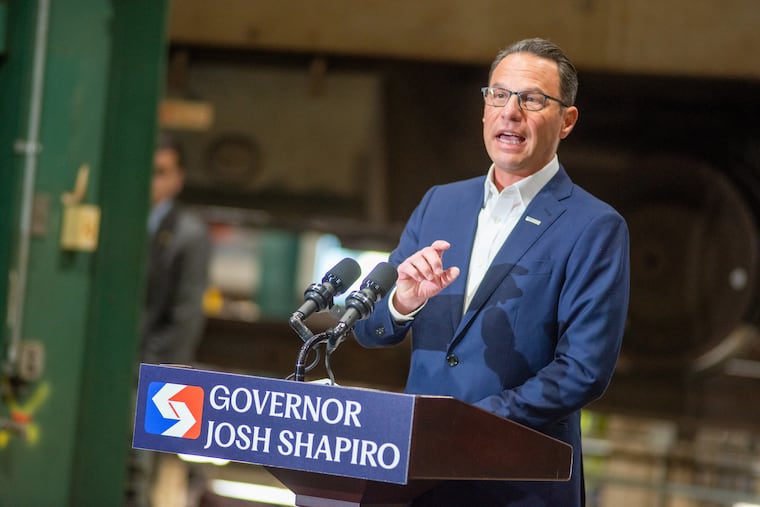
There are few things Gov. Josh Shapiro loves more than talking about how he likes to take decisive action. From quickly repairing the I-95 collapse to last year’s maneuvers in Harrisburg that secured an infusion of money for SEPTA, it all helps buttress his “get stuff done” reputation. But Monday’s announced transfer of $220 million to SEPTA, while necessary, does not represent a real solution for our commonwealth’s transit woes. In fact, it makes transit’s future more precarious, absent new sustainable funding from intransigent Republicans in Harrisburg.
That’s because Shapiro took the money from the state’s public transit trust fund, which is tasked with supporting systems across Pennsylvania. While Republicans have presented the fund as money that’s “just sitting there,” those dollars have already been earmarked for specific projects, like SEPTA’s proposed modernization of its trolley system. The money Shapiro used was being set aside for emergencies. Using it to abate a wholly political crisis is not ideal.
The proposed investments, however, represent a judicious use of public resources. Nearly every part of the system will be revamped, providing riders with faster and more efficient trips. It’s an opportunity for Scott Sauer, who’s been working as general manager for 11 months, to prove to the General Assembly that the transit agency can be effective and efficient if given the chance.