
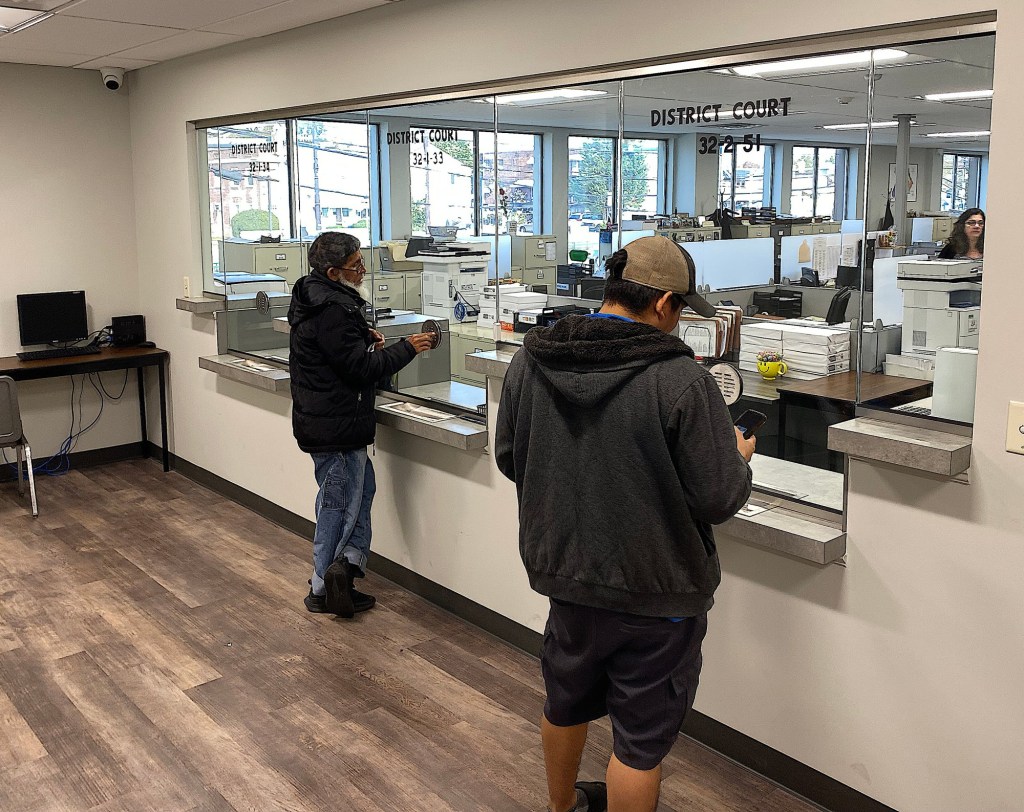
Upper Darby has a new magisterial district court complex to handle cases for much of the township.
The courtrooms and offices for district judges Harry Karapalides, Benjamin Johns and Christopher Mattox have moved to a new building at 1500 Garrett Road in the Barclay Square Shopping Center.
The old court offices were on the other side of the shopping center but were outdated.
“It’s a huge upgrade,” said Johns, who recently gave a tour of the facility that has two courtrooms.
The old facility did not have accommodations for prisoners, forcing cases involving them to be held at the Lansdowne District Court. With the new facility that issue has been resolved.
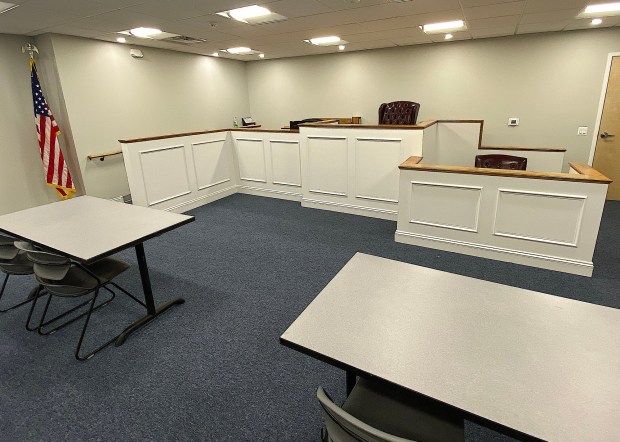 One of the new courtrooms at 1600 Garrett Road. The offices and courts have moved across Barclay Square Shopping Center to a new facility with two courtrooms. (PETE BANNAN-DAILY TIMES)
Visitors to the district court complex enter on the first floor where an elevator can take them to service widows on the second floor. One courtroom is on the first floor and a second in located upstairs.
Johns, who represents District 32-1-34, said the courtrooms are scheduled so there is no overlap between the three judges.
He’s been a district judge for two years. It was something he always wanted to do. He said his private law practice involves an entirely different part of the law, as class action federal lawyer so being a district judge gives him a new experience.
The DJ’s job
During the tour, Johns reviewed the work that he and other district judges perform. He said most criminal cases arraignments take place in Media where an on-call judge hears the arraignment. At that time, the district judge sets bail, and the preliminary hearing is held at the local district court.
“The preliminary hearing is a constitutional right, which takes place about 14 days after an arrest,” Johns said. “At that time government has burden to show what the case is about, possibly present a witness but it does not have to be proven beyond reasonable doubt.
He looks at the preliminary hearing as a gatekeeper for common pleas court by filtering out cases that won’t reach a minimum level of evidence.
He used example in which a critical witness did not appear. Those cases might be dismissed. He noted that at the district court level, police could rearrest someone if charges were dismissed.
When setting bail, the district judge has a great amount of discretion, Johns said. Before the arraignment an official will interview the person charged. That staffer will find out the prior history of the suspect, their job situation, and residential situation.
The judge then receives the bail recommendation, which he is free to follow but not binding.
“I think it’s generally helpful,” he said.
He noted the bail isn’t a punishment, it is to secure the subjects returning to court.
“Transients may not come back for a preliminary hearing,” he said.
In most cases the suspect only have to pay the 10 percent, but if they don’t appear they could be responsible for the total amount.
Another part of his work as a district judge involves approving search warrants which are usually for his district.
He said when he is on call he may get a request to approve warrants from anywhere in the county which exposes him a wide degree of issues.
One of Johns’ responsibilities is all cases involving Upper Darby High School and truancy cases.
He said those cases can be the most difficult because of the family situations encountered but they also are “the most rewarding,” when he sees a young person go from struggling to success.
He said many students will complain about bulling and ask to go into virtual learning but administrators need to see a commitment to school with good attendance.
“It’s kind of a chicken and egg. If you don’t have a good attendance record the school is not going to accommodate that,” he said. “Get your stuff together and it is more likely the school will likely accommodate that.”
Other cases that district judges handle are landlord tenant issues and civil cases. Civil cases are limited below $12,000 and typically involve contractor cases or small claims but most civil cases are debt collectors, usually third party, and a lot of them are defaults.
“All civil cases are subject to appeal,” he said.
Asked about court costs that those caught up in the judicial system can encounter, he agreed they can snowball, but often when it comes to parking tickets, authorities in the parking department will try to work with them.
Johns said the number of cases he handles depends on the week and each is a new learning opportunity.
‘Every case is different’
When first elected, he went to new-judge school.
“Like boot camp, he said. “It was a big learning curve, but once you get exposed to the job and have a general sense of the law, you’re good. But there are cases where there an unusual fact pattern. He said he can call a recess, confirm with books and call a more learned judge for input. He did that once.
Joining Johns on the tour was former District Judge Robert Radano, who held the position for 12 years. He noted the district judge is the initial contact most people make to the legal system.
 Magisterial District Judge Benjamin Johns, left, with his predecessor Senior District Judge Robert Radano. (PETE BANNAN-DAILY TIMES)
“As a magisterial district judge you are the initial conduit to the legal system,” Radano said.
Asked if people should hire a lawyer for anything that might bring them into court such as a speeding ticket or other traffic infraction, the two men said everyone is entitled to a lawyer.
He noted a lot of people are not going to represent, and they may not know what they are doing in court. He said you have to navigate the fine line between helping them navigate the system but not becoming part of the ligation.
“Every case is different,” said Radano, who used the example of a commercial truck driver who’s gotten a ticket.
“For him, losing a license could be catastrophic,” Radano added. “The main thing is you just have to listen to people. They might not always agree with the decision but they should agree that you gave them the chance to be heard.”
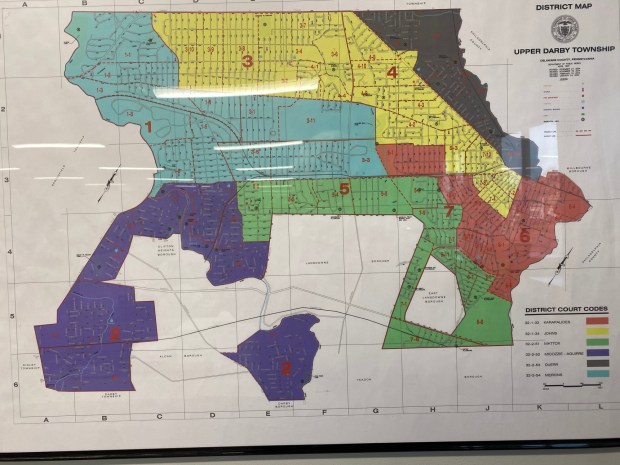 Upper Darby is divided into six Magisterial Districts. (PETE BANNAN-DAILY TIMES)
Both judges said with the accused and police and possibly aggrieved family member in attendance some court hearings can be tense. They’ve both had to handle incidents requiring additional officers to separate the parties though civil cases can be more charged emotionally.
Johns said that when he sees situations in civil cases that are at risk of getting out of control, it is often with the civil cases he will hold the ruling, which is allowed for up to three days. He will also have parties leave the building at separate times to lesson them meeting out front.
Asked if television shows accurately portray court, Radano was dismissive.
“I don’t think so,” he said. “It’s really hard for me to watch the legal shows. I practiced for a long time and some things I think that wouldn’t happen in real life.”
Karapalides and Mattox did not reply to a request for input on this story.