
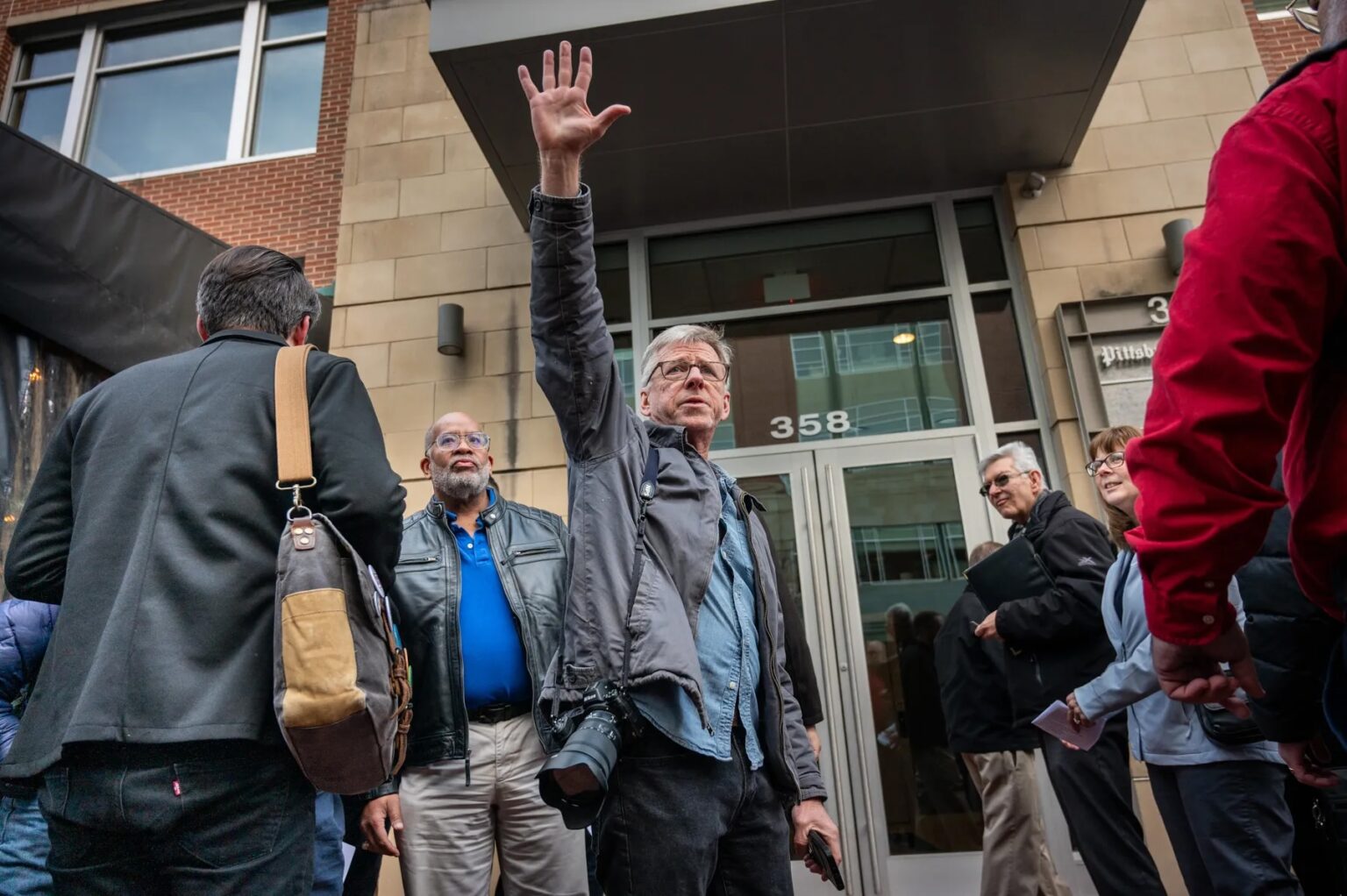
Also, information on the best way to resubscribe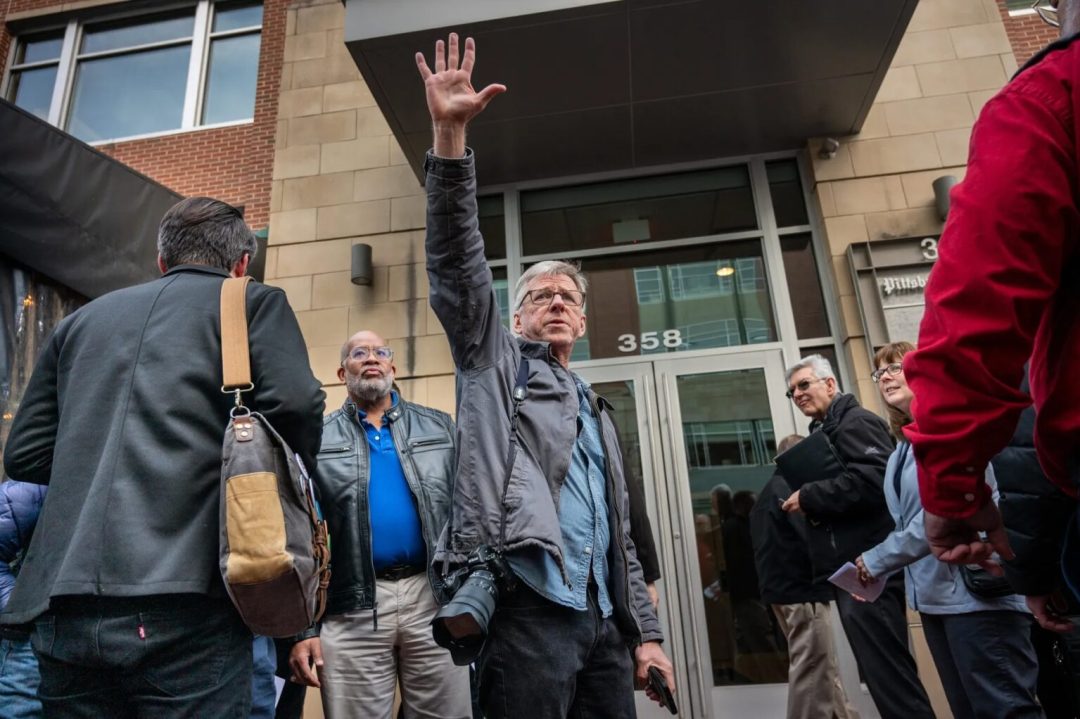 (Photo by Stephanie Strasburg/Pittsburgh’s PublicSource)
We’ll see more organizing in the future, as income inequality increases. The billionaire class has been ascendant but that will change. Workers are finding their strength. They’ll flex that strength through union organizing. – Steve Mellon
In our reconstituted Q&A series, Seven with Sue (+1), we are exploring the local arts scene. We customize the questions for folx in various parts of the arts community.
This edition is very special, a look at the victory of the Newspaper Guild of Pittsburgh returning to the Pittsburgh Post-Gazette workplace after a three year strike. There is an art to striking (and winning) as well as the creative themes that permeate the strike itself. So I asked journalist and veteran of two newspaper strikes, Steve Mellon, to answer my questions.
Also note that I asked 12 questions versus seven plus one. If you tilt your head, squint,and let your eye soften, you can pretend this is seven plus three (one for each year of the strike) plus one. And the last question is more about information sharing. But it is ultimately my blog so I can do what I want. Ha.
I’ve written about Steve before. Our friendship is why I thought he could best respond to my questions and put this into the context of the arts. I wanted a good frame to promote the Resubscribe plans of the Guild. We need tens of thousands of people to take this step in order to secure the labor victory. I’ve already resubbed.
Name: Steve Mellon
Pronouns: He/him
Employer: Pittsburgh Post-Gazette
The Questions and Answers
Tell us about your connection to or your first impression of Pittsburgh.
Brenda (my wife) and I first came to Pittsburgh in March 1989 for a photojournalism conference organized by The Pittsburgh Press. At the time we lived in Knoxville, TN, and I desperately wanted to work for the Press, which was producing great black-and-white photojournalism. I loved the newspapers’ commitment to hard-hitting documentary projects. At the conference, I talked with the head of the Press photo department and then followed up with several letters and phone calls. He offered me a job in late August.
Brenda wasn’t thrilled. During the conference, she saw a gloomy city. A cold rain fell every day of our visit. It was typical Pittsburgh weather in early spring. We visited Mt. Washington. Fog and drizzle obscured our view. It took a while for Brenda to warm to the city, but it has become our home. We raised three daughters here. I’m not going to speak for Brenda, but I’m a Yinzer.
Your union went on strike for three years. You won. You went back to work on Monday. Now what?
The first points of business are to get our folks back into the business of producing journalism at the Post-Gazette and bargaining a new contract. The strike is over, but the fight for workplace rights is ongoing. It sounds like a union talking point, but it’s true.
It would be interesting, and perhaps unifying, to produce a project involving the entire PG staff, or at least a portion of the staff. Bring folks together to focus on a specific issue facing the region, or some unique aspect of Western Pennsylvania life.
Describe the first moments when you returned to work.
I didn’t know what to expect. I wasn’t sure we’d even get into the building. But Goldy (Newspaper Guild of Pittsburgh President Andrew Goldstein) swiped his PG access card across the sensor and the door unlocked, and then we were in. It was an incredible moment. We stood in the lobby, waiting for the elevator, and could hear the crowd cheering outside. It was exhilarating. We’d worked and struggled for more than three years for this. I was one of the last to walk through the entrance, and as I looked behind me I saw Stephanie Strasburg of Public Source and several other photographers crowded into the doorway, shooting pictures of us. I’ve worked shoulder-to-shoulder with Steph for years. It felt strange to be on the other side of the news. We took the elevator to the third floor and met with managers. We’d anticipated this meeting. I figured it would be tense, perhaps even heated. It wasn’t. Everyone was professional, focused on answering questions. For me, at least, a lot of pent-up stress fell away very quickly.
This feature usually focuses on the arts and creators. Would you describe labor organizing as artistic or creative?
Yes, but in a way that’s different from creating stories or pictures. It’s less glamorous but incredibly demanding. It’s much tougher to practice creative problem solving than to practice journalism, at least for me. I practice a basic form of journalism: I try to understand a person’s experience, their thoughts, their hopes and fears, and then use pictures and words to convey those things. The first several weeks of the strike were a shock to me because the organizing work was much more expansive than anything I’d done before. I was a co-chair of the Health and Welfare Committee, so we spent several hours each day in meetings and on the phone. We had to learn which strikers were dealing with health problems, and set up a process to pay for that care. Who was struggling to pay bills? Mental and emotional health was a concern. It’s tough to walk away from a job that forms a significant part of your identity. Your daily schedule is screwed up. Your family doesn’t always understand the toll this takes. We created spreadsheets to organize the needs, called other organizers to get advice, and reached out to non-profits and bureaucrats, who walked us through often complex and confusing processes. We brainstormed solutions.
One gloomy afternoon early in the strike, people on the picket line seemed down and somewhat depressed. I didn’t know what to do. I’m not accustomed to taking a lead role in this type of situation but it seemed essential to do something. I walked down the line and told some of the younger strikers to follow me to a local coffee shop. We got out of the cold and spent a few hours talking about our journeys into journalism, our love for stories, anything but the strike. I didn’t say much. I didn’t have to. The simple act of gathering in a different, warmer space sparked the conversation. Was that creative problem solving? At the time it felt like a desperate move on my part. I got lucky. It seemed to work on that day. Over time, we had to come up with other solutions – one-on-one meetings, group sessions, picnics.
Newspaper work offers daily gratification. Organizing takes more of a long view. It’s hard to see the shape of what you’re sculpting in the moment but over time a shape emerges.
What other strikes and labor movements should we be following?
We should certainly follow the Starbucks workers’ strike, and respect their picket lines and boycotts. These workers are young and energized and smart about their organizing. Health care workers have been very actively organizing – that’s a big deal here, since health care companies loom large in our local economy. We’ll see more organizing in the future, as income inequality increases. The billionaire class has been ascendant but that will change. Workers are finding their strength. They’ll flex that strength through union organizing.
As a journalist, with whom in the Pittsburgh region would you like to collaborate and why?
There are so many different ways to collaborate. It would be interesting, and perhaps unifying, to produce a project involving the entire PG staff, or at least a portion of the staff. Bring folks together to focus on a specific issue facing the region, or some unique aspect of Western Pennsylvania life.
Has this strike made you a better journalist?
Absolutely. I’ve found that any personal struggle deepens my understanding of what it’s like to be a human in today’s world. I believe it’s made me a more effective listener, and thus a better storyteller. Working for the strike paper (Pittsburgh Union Progress) has been the most challenging and rewarding experience of my career. It’s given me the time needed to develop trust in communities that have often been distrustful of traditional journalists. I’ve spent countless hours in homes and in workplaces, trying to wrap my head around the experiences of people whose lives are very different from mine. I’ve found that most people are very patient and generous with their time – if you’re sincere in your quest for understanding.
Has this strike made the Newspaper Guild of Pittsburgh a better union?
Yes. We’re much more organized and cohesive. We’ve learned through experience what works and what doesn’t. We’ve supported each other through what has been the most difficult period of our professional lives, so we have a level of trust with each other that’s unusual in any organization.
Now that you’ve returned to work, how will the Guild and the paper itself help the community heal from this rupture?
We’ve been talking about this. Maybe we should propose a series of town hall meetings in which union members, non-strikers and managers listen to the community and stress the need for strong local journalism and community involvement.
This is an astounding addition to Pittsburgh’s robust labor history contributions. If this strike becomes your career legacy, how would that feel?
I’m crazy proud that we’re part of that legacy. Many of the first people I met when I came to Pittsburgh were Mon Valley activists and organizers. People like Barney Oursler, Charlie McCollester, Mike Stout. That list has grown and become more diverse over the years to include folks like Sala Udin, Sue Kerr (the writer of this blog), Alma Speed Fox, who I got to know while writing about Pittsburgh in the aftermath of the assassination of Dr. Martin Luther King Jr. The strike introduced me to young organizers like Tori Tambellini of Starbucks Workers United. I’ll never rise to their level, but I’ll be proud to be somewhere on that list.
The photo published in Public Source of you turning to wave and thank the crowd before heading into the PG with your camera slung on your shoulder and your phone in your hand is a rather iconic image. Tell us what you see in that photo.
I was surprised to see that image. I remember wanting to personally thank everyone who showed up to support the strike. Many of those people have stood with us countless times, at rallies and pickets. They’ve donated to the strike fund, they’ve helped us pass out leaflets, they’ve assisted with PUP stories. A handful have listened to me rant on the phone. The strike was a success because it was a community effort. Steph Strasburg captured that moment – I’m grateful for that, because I’m standing with my colleagues at a key moment in this historic strike. I see Zack Tanner, Rick Nowlin, Ed Blazina, Karen Carlin. I owe a special debt of gratitude to Karen. I’d often file PUP stories after midnight, sometimes as late as 2 a.m. Both she and Bob Batz were very forgiving. If we’ve learned anything the past three-plus years, it’s this: In times of stress and uncertainty, we need to offer our colleagues the gift of grace.
Where to find Steve and the other members of the Newspaper Guild
Tell us about resubscribing.
We’re urging people to resubscribe and, at the same time, send the company a letter of support for the workers. We’ve created a form to get that process started.
Pittsburgh Union Progress strike paper archive
Thank you, Steve.
Seven with Sue (+1) is one of our favorite Q&A series – a quick dive into the local arts world. (+1) is a nod to my need for a companion when I attend a performance and an acknowledgment of the need for universal accessibility to the arts. If you’d like me to craft a Q&A for your production, email pghlesbianblog@gmail.com.
Previous Q&A’s in this series (pre-re-launch, too)
Actor, Director, and Playwright Elizabeth Huffman Changes the Narrative: a Seven With Sue (+1) Q&A
Cartoonist Joe Wos Celebrates the Amazing Friends We Meet Along the Way: a Seven With Sue (+1) Q&A
Actor Phoebe Lloyd Talks About Queering Chekhov in a new local production: a Seven (+1) With Sue Q&A
My ‘Burgh Vivant Q&A with Jill Sobule #7WithSue
My new Q&A column at @BurghVivant with Nicole Gallagher, creator of ‘Mija: one bitch’s tale’
 Like this:
Like Loading…
Discover more from Pittsburgh Lesbian Correspondents
Subscribe to get the latest posts sent to your email.