
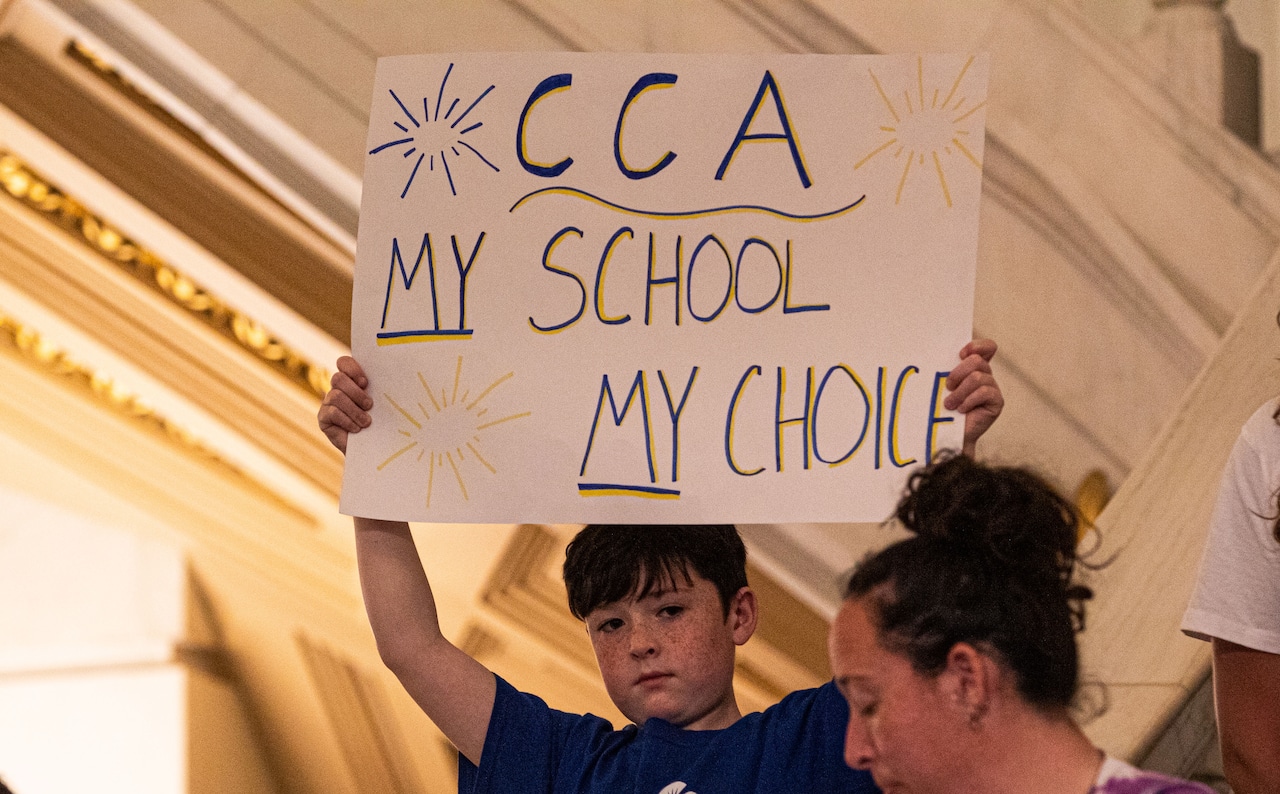
Pittsburgh Public Schools and three smaller districts accused Pa.’s largest cyber charter school, Commonwealth Charter Academy, of failing to provide an adequate education to its students, in a lawsuit filed in Commonwealth Court on Tuesday.
The lawsuit states that CCA “is operating in a manner that deprives students of their fundamental rights to an education” and asks the court to stop the Pennsylvania Department of Education from charging them more than $12 million in tuition payments. The lawsuit points to CCA’s low test scores and graduation rates and accuses CCA of breaking its charter by operating like a for-profit school.
“This case is not about about eliminating school choice,” said Tom King, the lead attorney for the four school districts. “It’s about ensuring that when there is school choice that the choice is a quality choice that is up to the standards that these kids are entitled to.”
Commonwealth Charter Academy [CCA] denied the accusations and fired back, accusing Pittsburgh Public Schools of trying to shift attention away from the problems that are causing students to leave Pittsburgh schools.
“Apparently, blaming and pointing the finger at public cyber charter schools is much easier than looking internally to fix what is broken,” said Tim Eller, a spokesperson for CCA, in a press release on Wednesday.
The lawsuit pits Pa.’s second and third largest educational entities in a legal battle. CCA overtook PPS as Pa.’s second largest educational institution during an enrollment rush in the middle of the COVID-19 pandemic. In the last five years, CCA has gone from serving less than half as many students as PPS, to now serving more than twice as many. CCA now has more than 36,000 students enrolled. These students represent more than half a billion dollars of tuition payments from traditional public school districts.
Eller, CCA’s spokesperson, said its enrollment has grown 271% over the last five years in the four districts involved in the lawsuit. “That kind of growth does not happen by accident — it reflects families’ frustration or dissatisfaction with the educational environment in those districts,” Eller said. “And suing CCA does nothing to fix it.”
The lawsuit is applying the Commonwealth Court’s 2023 decision that students have a constitutional right to an adequate education in a new and untested way. If successful, some of the arguments in this new lawsuit could be used against other cyber charter schools in the future. Many of Pa.’s other 13 cyber charter schools have test scores and graduation rates similar to CCA’s. That could put in jeopardy the $1.2 billion in tuition payments made by traditional districts to cyber schools last year.
“At this point we concluded that we were best served by focusing on the largest of them and frankly the most egregious of them in terms of test scores and methods of operation,” said Ira Weiss, the solicitor for Pittsburgh Public Schools. “It may be that once this case gets underway, other districts may seek to join in, there may be a decision to sue other [cyber schools]. But right now we’re focusing on CCA.”
Moving in opposite but uncertain directions
The lawsuit comes at an uncertain time for both CCA and PPS.
A budget compromise in Harrisburg earlier this month cut tuition payments to cyber schools like CCA by $175 million. The budget included additional regulations of how cyber charter schools can operate, some of which could potentially dramatically change how many students are able to complete their work. And this is on top of a cut in special education funding in 2024 that some cyber schools say already cut their budgets by 10% this year.
On the same day that PPS filed its lawsuit this week, its school board failed to pass a plan to revitalize its schools and close nine school buildings that had been in the planning stages for more than two years. The board’s proposed changes were meant to prepare the district for the realities of a district whose enrollment has been shrinking for two decades.
PPS has benefited from Pa.’s “hold harmless” educational funding provisions that have protected shrinking school districts. But PPS continues to lose students even as the overall population in the city of Pittsburgh has stabilized. The value of its tax base has been shrinking because the city’s biggest office buildings have never fully recovered from a pandemic drop in value. PPS’s board has proposed both raising taxes and cutting costs this year–and still will have a larger budget than CCA.
Is CCA acting as a nonprofit?
PPS argues in its lawsuit that CCA is no longer acting like a nonprofit even if technically it is registered as a nonprofit because of the high salary of its leaders and because of the amount of money it is spending on constructing buildings.
CCA “is functioning de facto as a for-profit enterprise contrary to its nonprofit charter and Pennsylvania law,” according to the lawsuit.
The lawsuit cites the high salaries and compensation of CCA’s leadership team. PennLive looked at the salary of charter school CEOs, including the salary of CCA’s CEO Tom Longenecker, and found that his base salary was nearly identical to the salary of PPS’s superintendent, Wayne Walters. When compared to the number of students enrolled, CCA’s CEO actually earns less money than PPS’ superintendent.
PennLive also analyzed the finances of Pa.’s cyber schools and found that CCA is unique, even among cyber charter schools, in terms of how much money it spends on buying and constructing buildings. The lawsuit complaint says this spending violates the state’s charter school law, which limits how cyber schools can use buildings for instruction.
“Why would you charge these schools tuition that enables the cyber charter school to build brick and mortar schools, to build a Taj Mahal?” said King, the lead attorney for the lawsuit.
CCA says it uses its more than two-dozen buildings in a way that adheres to the spirit of the law. “Our Family Service Centers across Pennsylvania exist as regional locations where our staff work from, and so families have in-person access to support, educators, technology, and community resources – exactly the type of innovation the Charter School Law encourages and allows,” Eller said.
Who decides if CCA’s students are being served?
The lawsuit claims that CCA’s students are receiving an inadequate education and cites its low test scores and graduation rates. Last year, for example, only 4% of CCA’s students tested on grade-level or above in math on end-of-course exams.
CCA said in a statement that its low test scores reflect the fact that cyber school students opt out of state tests in high numbers. “Low participation results in scoring penalties and misleading performance indicators,” according to CCA’s statement.
This is only partly true. While most cyber schools have low participation rates compared to traditional school districts, CCA has a much higher proportion of its students opt out of state tests even compared to its 13 cyber charter peers.
CCA’s leaders don’t think test scores are a reliable indicator of how well its students are doing. “Parents are the best measure of their child’s academic growth and success at school,” Eller said. And Eller accused traditional schools of having their own test score challenges.
CCA’s claim is at least partially true: for example, only 10% of the 77 students enrolled in PPS’ own cyber school last year scored on grade level or above in math. Weiss said PPS is in the process of revamping its cyber school curriculum.
“They have changed the administration in that program and are making significant changes,” he said. “Obviously, there’s room for improvement.”
The lawsuit also highlights CCA’s graduation rates, which have historically been below 70%. (The school has said those rates have recently shown improvement.) But as the lawsuit notes, Carrick High School, in Pittsburgh, has a graduation rate comparable to CCA’s.
“Overall, PPS’s graduation rates have improved, ” Weiss said. “There are schools that have challenges, and we’re dealing with that.”
Weiss said he thinks CCA’s leaders are “either tacitly or openly encouraging” parents to opt out of state tests. He doesn’t think CCA’s parents are getting good information about how much their students are actually learning.
“I believe they’re easy either being misled or not informed,” Weiss said.
Charter school renewal
The lawsuit cited an article from PennLive’s series about CCA called “Virtual Dominance” to highlight the fact that the Pennsylvania Department of Education [PDE] hasn’t renewed CCA’s charter in recent years because the school would not agree to an enrollment cap. Although six other cyber charter schools have agreed to enrollment caps, the caps are voluntary. In its statement Wednesday, CCA said it has otherwise complied with the charter school renewal process.
Weiss said it is the Department of Education’s [PDE] failure to act on CCA’s charter that exemplifies its failures more generally to regulate CCA. “Either don’t renew them or you renew them and come to some resolution,” Weiss said. “PDE has all the tools it needs to provide oversight to cyber charter schools and they haven’t been doing it.”
A spokesperson for PDE said the department doesn’t comment on pending litigation.
CCA has a month to formally respond to the lawsuit.