

The Easton Planning Commission may come to a decision about a mega warehouse on Wood Avenue in Easton by December.
For now, the commission is continuously hearing information and evidence from developers and opposing residents.
The planning commission continued its rebuttal hearing Wednesday night for the proposed one million square-foot warehouse. The hearing is part of an ongoing process that began after opponents presented the commission with documents and testimony challenging the warehouse’s environmental and community impacts.
In response, the developer, Scannell Properties, has been calling expert witnesses to support its case. They are represented by Attorney Mark Kaplan.
The matter has been in the commission’s hands since 2024. The footprint of the warehouse is both in Wilson Borough and Easton. Though developers have received approval from Wilson, it still needs approval from Easton.
To start the hearing, Kaplan and developers attempted to recuse commissioner Kim Wagner as a participant of the matter. Wagner has previously questioned developers in detail about the project, and alleged pieces of the application were missing.
“Ms. Wagner has expressed a clear disposition against my client’s application,” Kaplan said.
Wagner appeared at a recent Zoning Hearing Board meeting regarding a portion of the warehouse. Members of the public had an opportunity to question witnesses at this meeting, and Wagner asked several questions at this time.
Kaplan said this incident compelled his clients to request the recusal.
The request was denied. Following a brief executive session, Solicitor Joel Scheer explained that Wagner does not have a stance on the warehouse and has not decided how she will vote. Scheer added that Wagner’s raising of certain questions is part of her job as a commissioner.
Kaplan called two specialists to testify: environmental consultant Jeff Smith and acoustical engineer Ben Mueller.
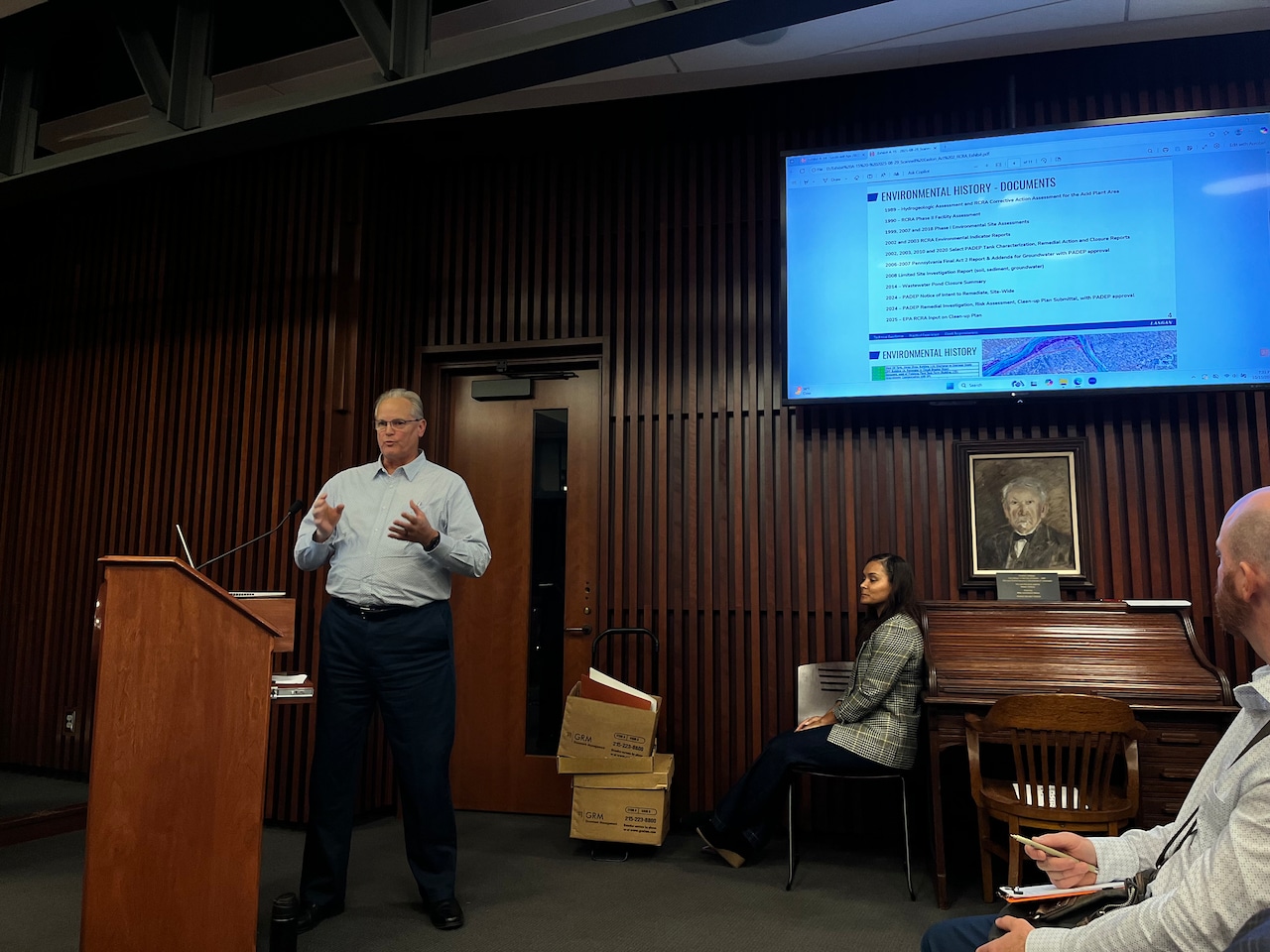 Environmental consultant Jeff Smith explains the cleanup and environmental process regarding the proposed Wood Avenue Warehouse in Easton on Oct. 15, 2025.Chelsea McClure | For Lehighvalleylive.com
Jeff Smith, a professional geologist, outlined his firm’s environmental assessment and cleanup plan for the site.
Smith explained that his work was conducted under Pennsylvania’s Land Recycling and Remediation Standards Act, also known as Act 2, which governs site cleanups and liability protections for remediated properties.
Smith said his team identified 15 areas of environmental concern on the property, including former storage tanks and waste areas, and conducted soil and groundwater testing.
The contaminants found were mainly metals such as iron, arsenic, cobalt and manganese, with limited or no detection of volatile or semi-volatile organic compounds or PFAS substances. He said the remediation plan includes removing and managing contaminated materials, placing clean fill, and applying deed restrictions to prevent groundwater use.
He also noted that the Pennsylvania Department of Environmental Protection and U.S. Environmental Protection Agency are both reviewing the cleanup plan, which cannot receive final approval until the work is completed and verified.
Commission members questioned how the plan accounts for airborne dust, potential future disturbances of the site, and differences in cleanup standards between residential and non-residential properties.
Risks to workers and nearby residents would be minimized through dust control, protective measures and perimeter monitoring during construction, Smith testified.
“You can never eliminate or characterize everything, right? It’s just not possible,” Smith said. “So the intent of a materials management plan is it establishes protocols and procedures for encountering things that you didn’t expect or that you didn’t previously know about, and it provides a list of procedures about what to do about that.”
Commissioner Ron Shipman also raised questions about previous environmental lawsuits related to the property and the potential for contamination from stream relocation or blasting activities, but Smith said it is beyond the scope of his work.
Following Smith’s testimony, Ben Mueller, principal at Ostergaard Acoustical Associates, presented findings from a noise analysis conducted for the project. Mueller said he used Easton’s municipal noise limits as the standard for his modeling, applying them to all nearby residential and commercial properties.
“We would heavily be involved in designing the performance to make sure sound doesn’t come in or out and that it is pleasant room acoustics,” he said.
Mueller explained that his team used conservative modeling to estimate sound levels from both fixed sources, such as HVAC systems, and intermittent sources like trucks and backup alarms.
According to his analysis, projected noise levels from the warehouse are expected to remain within Easton’s limits, even under high truck activity scenarios. He also said the study accounted for topography and site layout, and that compliance with noise regulations will remain an ongoing requirement if the project is approved.
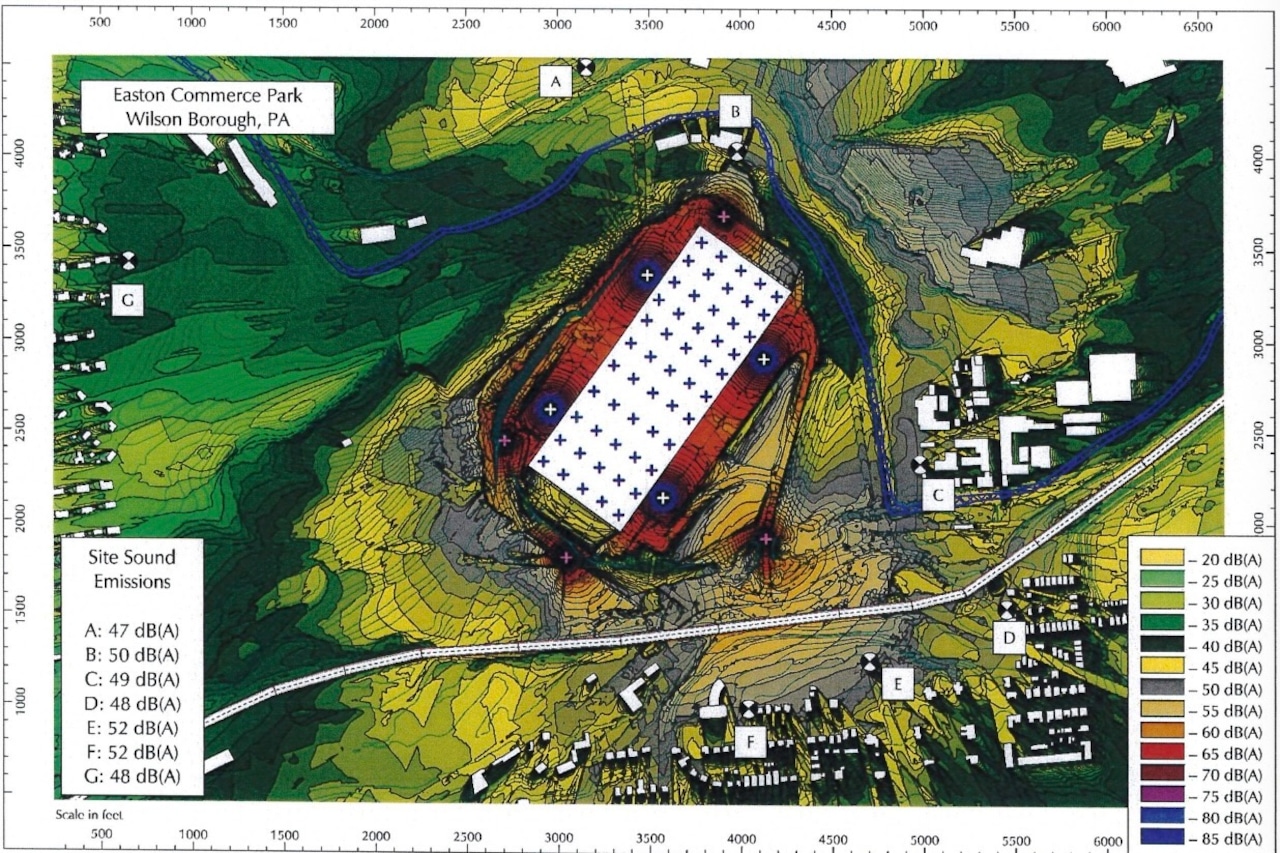 A diagram showing potential sound emissions from several different sources, such as HVAC systems and trucks, of the proposed Wood Avenue Warehouse in Easton.Courtesy of City of Easton/Ostergaard Acoustical Associates
Planning commissioners asked how the noise model handled variables such as nighttime operations, the number of trucks on site, HVAC unit noise, and differences between warehouse types. Other questions focused on enforcement procedures if future complaints arise and whether cumulative background noise, such as from nearby highways, was considered in the analysis.
“Compliance with noise ordinances is a perpetual requirement, regardless of future changes in use or surroundings,” Mueller said.
Attorney Cody Harding, representing directly adjacent resident Tim Haas and members of the Stop the Wood Ave. Warehouse coalition, asked about the timing and frequency of truck trips, particularly during overnight hours. He presented a traffic report from June 2024 stating truck traffic will increase overnight, but he claimed Mueller said truck traffic would decrease overnight.
“This doesn’t appear to be any sort of a flag on, on my part,” Mueller said. “I’ve provided testimony tonight of the total number of trips, which is what the traffic study is based on, per day.”
He asked if blasting or other construction activities had been factored into the noise projections and whether the model considered how vegetation, hillsides, or hard surfaces could affect sound reflection.
He also asked if the study accounted for subjective noise impacts, or how the sound might be perceived by nearby residents.
Mueller said these aspects were not part of his study.
The next meeting, scheduled for Nov. 5, will give the opposition a chance to present its own experts and evidence before the commission decides whether to recommend the project for approval. Scheer made it clear that any opposition that wishes to plead their case must have strong, clear and supporting evidence.
Scheer recommended the commission deliberates after that, then comes to a decision at its Dec. 3 meeting.
The Zoning Hearing Board will also continue its own hearing on a piece of the project that relocates an unnamed tributary in a designated floodplain. This will take place on Oct. 27.
If you purchase a product or register for an account through a link on our site, we may receive compensation. By using this site, you consent to our User Agreement and agree that your clicks, interactions, and personal information may be collected, recorded, and/or stored by us and social media and other third-party partners in accordance with our Privacy Policy.