
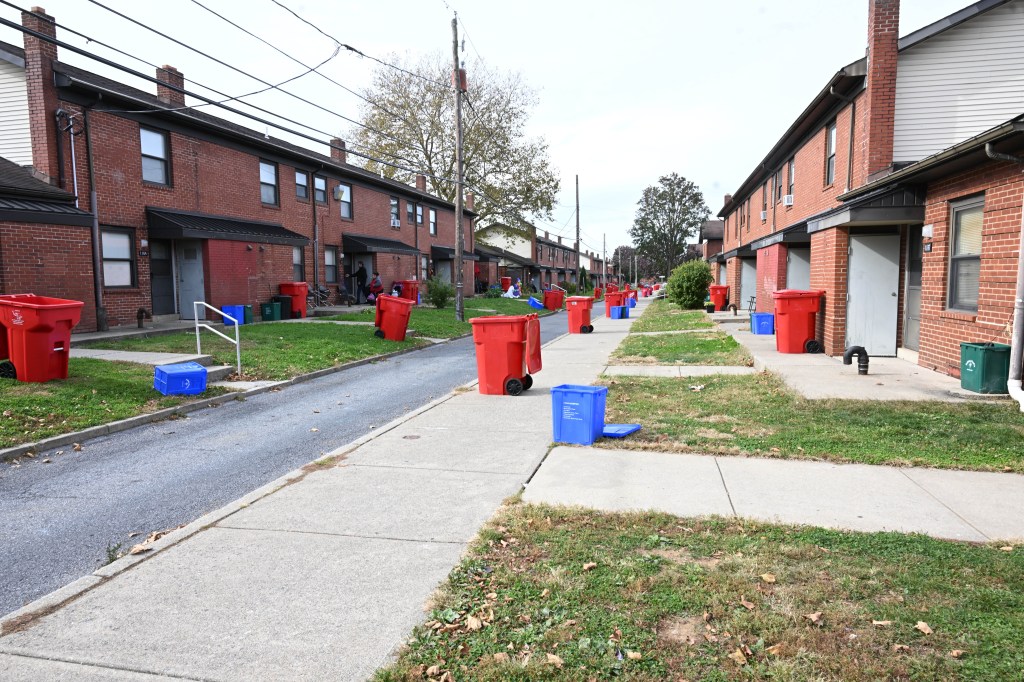
Bethlehem’s Pembroke public housing neighborhood is largely unchanged from when it was constructed in the 1940s.
Two-story, box-shaped brick buildings line the sidewalks of the northeast Bethlehem neighborhood nestled near the city’s border with Freemansburg. At its center is the Northeast Community Center, a hub for community events and programs, with a basketball court, baseball fields and a small playground area.
The neighborhood largely feels like its own island sectioned off by busy roads like Stefko Boulevard and Pembroke Avenue, which seem to separate the neighborhood rather than connect it to its surroundings.
But Bethlehem is looking to transform Pembroke from a typical, outdated public housing neighborhood into a vibrant, mixed-income community.
Pembroke was one of 14 housing projects across the United States to receive a $500,000 federal “Choice Neighborhoods” planning grant in 2023, allowing the city to create a comprehensive proposal to transform the neighborhood.
It is about righting the wrongs of the past when it comes to public housing, Mayor J. William Reynolds said, by incorporating Pembroke residents’ thoughts and feedback every step of the way and giving them a leading voice in what happens to their neighborhood.
“We are trying to fix the mistakes that were made in 20th-century America … — and I think this is important, both from a moral point of view and from a planning point of view,” Reynolds said. “And a lot of this process over the past two years has been grounded in this idea about, how can you learn those lessons from the mistakes of the 20th century, both from a moral and a planning point of view?”
The result? A plan to demolish all 196 units, and replace them with 456 units of housing. Residents will be relocated during construction and offered the opportunity to return to a new, affordable unit, city officials said.
In addition to replacing the outdated units with modern ones, the city, in collaboration with the Bethlehem Housing Authority, which owns the properties, aims to increase the “connectivity” of the neighborhood via additional green space like outdoor pavilions and picnic tables, safer pedestrian crossings, and a “welcoming gateway” with signage and greenery, helping bestow a sense of neighborhood pride among the residents.
Overcoming distrust, engaging residents
The Housing Act of 1937, a New Deal-era program, facilitated the construction of public housing across the United States via establishing local housing authorities and providing them with money to construct housing units rented at low cost to low-income people.
It was the result of successful lobbying from tenants and poor peoples’ advocates at the time. However, the units themselves were often segregated by race until the Fair Housing Act of 1968, which outlawed housing discrimination.
Shortly after the Fair Housing Act passed, however, the federal government dramatically scaled down its support for public housing. President Richard Nixon issued a moratorium on future construction of public housing, and a 1990s-era federal program, meant to rebuild and modernize public housing, ended up replacing only around half of the units it tore down, so tens of thousands of housing units were permanently lost.
“Historically, much of public housing in America was built on the outskirts of towns, near industry, behind highways, just the less desirable land from a development perspective,” said Sara Satullo, Bethlehem’s director of community development. “You saw through various programs that came before Choice, trying to right those wrongs in small ways, and every time they kind of learned lessons, I would say.”
Bethlehem vows that its plan to rebuild Pembroke is different. The Choice Neighborhoods program, from which the funding was awarded, aims to improve and revitalize public housing neighborhoods without displacing residents. It requires one-to-one replacement for any units that are abolished and rebuilt.
Reynolds said it is understandable that some Pembroke residents are distrustful of the city’s efforts due to that history, which is why the city has gone to lengths to incorporate residents’ feedback in the process.
“It is understandable that people look at change in America as often leaving people behind, if they don’t have a seat at the table,” he said. “The Choice Neighborhood process has been about giving people a seat at the table, to make sure that their voices are heard.”
According to data gathered by the city, the average income of Pembroke residents is around $28,500, just 23% are employed full time, and nearly half have a physical or mental disability.
Around 51% consider Pembroke a “tight-knit community,” and 45% have had “mostly positive experiences” with the Bethlehem Housing Authority. Officials with the authority did not respond to emailed requests for comment.
Bethlehem project leaders gathered feedback from residents however they could, through a series of in-person and online meetings and online surveys. The idea of the redesign is to incorporate what residents want to see, city leaders said.
What the surveys found
Bethlehem received feedback from 96 Pembroke households, just over 50%.
Some of the most-desired changes residents said they would like were more outdoor gathering areas like picnic tables and pavilions, a fitness center and a health clinic — all of which city leaders said they will accommodate in the final plan for the neighborhood.
Merali and Henry Quinones, a husband and wife duo who live in Pembroke, were selected to be “ambassadors” for the redesign project.
Merali Quinones has lived in Bethlehem public housing her entire life, and Henry, a New York native, moved to Pembroke in 2014. Both are disabled and rely on Social Security income to get by.
The Quinoneses said they are excited about the changes coming to their neighborhood — particularly the new, refurbished units; additional parking spaces; and speed bumps that will curb excess speeds on the streets in front of their home.
But they said not all of their neighbors feel the same way, and some are worried about how the rebuild will affect them.
“A lot of them don’t like changes since they’ve been here for so long, and they hear something new, they are like, ‘Where are we going to go? Is it going to happen overnight?’ ” Henry said.
The Quinones and other advocates for the rebuilding project have tried to assuage concerns. The redesign certainly will not happen overnight. The city and Bethlehem Housing Authority will cover the cost of temporary relocation for residents, and construction will happen in “phases” so that residents have a temporary unit to move to while a permanent unit is under construction.
The city plans to apply for “implementation funds” early next year when the federal government opens applications; if granted, the city could receive $30 million to $50 million to cover demolition and construction costs. Bethlehem anticipates demolition and construction to take five to seven years, if the city wins that funding.
However, even if the city does not receive the implementation funding, it still would rebuild the entire neighborhood, though it would likely take much longer. The city would instead apply for low-income housing tax credits, and estimates that the rebuild would take 10-15 years under that scenario.
‘Growing pains’
Paula Johnson, executive director of the Northeast Community Center, which serves the Pembroke and surrounding areas, said that although the city has done its best to inform residents about the rebuild plans, there are many that still don’t understand — whether it is due to a lack of trust of authorities, a language barrier or lack of literacy.
“It was kind of a painstaking two years,” Johnson said. “I enjoyed being on the steering committee, but it was really tough to try and engage this community, because people are scared of change.”
She anticipates “growing pains” as residents face the reality of temporary relocation and adjusting to a brand new space.
Despite some hesitation and mistrust, officials hope that the outcome of the rebuild will be worth the short-term displacement.
The project will increase the amount of units available from 196 to 456, including market rate rentals, homes for sale and subsidized units for people that make 30%-80% of the area median income, helping meet additional demand for housing of all price points in Bethlehem. Only around 2% of housing units in Bethlehem are vacant, according to the city’s comprehensive housing plan, indicating a severe shortage of available homes.
It will increase the density of the neighborhood via building housing on the baseball field in the middle of the neighborhood, which Satullo said is underutilized.
In addition to adding much-needed housing units, the rebuild will accommodate residents seeking economic self-sufficiency. Currently, residents are only eligible to live in Pembroke villages if they make 30% or less of the area median income, which disincentivizes residents from seeking a better-paying job. But by adding additional subsidized and market-rate units, a resident could move within the neighborhood if they begin earning more than allows them to qualify for public housing.
“A lot of those people, you know, they were nervous like, ‘Oh, we are going to get kicked out,’ ” Henry Quinones said. “People got nervous, but I’m glad that they explained it, with the new way that they’re going to build the new houses, that they’re going to do it mixed income.”
The redesign also aims to better connect residents with jobs, education and other resources via partnerships with local nonprofits and organizations. It will demolish the Northeast Community Center and replace it with a “resource center” with hubs for multiple nonprofits, although the community center has been offered a space in the new building, Johnson said.
The comprehensive plan sets specific goals, including enrolling at least 50 residents in Northampton Community College classes, at least 30 into workforce training programs and at least 10 into a local employer job track program.
It also hopes to increase access to pre-kindergarten programs, better develop a retail corridor in the surrounding neighborhood and launch a resident council to give neighbors a voice to lobby the local government.
Though the full rebuild will take years to complete, Bethlehem already is embarking on an initial project — a redesign of Demko Park, a small, triangle-shaped green space just next to Pembroke Villages. The city plans to add playground equipment, lighting, seating and public art displays, based on feedback from residents.
Officials hope it will show Pembroke residents that the project has momentum ahead of the bulk of the relocation, demolition and construction work.
“I’m excited for this project,” Merali Quinones said. “I know it’s going to take long, and I’m like, ‘Oh, man. The impatience.’ But I’m excited. I love what’s going to go on.”
Reporter Lindsay Weber can be reached at Liweber@mcall.com.