
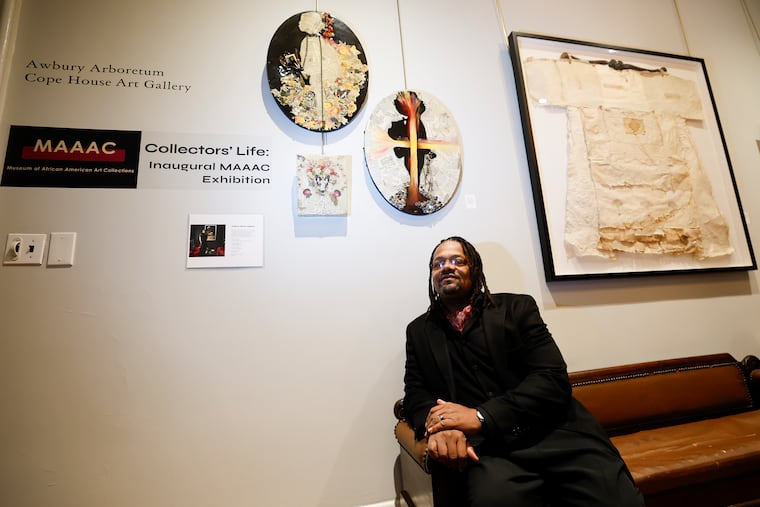
On a recent Thursday evening, Philadelphia art collector William Skeet Jiggetts sat in the foyer of Awbury Arboretum’s Francis Cope House surrounded by grand collages taken from the walls of his East Falls home.
The art — all made by living artists and friends of Jiggetts — is striking. A framed paper and antique lace dress by textile artist Rosalind “Nzinga” Vaughn-Nicole sits next to portrait-size cameos that mixed media artist Danielle Scott fashioned from newspapers and other found objects.
Jiggetts, 57, an art collector for more than 30 years, has had pieces from his collection on display in small shows, but never in his wildest dreams did he think that they would anchor an exhibition — in a traveling museum that he founded.
But here he was, at the opening reception for the inaugural exhibition of the Museum of African American Art Collections. Pieces from the art collections of Diana Tyson, Stephanie A. Daniel, and gallerist couple Adrian Moody and Robyn Jones were also on display.
Collector-centric art
Museums routinely curate exhibitions centering collectors’ works to celebrate and cultivate existing and potential donor relationships.
Some recent examples include the African American Museum in Philadelphia’s show drawing from actress CCH Pounder’s substantial collection and the Michener Art Museum’s show honoring the legacy of collector Lewis Tanner Moore, the great-nephew of 19th-century painter Henry Ossawa Tanner.
While the Barnes Foundation houses the late chemist and art collector Albert C. Barnes’ collection, there are very few other — if any — museums whose walls are solely dedicated to the collections of collectors. Nomadic, traveling museums, at that.
“It got to the point where I had more art than walls,” Jiggetts said looking over his black-framed glasses. “Nobody saw it … I didn’t even see it. I thought, ‘Wouldn’t it be cool for a bunch of collectors to get together and create a space to show our work. Tell our story?’”
Jiggetts got the itch to show his collection in the early 2020s after talking with colleagues who wanted to show theirs, too. In 2023 he set up a foundation, started approaching collectors, and began nailing down locations.
“There is a treasure trove of African American art in our living rooms, in our reading rooms, and in our dens that need to be shared,” Jiggetts said. “The Museum of African American Art Collections is a forum to host these collections and tell the stories that come with them.”
That’s how the Museum of African American Art Collections began.
A $200 frame and an obsession
Jiggetts, who works as a tax accountant, grew up in Germantown and spent Sunday afternoons at the Philadelphia Art Museum gazing at the impressionist works of Manet and Monet.
When he was in his 20s, he bought a poster of Vincent van Gogh’s Sunflowers. “I spent $200 of 1989 money on that frame,” he said with a laugh. That purchase marked the beginning of an obsession. He bought his first piece of original art from Germantown painter Lucien Crump Jr., who, according to a 2006 Inquirer obituary, owned the first gallery in the city dedicated to Black art.
Jiggetts scoured galleries and festivals for original art, buying any piece that tickled his fancy for under $500. In the early 2000s, his mentors — well known Philadelphia appraiser Barbara Wallace and the late African American collector Ronald Ollie — urged him to start evaluating his choices and he became a serious art collector.
“I figured out what it was I really liked,” Jiggetts said, describing his favorite pieces as ones that marry impressionist and abstract art, like the ones on display at Awbury Arboretum. “I realized I enjoyed the experience of buying art as much as the art. I like the company of artists.”
His collection is comprised of mostly living artists like the mixed media artist Danielle Scott; abstract painter Ben F. Jones; and Paul Goodnight, who is known for his colossal oil paintings featured in the backdrops of TV shows like Seinfeld and The Fresh Prince of Bel-Air. (Although Jiggetts does have a pencil sketch by the late Bahamian artist Purvis Young.)
Keepers of history
Collectors are the glue that keep the fine arts ecosystem — artists, patrons, buyers, gallerists, and museum creators — connected and running.
They are often patrons of the arts like James J. Maguire and his late wife, Frances, investing in artists and art institutions, building impressive art collections in their homes. Collectors Adrian Moody and Robyn Jones connect artists to buyers at Jenkintown’s Moody Jones Gallery, but their personal collection has more than 400 pieces.
“Collectors drive the market,” said Valerie Gay, chief cultural officer for the city of Philadelphia. “They have the power to catapult an artist from obscurity to a household name.”
Black collectors play an even more vital role in fine arts communities, explains Brooklyn, N.Y., collector Myah Brown Green, author of the forthcoming Keepers of a Movement: Black Collectors Who Preserve Art, Stories, and Legacies that Define Black Life.
It’s the Black collector who discovers artists at street fairs, off-the-beaten-path galleries, hair salons, and their friend’s basement.
Their interest — like mid-20th-century author Ralph Ellison’s enthusiasm for Harlem Renaissance-era oil on canvas master Romare Bearden — brings artists’ work to a wider audience that can lead to cementing an artist’s place in the fine arts canon. Their picks speak to the collective Black experience, shaping Black America’s historical image.
“They are the keepers of our history,” Green said. “Mediators who carry the work forward and continue the legacy.”
Setting value
The Black collectors’ library, Jiggetts says, is the first stop on living artists’ journeys to corporate boardrooms or the walls of major museums. “Our role is that of an economist,” Jiggetts said. “We set the value.”
The Museum of African American Art Collections will next move to Allens Lane Art Center for its February and March show and will host an exhibit at the Black Lotus Holistic Health Collective in May and June.
Collectors shared their experiences over white wine and sweet potato cupcakes on opening night.
Daniel — whose collection features local masters — spoke effusively about her Dox Thrash mezzotint. She will never let the print by the important early 20th-century Black artist go, she said. Robyn Jones interpreted the Jesse Read and Antoinette Ellis-Williams vibrant abstracts. (This reporter thought both of those pieces were images of shoes.)
The concept of a collectors museum is a new one. Black collectors are not.
“We’ve always collected our work,” Jiggetts said, stressing that these times require Black people to be stewards of their own stories.
“At the Museum of African American Art Collections, no one can tell us what to do, what not to do, and what we need to do differently. We don’t have to worry about having it being taken away. It’s ours.”
The Museum of African American Art Collections, through Dec. 31, Awbury Arboretum’s Francis Cope House, 1 Awbury Rd., Phila.Monday to Thursday, 10 a.m. to 4 p.m.; Saturday and Sunday, 10 a.m. to 2 p.m. Admission is free.