
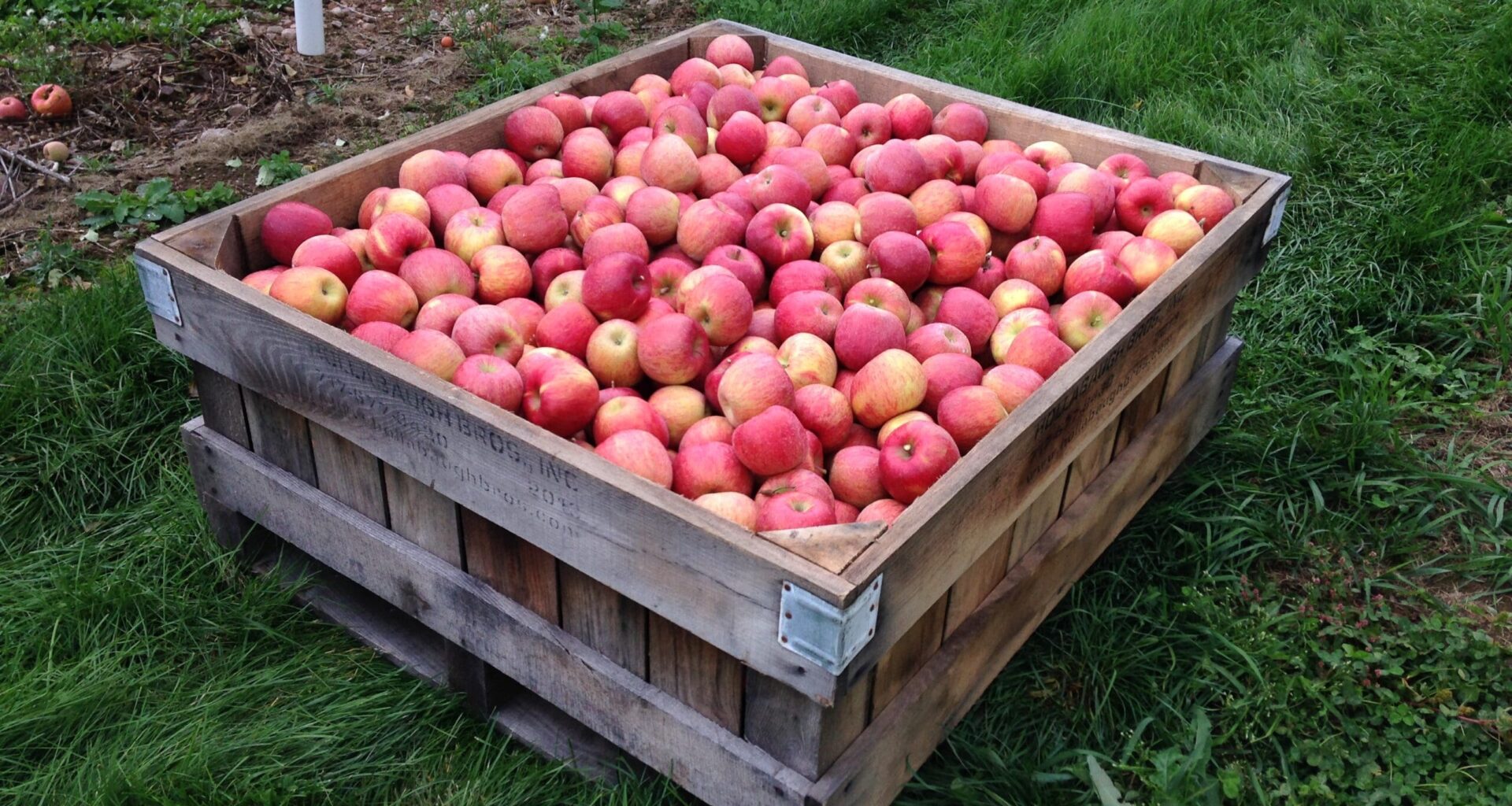
Pennsylvania grows over 100 different kinds of apples, including popular varieties such as Red Delicious, Honeycrisp, Gala, and Granny Smith. Pennsylvania is the fourth-largest producer of apples in the nation, behind Washington, Michigan, and New York.
Adams County, also known as “Apple Country USA,””” located in south-central Pennsylvania, is the heart of the state’s fruit belt and produces more apples than any other county in the state.
Cindy Heller is a volunteer at the National Apple Museum in Biglerville. Housed in the Biglerville Historical and Preservation Society, the museum was founded in 1990 to preserve and exhibit the history and artifacts of the apple industry in Adams County.
“We talk about William Penn, as well as Johnny Appleseed and their connection with the whole fruit industry,” Heller said. “We give you a history from the plow and horse that was there from the Levi Strauss, their first display, and then it goes through the whole process, around to the different agriculture areas of packing, processing, and all that to how the railroad started, how we started shipping out of there, how the shipping first started.”
Penn was a Quaker, born in 1644 in England. In 1681, he came to the United States and founded the Province of Pennsylvania. Johnny Appleseed, born John Chapman in Massachusetts in 1774, was a pioneer who dedicated his life to planting apple trees from Pennsylvania to Ohio, Illinois, and Indiana.
Adams County owes its successful apple production to a favorable microclimate, offering mineral-rich and well-drained soil, as well as protection from frost on the southeastern slopes of South Mountain.
Heller said another remarkable aspect of apples from Pennsylvania is that many of the farms are still family-owned, often spanning several generations.
“There are a number of 100-acre farms that we have here in Adams County, which makes it so that you get the, I’m going to call it, the extra attention, the extra quality, the fact of how it is picked,” she said.
According to the Pennsylvania Department of Community and Economic Development, the state has 21,000 acres of orchards and produces up to 500 million pounds of apples each year.
“We do have three of the top processors in our county here, which are Musselman’s, Knouse Foods, and Motts, but the biggest thing with all of the quality of the fruit, is far above what you see in a lot of other areas, is that personal small farmers can get you a lot more fresh fruit production than factory production,” Heller said.
Jim Benner’s family has owned El Vista Orchards, Inc. in Fairfield since 1915. Benner says the farm, which grows about 19 varieties of apples with over 100 different strains, ships apples to as far away as Dubai and Israel, and parts of the Caribbean and Central America to local U.S. grocery stores in Florida and North Carolina.
Benner says tastes and popular apple varieties have changed over the years.
“Now Gala is number one and Red Delicious, Golden Delicious, Honeycrisp, Fuji, the Pink Ladies, they’ve all picked up a lot of markets now,” Benner says.
Benner’s farm employs approximately 85 people, and during the busy season, including H-2A workers, members of a federal program that allows agricultural employers to hire non-U.S. citizens for temporary or seasonal jobs when there are insufficient U.S. workers available. He said the work of apple picking isn’t easy, and people don’t see the hard work that goes into it.
“It’s a lot of work, a lot of hard work, and sometimes really big weather conditions. But even in the rain, our guys will be out there working, because they know that work’s got to get done. And in wintertime, it’s freezing temperatures, you’re out there working, trimming trees, getting work done. That’s probably why we don’t have a lot of local people doing the work. They don’t want to do that kind of work. It’s not easy,” he said.
Ellie Hollabaugh Vranich is the retail market manager and assistant business manager at the 70-year-old Hollabaugh Bros farm in Biglerville.
The 500-acre family-owned and operated farm opened in 1955, and Vranich is part of the third generation to own and operate it.
“We grow over 50 varieties on our farm, so we do have a pretty wide mix, and that’s part of our claim to fame, is that people can come here in the fall, and choose from 20 to 35 different varieties all at one time,” Hollabaugh Vranich said.
In recent years, Hollabaugh Vranich said there’s been a shift away from traditional apple varieties to older heirlooms such as the Arkansas Black.
“It has a very, a very thick skin, which I think is part of why it kind of did not become a mainstream variety, but it has an interesting flavor profile, and it does, I think, cook and bake nicely, so people seem to like it,” Hollabaugh Vranich said.
She adds that thanks to modern technology, cold storage facilities, apples can be enjoyed year-round.
“A lot of people have a misconception that, oh, you know, apple season is in the fall, and I buy my apples in September and October, and at the holidays, and then I’m done for six months,” Hollabaugh Vranich said. “But apples are a great source of nutrition, and to include them in your diet on an ongoing and year-round basis is beneficial.”