

With Pittsburgh Tomorrow turning two years old, a citizen might ask: What is it and what is it doing?
I publish this magazine, and I also started Pittsburgh Tomorrow, working with a great team to improve this region’s future. Pittsburgh Tomorrow is a nonpartisan 501(c)(3) non-profit funded by Pittsburgh citizens — wealthy people and working people — Democrats, Republicans, and independents. We purposely didn’t seek initial funding from the region’s deepest pockets — foundations, corporations, and government. Instead, we sought to test whether citizens would support a bold and ambitious revitalization campaign. If they wouldn’t, it either meant we had a crummy plan or they didn’t care. Either way, Pittsburgh Tomorrow wouldn’t deserve to exist. But they did, and they do. And now, based on the demonstrated success of the programs underway, we’re asking foundations, corporations and the government to match our citizens’ support and inviting new citizens to join us.
No other group is doing what we are doing.
Demographically, of all 387 U.S. metro areas, Pittsburgh has the highest natural population loss — more deaths than births — 17 percent more than the second worst region (Tampa/St. Pete) and 63 percent more than the third worst region (Bradenton/Sarasota). Economically, in 16 similar benchmark regions, the average 10-year job growth is 28.2 percent; only one of the 16 actually lost jobs and workers: Pittsburgh.
It all stems from the 1980s unparalleled industrial collapse, when 300,000 young people left, taking their future children and grandchildren with them. We became the nation’s oldest region almost overnight and lost a generation of risk-takers who believed they could do better elsewhere. Broad brush, that massive brain drain left a relatively risk-averse and insular Pittsburgh. And aside from being non-coastal, we’ve been out of business for jobs since the 1980s, compared with other regions. So we missed the enormous immigration that has defined modern America. From 1970-2024, U.S. Asian population increased 16-fold. Since 1975, the U.S. Hispanic population has increased sevenfold.
Pittsburgh Tomorrow exists to reverse those trends. In our first year, we created the organization and four short-term projects: resuscitating the Pittsburgh Passport, which connects college interns with regional life; creating a year-long journalistic project with 35 stories educating regional citizens about what immigrants face here; holding a seminar for local employers demystifying the hiring of foreign students; and launching a high school leadership corps pilot project. The country has changed in the last year, and now, in our second year, we’ve launched the four long-term projects that will define Pittsburgh Tomorrow.
Initiative 1: Welcoming Newcomers
There are only two ways to grow a region’s population: No. 1: Having more births than deaths. Given our natural population loss status, that option isn’t open to us. That leaves No. 2: Attracting and keeping more people than the number of people who leave. The conclusion, therefore, is simple and obvious: More than any U.S. metro area, Pittsburgh must attract, welcome and support newcomers if we are to stop decline and grow again.
Pittsburgh often is described as friendly but not welcoming. A large majority of us have lived here for decades — our social patterns and friend groups have long been set (“Where did you go to high school?”). That has its charms, including a strong social fabric and very low crime rate. But for new residents to thrive and stay, they must not only have a job; they must connect socially and feel part of Pittsburgh. It took me 10 years to feel connected and to “break in” socially. Many won’t wait that long. We’re going to reduce that period, helping newcomers connect and increasing the numbers who build lives here. We’re targeting professional transplants, boomerangers, people considering moving here, immigrants and secondary migrants from other cities, and graduate students.
Pittsburghpioneer.com
Our first salvo, which we just launched, doesn’t exist anywhere else in the world: an AI-powered, digital concierge connecting newcomers to everything they need to start a new life here, from basic services to social connections. Customized, confidential, secure and free, it saves hours of searching and it’s more effective. Where a Google search shows everything, Pittsburghpioneer.com shows exactly what matters, based on the personal profile each newcomer creates. Where an AI chatbot offers answers, Pioneer creates a roadmap, whether finding housing, enrolling children in school, learning English, or meeting people who share the same faith, language, or interests.
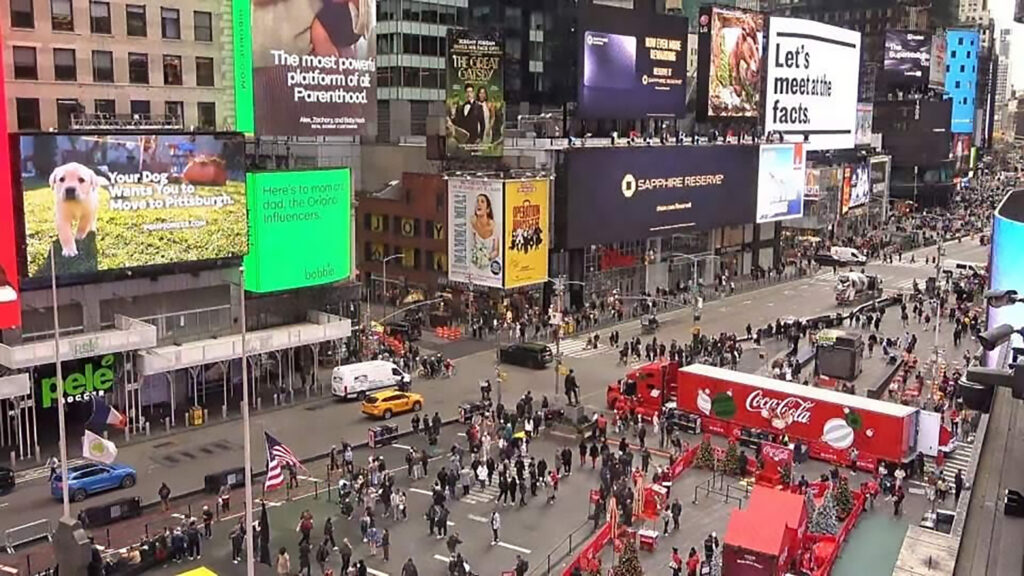 Pitching Pittsburgh at Times Square: Our first ad getting people to move to Pittsburgh appeared in mid November on Broadway in New York City. For a closer look at the actual ad, please see the image at the top of the story. We’re a scrappy, thrifty nonprofit, and we got the ad for just $500.
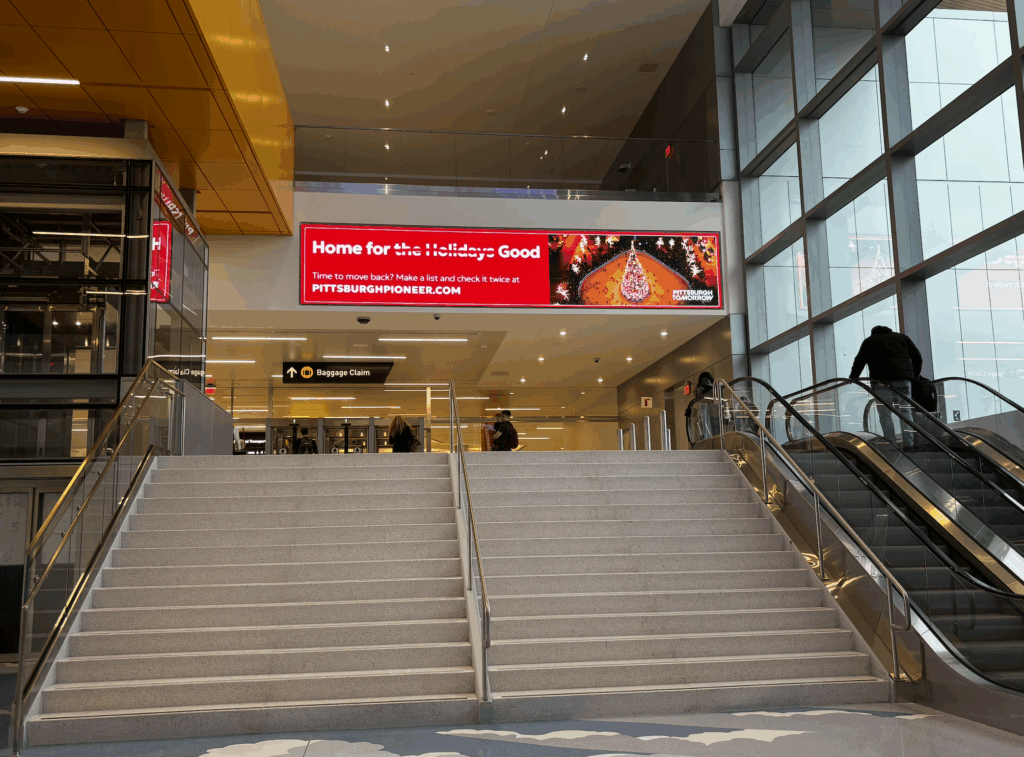 It’s Working: At key times at the new airport — Thanksgiving, Christmas & the NFL Draft — we’re running this electronic billboard that all arrivals pass directly under — directing visitors to Pittsburghpioneer.com — and the site has gotten 8,000 unique visitors in the first two weeks since launch.
Pittsburghpioneer.com also connects newcomers with our nonprofit partners, reducing service duplication and extending nonprofit capacity. It steers newcomers to prospective employers. Finally, it works hand in glove with the second, larger part of our newcomer welcoming strategy: The Pittsburgh Tomorrow Newcomer Center.
The Pittsburgh Tomorrow Newcomer Center
The center will be a visible, welcoming brick-and-mortar beacon in Downtown Pittsburgh, connecting newcomers to resources, culture, community, and fun. Especially since the pandemic, these last two have been in scarce supply and great need across the country, including in Pittsburgh. We anticipate a first-quarter 2026 opening in a key location, which will inject new vitality into Downtown. It will feature two separate and distinct parts — getting help with settling into our community and enjoying a place to relax and experience the best culture, music, art, food and beverage of Greater Pittsburgh.
The center will feature a welcoming lobby and reception area where newcomers of all sorts can walk in, learn about resources, and connect with and use them. This will include conference rooms, office suites and information kiosks, for use by newcomers and our nonprofit partners for their meetings. This part of the operation will be the “Welcome Wagon of the 21st Century,” where we’ll collaborate with regional partners, hosting drop-in educational sessions.
The heart of the center will be a vibrant “Third Space” (not work, not home). Working with hospitality joint-venture partners, this space will feature an “internet cafe” by day and multifaceted gathering spot by night, providing a free-spirited and sophisticated space for newcomers and Pittsburghers alike. The attractive, versatile flex space will be adapted to a multiplicity of uses. We’ll host Pittsburgh Welcome Days, after-hours hiring events, how-to classes on all aspects of Pittsburgh, “Meet Our Leaders” gatherings, global cultural themed evenings (e.g., Moroccan Night, Brazilian Carnival, and Chinese New Year). We’ll have, food tastings, Sip & Connect, as well as live music, DJs, dance, and speed friending and dating — all curated to create a fun and vibrant atmosphere that moves between salon and social mingling space. In short, a blend of intellect, inspiration, connection and fun.
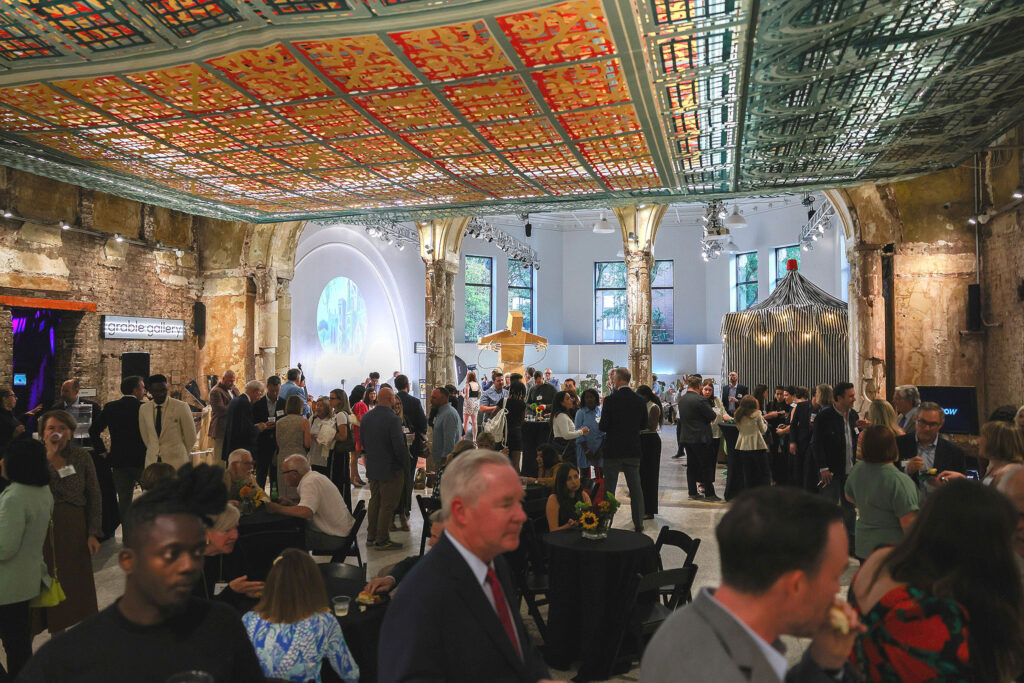
We’ll also host our Pittsburgh Tomorrow Intersections there. These cross-sector events — parties with a point — feature all-star panels of regional innovators and leaders catalyzing a new vision and action among the 250 diverse guests enjoying post-panel food, drink and what is becoming known as “Pittsburgh’s Best Conversation.” We have held three since April, with a fourth scheduled for Dec. 3. Email hello@pittsburghtomorrow.org if you’d like to register.
We have the location and we’re excited about this center, but it will only happen if we receive the necessary corporate, foundation and government support — which we are seeking now.
Initiative 2: The Pittsburgh Tomorrow Leadership Corps
After the success of last fall’s pilot — 300 students from 15 high schools created community conservation projects — we’ve launched an expanded program blending engagement and leadership development for high school sophomores and juniors across Allegheny County. We need these young people for our future, and this program builds their knowledge of and affinity with their home city, increasing the chances they’ll build their adult lives here.
At our first gathering on Oct. 18, students from across the county (the largest group ever for our partners, Allegheny Cleanways and Friends of the Riverfront) cleaned up the North Shore, North Side, Downtown and the Strip District. They loved it, both meeting students from other schools and being part of something bigger. (See the video at https://youtu.be/KEjF1yI2XyI?si=w5TU7CPUBm32SQK-)
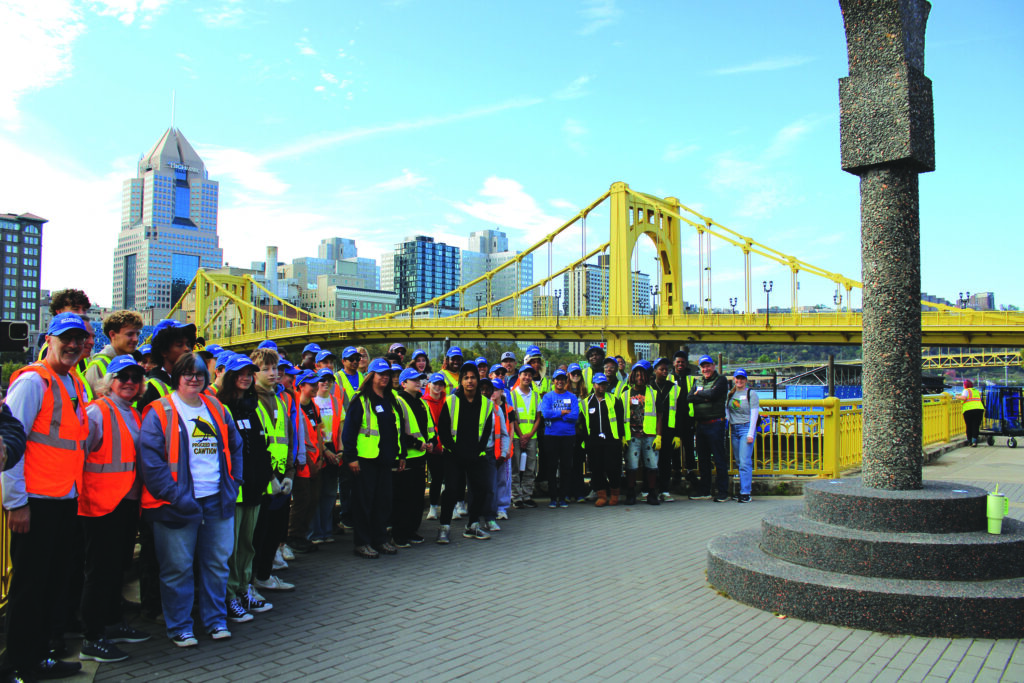 On Oct. 18, more than 60 high school students from across Allegheny County converged on the North Shore to clean up Pittsburgh — the start of a year of varied activities for the Pittsburgh Tomorrow Leadership Corps.
On Jan. 10, they’ll learn Pittsburgh’s fascinating history with Andy Masich and the Heinz History Center team. On Jan. 31, the Carnegie Mellon admissions team will help them frame their future college applications and financial aid plans. In February through May, they’ll learn about key Pittsburgh industries and how to prepare with the Pittsburgh Technology Council, visit a Pittsburgh Symphony Orchestra rehearsal, taste the game of golf and its etiquette with First Tee Pittsburgh, and rub elbows with Pittsburgh’s top political leaders — city, county, state and federal. We need these young people, and we’re building this program to number in the thousands. There’s nothing like it in this country, and we’re going to change the national image of Pittsburgh from old, brown, and rusting to young, green and involved.
Initiative 3: Media, Messaging and Marketing
Historically, marketing is not part of the culture in this manufacturing and engineering center. Unlike Cincinnati, where Procter & Gamble created the soap operas to sell products, Pittsburgh was a place of basic materials that didn’t need to be “sold.” That humility and modesty, however, is no longer a virtue in the competition among regions for people.
We need to get this region’s main horsepower — its citizens — behind the effort to build the new Pittsburgh. That’s where the power lies, and if we can get the local population to believe and to put their shoulder into the effort, we can do anything.
We have a great story to tell the outside world too. Our quality of life and blend of assets is unmatched: great culture, low crime, water, life on a human scale but near big cities, affordability, kindness, great schools and universities, medical excellence, four seasons, and a beautiful natural playground. Yet the world doesn’t know this. You can do anything here, and we’re telling that to the world, starting this fall.
Media, messaging, and marketing are so important that two years ago, our first step in determining whether to undertake Pittsburgh Tomorrow rested on the outcome of a dinner with the heads of 15 media companies. Would they be willing to donate ad space and air time to help involve citizens in the effort? If they had said no, Pittsburgh Tomorrow would not have moved ahead. But they said yes, and this messaging just began this fall with our Rosie the Riveter “We Can Do It” campaign. (See an example on page 102) No city in the U.S. has this kind of partnership.
Our Pittsburgh Tomorrow Pioneer videos bridge the local and the national. In August, we started this major social media campaign — a video-first content marketing series featuring the founders, creators, and visionaries building the future here. It’s designed to change external perceptions and inspire young pioneers to build their dreams here. The 12 subjects filmed so far include Sarah Coppolo (owner of the Bloomfield soup restaurant Brothmonger); Nisha Blackwell (a fashion entrepreneur from Homewood who dressed Danny Glover for the Oscars); and Utkars Jain (founder of HEARTio, a biotech startup recognized as an FDA Breakthrough Device).
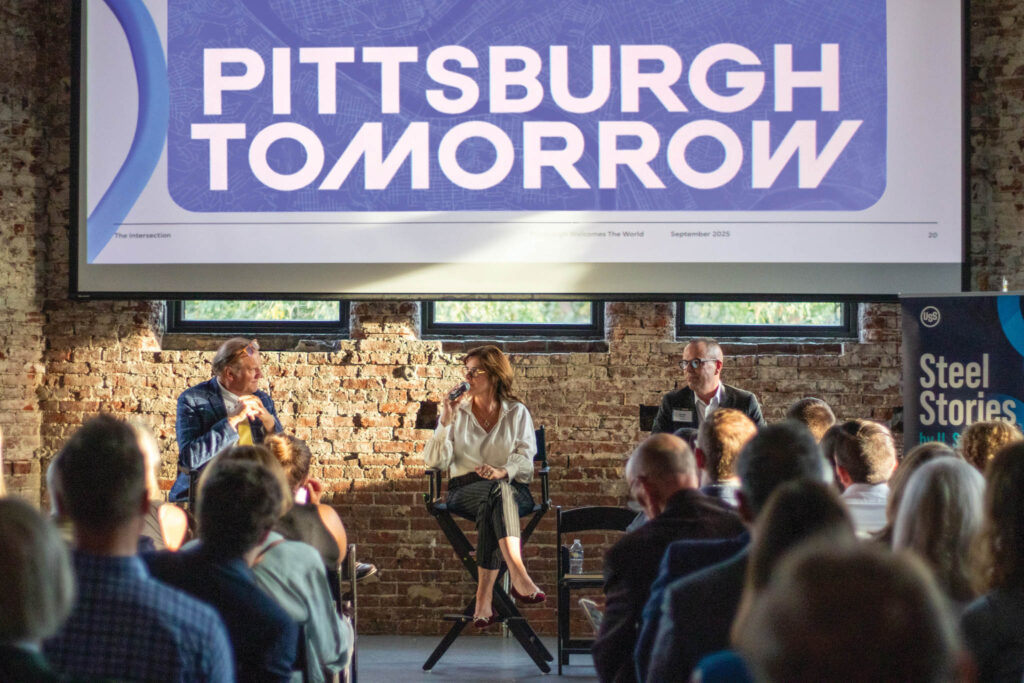 On Sept. 16, a wide cross-section of 225 leading citizens gathered for the third Pittsburgh Tomorrow Intersection. Airport director Christina Cassotis and Visit Pittsburgh’s Jerard Bachar discussed the new airport and the NFL Draft as “Pittsburgh Welcomes the World.” Food, drink and music followed.
In two months, we’ve posted the 24 unique pieces of content 83 times on six platforms. The videos have grossed over 285,000 organic views, reaching 125,000 unique accounts and garnering 1,400 hours of watch time. Nearly 70 percent of viewers live outside of this region, and 90-plus percent are not Pittsburgh Tomorrow followers — meaning our message is reaching far and wide. See the pioneer videos at https://www.instagram.com/pittsburghtomorrow
Initiative 4:
Our first three initiatives are underway and succeeding. The fourth is the biggest of all. We’re not ready to announce it yet, but it focuses on creating more jobs and attracting more visitors.
Across Pittsburgh, many passionate and capable people are working toward building a brighter future. Yet too often, these efforts occur in isolation — each group “doing its own thing” rather than combining strengths toward a shared vision. This fragmentation limits our collective impact. Imagine a unified front where leaders in Life Sciences, AI, Robotics, and Energy collaborate, coordinate, and invest together to elevate Pittsburgh’s standing as a global center of innovation. Henry Ford captured it well: “Coming together is a beginning; staying together is progress; and working together is success.” I would add that investing together is the next essential step in transforming progress into prosperity — driving both job creation and population growth for generations to come.
If you like what you’ve read, I hope you’ll support Pittsburgh Tomorrow today. You can donate online at
https://www.Pittsburghtomorrow.org or if you want more information, email me at doug@pittsburghtomorrow.org If you believe in the future of this region and want to help make it happen, we need your support. Together we go higher.