
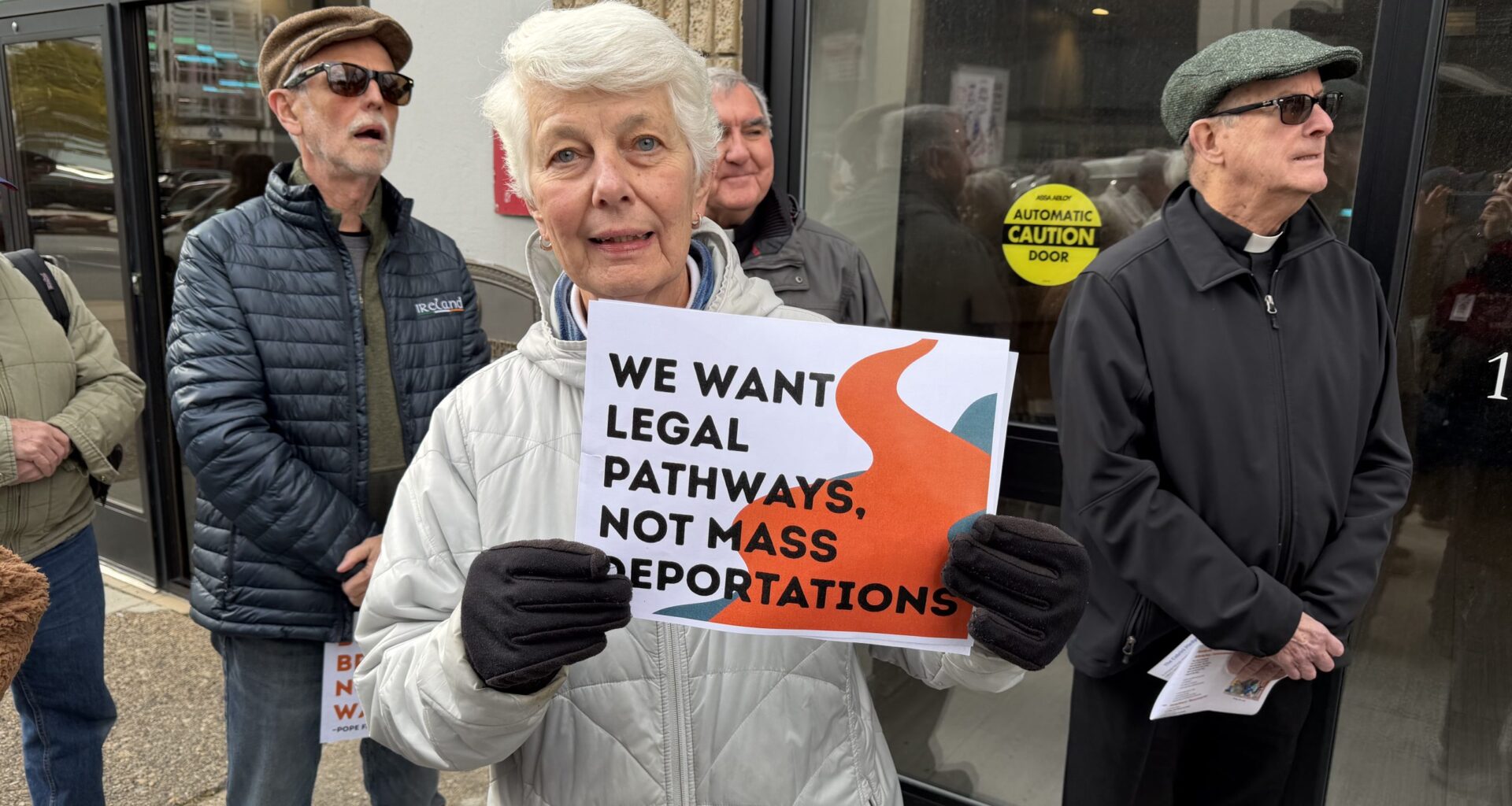
Dozens of people crowded the sidewalk and partly blocked 8th Street in front of the U.S. Immigration and Customs Enforcement office in Center City, holding up signs and listening to speeches protesting the Trump administration’s sweeping campaign of detention and deportation.
The demonstration last month was organized by the New Sanctuary Movement, an interfaith group, and drew participants from around the Philadelphia region. Catholic school students, members of religious orders, and laypeople joined a prayer vigil and a silent Eucharistic procession around the building.
The protesters included Jerry Zurek, a retired Cabrini University communications professor who co-leads a regional chapter of the NETWORK Lobby for Catholic Social Justice. He came in from Haverford for the event, and said he planned to keep visiting 8th Street weekly for a continuing series of anti-ICE protests.
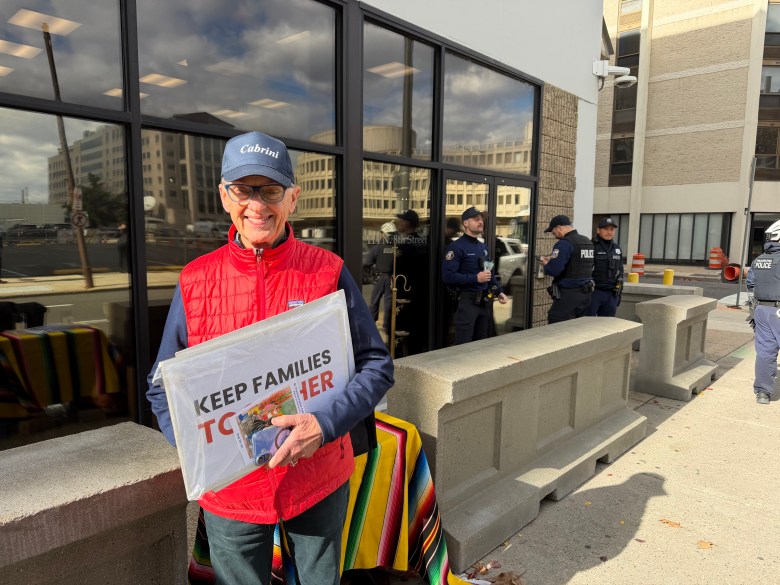 Jerry Zurek of Haverford participated in a protest outside the ICE office on 8th Street in Center City. Nov. 11, 2025. (Meir Rinde/Billy Penn)
“I believe we should welcome all people of good will,” he said, as he leaned against a low wall in front of the building’s dark-tinted windows, waiting for the processing protesters to finish their circuit. “They enrich our country. I’m a former teacher, and I had so many students who were immigrants themselves, some of them undocumented. I want to do whatever I can to help them.”
Zurek, who is in his 80s, was one of many older people at the protest. He said he wanted to be there, despite the day’s cold wind, in part because of his many years traveling to poor countries. He’s seen up close how conflicts stoked by the U.S. have forced people to abandon their homes and emigrate, and he wants to help create a more just future, he said.
“I’m trying to do everything I can to support our immigrant community, to make America better,” he said. “We just had twin granddaughters born, and I think we want to make the world OK for our grandchildren.”
A powerful graying demographic
Political activity and protest are often seen as pursuits for the young, but the grayer heads of retirees who have more time to attend events during the day — or who are newly energized to speak out by the tumult of the Trump era — also make up a noticeable contingent of protesters at many demonstrations, rallies, marches and press conferences.
“Because bad things keep happening — that keeps people coming more and more,” Sister Margi Savage said during the ICE protest. Savage is a Flourtown resident and a member of the Sisters of Saint Joseph, a Catholic religious congregation of women. “It’s grown, the public witness and the desire to stand up against what is unjust in our eyes.”
That may be particularly the case in Philadelphia, which leans heavily Democratic and has a substantial community of both mainstream liberals and far-left progressives outraged by what they see as the Trump administration’s authoritarianism.
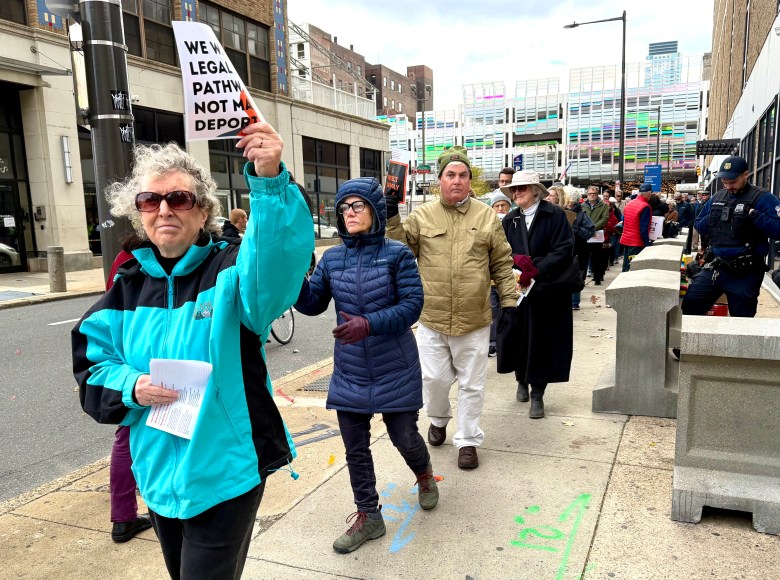 Protesters marched in a procession around the building that houses ICE offices on 8th Street in Center City. Nov. 11, 2025. (Meir Rinde/Billy Penn)
Nationally, older people tend to be more conservative than average; among Americans in their 60s, for example, 53% are aligned with the Republican party compared to 43% with the Democrats, according to a 2024 Pew Research poll. However, that still means there are vast numbers of centrist and left-leaning seniors who might be motivated to speak out.
Seventy million people in the United States are over age 60, and 10,000 per day are turning 65. The author and environmental activist Bill McKibben, who is 64, has noted that they vote in high numbers and own about 70% of the country’s financial assets. Their energy, experience, free time, resources, political influence and sheer numbers inspired him in 2021 to establish Third Act, a national political movement of retirees committed to the environment and other progressive causes.
“If you want to push around Washington or Wall Street or Beacon Hill, then having some people with hairlines like mine is a useful asset,” he told WBUR in Boston last year, while pushing up his cap to reveal his own thinning hair.
Third Act’s Pennsylvania branch includes some newly minted activists like Eric Pumroy, who is 73 and headed Bryn Mawr College’s special collections department until he retired in 2022.
A Center City resident, he coordinates the local group’s Climate Finance team, which has recently been holding workshops that explain how to move personal assets — bank accounts, credit cards, insurance policies — out of financial providers that invest in fossil fuel production and into more climate-friendly alternatives.
“Places like Bank of America, Wells Fargo, Citibank, JP Morgan Chase, are the biggest funders of fossil fuel infrastructure in the world among banks, to the tune of $40 billion to $50 billion a year,” Pumroy said. “There are other ways of having credit. There are other banks that you can have your money in. The term we use with this — and this is a national movement — is ‘align your money with your values.’ ”
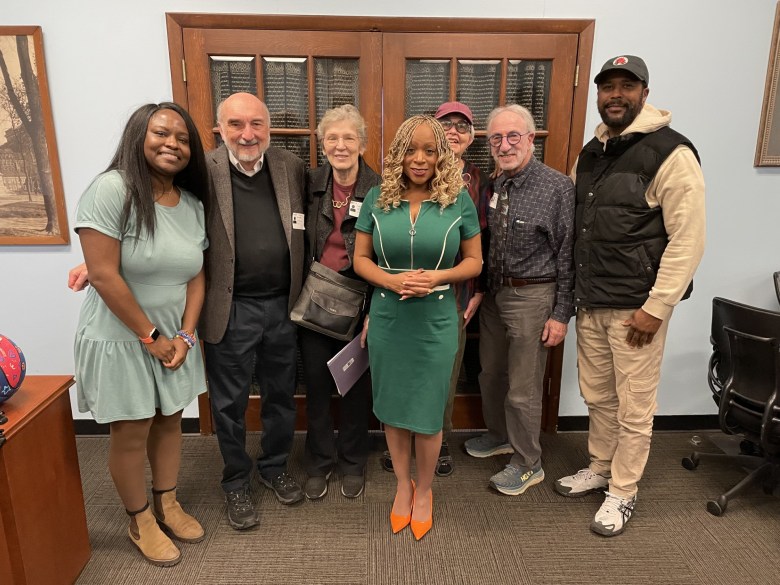 Eric Pumroy, second from left, was part of a group of Third Act PA members who met in October with Philadelphia Councilmember Jamie Gauthier, center, and her staff. (Courtesy of Third Act PA)
Among other activities, he recently spoke at the showing of a documentary about the Clean Air Act at Fountain View at Logan Square, a senior living facility in Philly. In October, he was part of a group that asked Councilmember Jamie Gauthier to rally City Council support for state legislation that would make it easier to build community solar projects.
Pumroy also joined Citizens Climate Lobby, another national group, and went to Washington, D.C., last summer to lobby aides to Sen. David McCormick, Rep. Dwight Evans, and other legislators to support climate-related measures.
A sense of debt
Pumroy said he’s been interested in politics for a long time; he’s donated to different causes and he knocked on doors for Barack Obama’s presidential campaigns in 2008 and 2012. But his job precluded spending much time on activism, and he and his late wife were also busy raising their two daughters.
Shortly after he retired, he attended a book talk by McKibben at the Free Library and heard about Third Act. He was recruited to the Climate Finance team and took over running it when his predecessor moved away.
“It was something I hadn’t thought about very much before, but the more I thought about it, the more I realized that this is something that people can do without leaving their homes. You can make the changes personally,” he said. “There’s lots of other important work that needs to be done that involves political work and so on. This is a pretty low threshold, but if enough people do it, it can start to make a difference.”
He and many of the activists he works with are motivated by a sense of debt, he said — the feeling that they have lived prosperous, comfortable lives thanks an economy powered by cheap fossil fuels, and that their own family members are among those who will suffer the consequences if things don’t change. Pumroy has two granddaughters.
“There is a extremely well-funded power in the United States that says climate change is not an issue, and we need to just keep pouring these greenhouse gases into the atmosphere, and your grandchildren may have miserable lives as a result,” he said.
“I don’t think I’ll ever stop”
A specific concern about their own family’s future is often the spur that gets people engaged in work to better not only their own lives, but eventually those of their communities and society broadly.
For Overbrook resident Sylvia Witherspoon, the galvanizing moment happened 12 years ago. Her 8-year-old adopted son attended Cassidy elementary school, and after talking to a substitute teacher who was from the suburbs, had began to understand the Philadelphia school district’s yawning resource gap.
“He came home one day and said he does not get the things that the white kids get,” she said. “He wasn’t doing 21st century learning. Do they do their assignments on the computer and things like that? He wasn’t. He wanted a science club, and they didn’t have that. They didn’t have a lunch room — they had to use the gym for the lunch room. There was a lot of things missing at the school at that time.”
Her son also talked to an afterschool program staffer who is a member of POWER Interfaith, a coalition of church congregations that presses for social change. The staff member said, “If you want some things to change, then we have to get to work,” Witherspoon recalled.
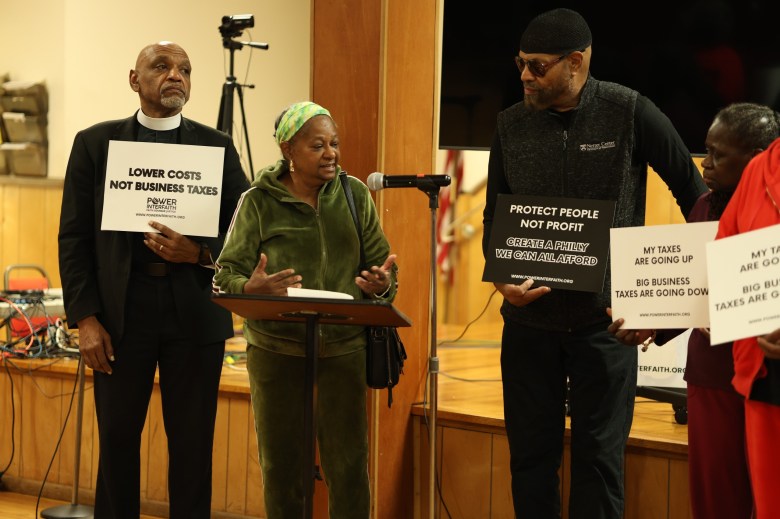 Sylvia Witherspoon, center, spoke about the rising cost of housing at POWER Interfaith event at Mt. Pisgah A.M.E. Church in November 2025. (Courtesy of Sylvia Witherspoon)
“So we joined POWER. I took him up to Harrisburg with me. He spoke to the senators and the state representatives in the [state capitol] rotunda about what he wanted,” she said. “I took him to let him know that there was a way that we could help improve his school. I’m a former social worker in the city of Philadelphia, so my brain goes, ‘Just don’t complain about it. Learn how to solve problems.’ ”
The movement they joined culminated in a historic court decision in 2023 that deemed Pennsylvania’s education funding system unconstitutional and paved the way for the state to gradually increase funding for resource-starved districts in Philadelphia and other cities.
Witherspoon, who is 67, continues to be part of two POWER teams focused on housing policy and education. She was recently in Harrisburg again, working to make sure legislators authorize the next set of promised education payments. She said there’s no way that getting older, or anything else, would make her stop pushing for change.
“Are you kidding me? There’s special needs children who aren’t getting what they need because of lack of funding, and they fight over who’s going to pay for what,” she said. “No, I don’t think I’ll ever stop as long as they want to treat our kids like this.”
A lifelong battle
To trace the roots of Joe Piette’s political awakening, you have to go much further back.
Piette served in Vietnam and, upon returning, joined Vietnam Vets Against the War, which led to a lifetime of attending anti-war protests. Thanks to a cheap camera he bought on base during his service — “the only good thing I got out of the military” — he became an “activist photographer,” with tens of thousands of pictures to his credit.
“I try to make them good photos, but the main purpose of them is to help build the movement,” he said. “I want the people in the protest to look good, so someone viewing them says, ‘Well, I should be there too.’ ”
He also worked for the U.S. Postal Service, joined the union, and got involved in the labor movement. He’s a constant presence at rallies around the Philadelphia region, mostly recently protests against ICE, Israel’s war in Gaza, a potential attack on Venezuela, and federal cutbacks to health and education funds, among many others.
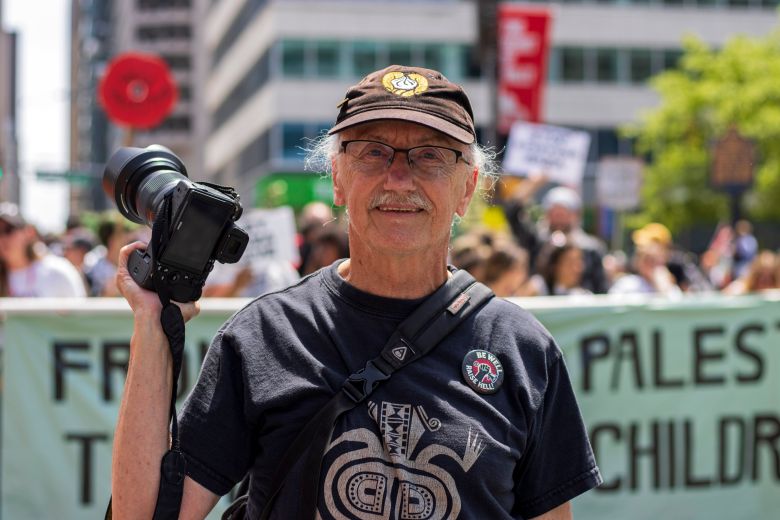 Political activist and photographer Joe Piette attended a protest march in Philadelphia on May 11, 2025. (Conner McHugh)
Piette says he’s part of a core contingent of lifelong activists, forever pushing back against a “billionaires’ government” that helps the rich get richer while failing to provide people with basic needs like housing and oppressing other countries, he said.
“They were the activists 30, 40, 50 years ago. It doesn’t go away, because the system is still the same system. The same system that promoted the war in the ‘60s and ‘70s in Vietnam is the same one doing it today and threatening it against Venezuela. So there’s one continuous line there,” he said.
Lately, he has been preparing for a 12-day, 103-mile “March for Mumia” from Philadelphia to SCI Mahanoy, the prison where Mumia Abu-Jamal is serving a life sentence for killing a Philadelphia police officer in 1981. “People in prison are not given health care that they should get,” Piette said. “Why are people 70 and 80 years old still kept in prison? They’re not a threat to society now.”
Piette himself is 79 years old, but said he’s not concerned about the rigors of marching for days in the cold. After all, he was a letter carrier for decades and ran marathons into his 60s, he said. And unlike some of his compatriots who get depressed by the lack of progress on various important causes, he’s always motivated to keep going.
One organizer friend who was discouraged by declining union membership asked him, “How come you’re at all these protests? You’re involved in so many things,” Piette recalled. “And I told him, well, that’s the reason.”
“If you look at it from a wider viewpoint than just a narrow part that you might be involved in in a particular week, if you look at a broader scope, there’s always stuff going on that needs your participation,” he said. “So I’m never depressed because something isn’t going well — because there’s always other things that are going well.”

This article is part of WHYY’s series, Growing Golden: Aging with Purpose.