
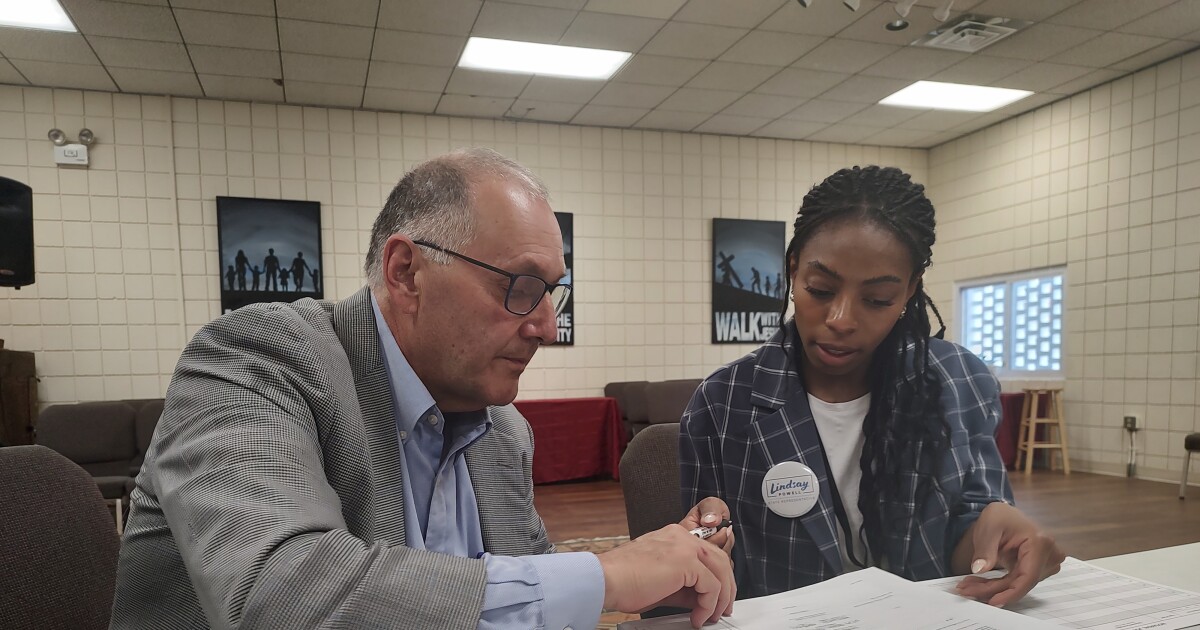
Sam Hens-Greco has chaired the Allegheny County Democratic Committee through generational change, the Democratic disaster of 2024 and the party’s resurgence last month. Not to mention a slew of special elections in between.
But local Democrats will face the 2026 midterms without his leadership: Hens-Greco will step down from his leadership role early next month, several months short of the end of his four-year term. Vice chair Kate Garfinkel will assume the chair at least until June, when the party will select local leaders for full four-year terms.
Hens-Greco couldn’t have chosen a higher note to end on than the 2025 election cycle, in which Democrats drubbed Republicans across the county and the nation.
“Timing is everything in politics,” he told WESA Monday evening. After his party romped in races from school board contests to statewide judicial fights this fall, “there‘s energy and enthusiasm,” he said.
“It’s hard to parse how much of this was voters hating [President Donald] Trump,” he allowed, and then joked, “But I’ll take the credit.”
As chair, he spearheaded a number of initiatives, drawing broad acclaim for a successful vote-by-mail program, overhauling the local party’s financial model, and pioneering the use of ranked-choice voting to choose nominees in special elections.
The committee chair oversees more than 2,000 committeepeople, who are elected or appointed in pairs to represent each of some 1,300 voting districts countywide. They help with voter education and turnout, and make candidate recommendations of their own by endorsing office-seekers before the Democratic primary.
In a Monday-evening email to committee members, Hens-Greco said his goal had been “to steer the ACDC toward a true grassroots model — one that welcomed every person ready to go door to door to elect Democrats up and down the ballot. Now, with the successes of this election behind us, and with time to do some careful reflection, I have decided that I will not seek re-election as the ACDC Chair in June 2026.”
He told WESA that with his 70th birthday coming up and his wife, Common Pleas Judge Kathryn Hens-Greco nearing retirement, “I took some time after the election and said, ‘What do you want to do over the next four years?’”
When he took the chair in 2022, he said, “I had a really clear agenda, but it was a little harder to define what I would be doing in another term. It’s about making sure you have the fire in the belly.”
‘A heck of a job’
Allies credit Hens-Greco with not just holding the local party together, but moving it forward at a time when a new generation of leaders — including U.S. Rep. Summer Lee, Pittsburgh Mayor Ed Gainey, and County Executive Sara Innamorato — were shaking up the region’s political culture.
“Sam is a good friend, and I think he’s done a heck of a job,” said state Democratic Party chair Eugene DePasquale. “He united a lot of competing forces inside the coalition, and he was really ahead of the curve on mail-in voting.”
This year, for example, local Democratic efforts included reaching out to voters who had cast mail-in ballots in 2024 but not requested a ballot this year — the kind of one-on-one effort that pays off on Election Day.
“You don’t have the kind of mail-in voting this county has without hard work and a strong partnership between labor and the party,” said labor leader Darrin Kelly, who will step down as head of the Allegheny County Labor Council next month.
Kelly credits Hens-Greco for keeping labor’s concerns at the forefront: While ties between organized labor and Democrats are generally strong, there are sometimes tensions over issues such as natural gas drilling.
“Sam knew there were going to be times when we wouldn’t be on the same page,” Kelly said. “But the commitment was always to the movement.”
Hens-Greco also earned plaudits for his stewardship of numerous special elections for the state House of Representatives — three of which took place at the same time in early 2022. When it came time for the party to choose a nominee, Hens-Greco used ranked-choice voting to determine the committee’s pick — a novelty for a party with a reputation for resisting change.
Despite some wariness, DePasquale said, “Everyone knew they would get a fair shake and be treated fairly. What else can you ask?”
And he noted that while this fall was huge for Democrats everywhere, in 2024 Allegheny County was among the few deep-blue enclaves that didn’t see a precipitous drop in voter engagement.
“Allegheny County held steady” in 2024, said DePasquale, who lost his own bid for attorney general that year. “There’s never one reason for that — I’d like to think it had something to do with having decent candidates — but Sam deserves a lot of credit.”
Hens-Greco also addressed long-standing resentment about how the local party financed its operations. Historically, it relied heavily on endorsement fees — money paid by Democratic candidates seeking a stamp of approval by the party’s leadership before the primary. The fees could cost several thousand dollars for a countywide race — a hardship for many candidates.
Hens-Greco moved to reduce the fees and to devote some of the proceeds to publishing a voter guide — one that featured endorsed candidates and non-endorsed hopefuls alike. The party redoubled fundraising efforts through its annual Kennedy-Lawrence dinner and other initiatives.
The party’s funding “used to be on the backs of candidates and elected officials,” he said. And while some endorsed candidates don’t like seeing their money spent on voter guides that advertise their rivals, “My biggest constituency is the Democratic voters, and what they want is information.”
A succession fight?
Historically, leadership of the committee has swung, pendulum-like, between a progressive faction and one that aligns with an older-school base that tends to be more moderate. (Hens-Greco himself took the reins from Eileen Kelly, who aligned more with the party’s old guard.) Such tensions have defined the Democratic Party nationally as well, and they may shape the choice for Hens-Greco’s full-term replacement.
Democrats will choose local leaders in June after new committee members are elected the month before.
Garfinkel, a retired lawyer who has spearheaded the local party’s fundraising efforts, will take the reins on Jan. 5, and says she plans to run for a full term next summer: “I’m in it for the full thing.”
In the meantime, she will choose an interim replacement to fill her old job as vice chair, though she says she hasn’t made her pick yet.
Among her first challenges: overseeing the party’s nomination in another special election, when at least two Democrats vie for the soon-to-be vacant seat of state House member Dan Miller. Beyond that, she said, her most immediate goal is to “keep things running smoothly” in the style of Hens-Greco, who she called ”the heart of the committee, [with] an instinct for Allegheny County politics and a cadre of dedicated volunteers.”
As for whether she will face rivals this summer: “I’m as curious as you are.”
Jim Burn, who formerly chaired both the county and the state Democratic committees, said a contest is all but certain. In fact, he said he had been approached about seeking a return to the county post himself, though he said he hadn’t made a decision either way.
“I’d have to have a lot of conversations” first, he said, but he added that either way, “You’ll see coalitions begin to form between now and June, no doubt.”
Burn said Hens-Greco “deserves to be congratulated” for changes he brought, but “a portion of the party felt distanced” from his leadership. He noted that Hens-Greco had tried to convene a convention in 2024 to overhaul the party bylaws, but the effort failed when not enough committee members attended to establish a quorum.
Burn says that such tests reflect “the inability or the inability of the chair to whip the votes needed to get things done.” Anyone seeking to be the chair next summer, he said, should recognize that “the rank-and-file choose the leader.”
Hens-Greco acknowledged that changing the bylaws — including the endorsement process — was a piece of unfinished business, and that the abortive 2024 meeting suffered from several missteps.
Still, he said, “I hope folks will say, ‘He left the organization better than he found it.’ That’s what everyone in this role wants to do.”