
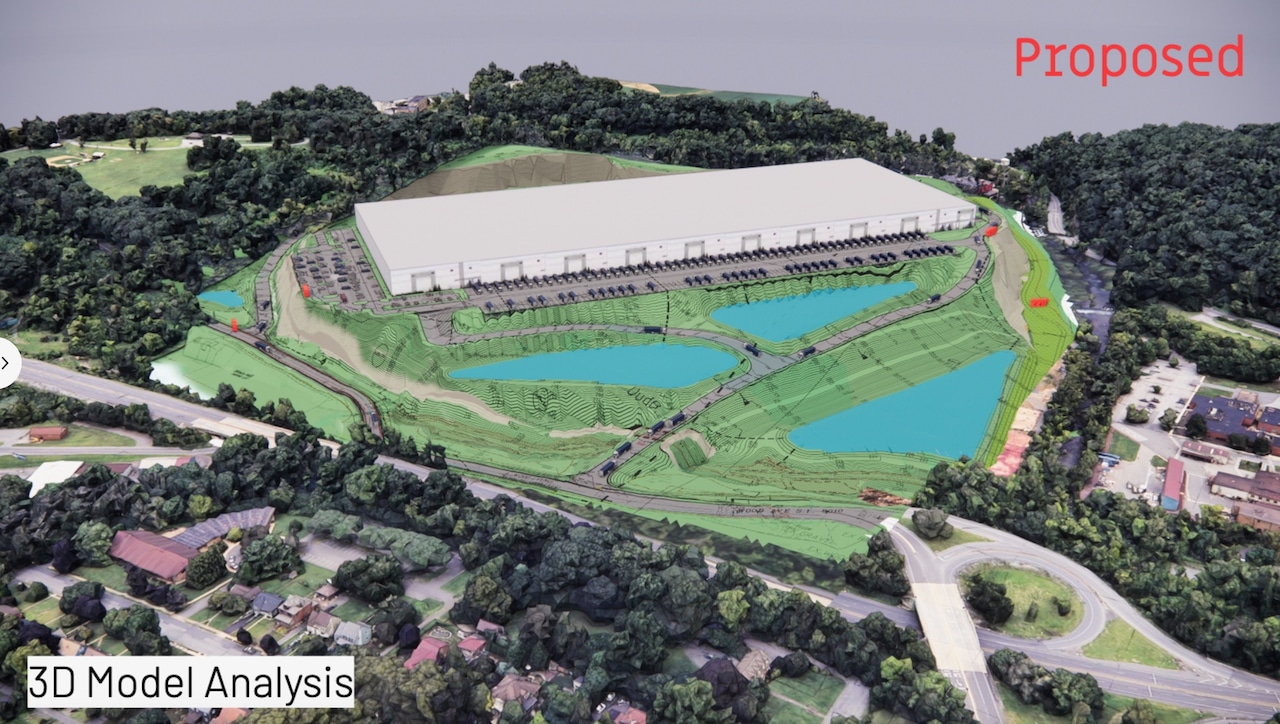
As one component of the Wood Avenue megawarehouse project is pending for Easton’s Zoning Hearing Board, both developers and opposing residents are continuing to put up a fight.
Scannell Properties’ request for a special exception to relocate an existing tributary that will daylight into the Bushkill Creek, a retention basin and a 40-foot-wide access road within a designated floodplain continues to move through the zoning hearing board.
The relocation is one piece of Scannell’s plan to build the million-square-foot warehouse at 1525 Wood Ave., which is named Easton Commerce Park. This component requires a separate approval from Easton.
The Easton Planning Commission voted on this specific piece in August, recommending to the zoning hearing board to not approve it. Separately, the planning commission must make a final decision on the entire warehouse project, which will take place at its meeting at 6:30 p.m. this Wednesday in Easton City Hall.
The zoning board first heard testimony from Scannell representatives on Sept. 18 after the Easton Planning Commission recommended not to approve the plan. Expert witnesses included project manager Donald Haas and environmental consultant Jeff Smith.
Residents opposed to the project began presenting their case, led by attorney Edward Shaughnessy on Oct. 27, with witness professor David Brandes.
Testimony resumed Monday night with geologist and Lafayette College professor Dru Germanoski, who outlined risks associated with moving the tributary through a landscape underlain by carbonate rock formations.
“The main issue with carbonate rocks everywhere is the potential for sinkhole development and surface instability,” Germanoski testified.
He explained that redirecting a perennial stream could channel new water into subsurface voids, potentially triggering collapses over time, particularly in areas where soils and unconsolidated materials overlie fractured rock.
Attorney Mark Kaplan, representing Scannell, made several objections during Germanoski’s questioning and testimony. He was unconvinced Germanoski was an expert in the matter at hand. He also argued much of the testimony was beyond the scope of the presentation.
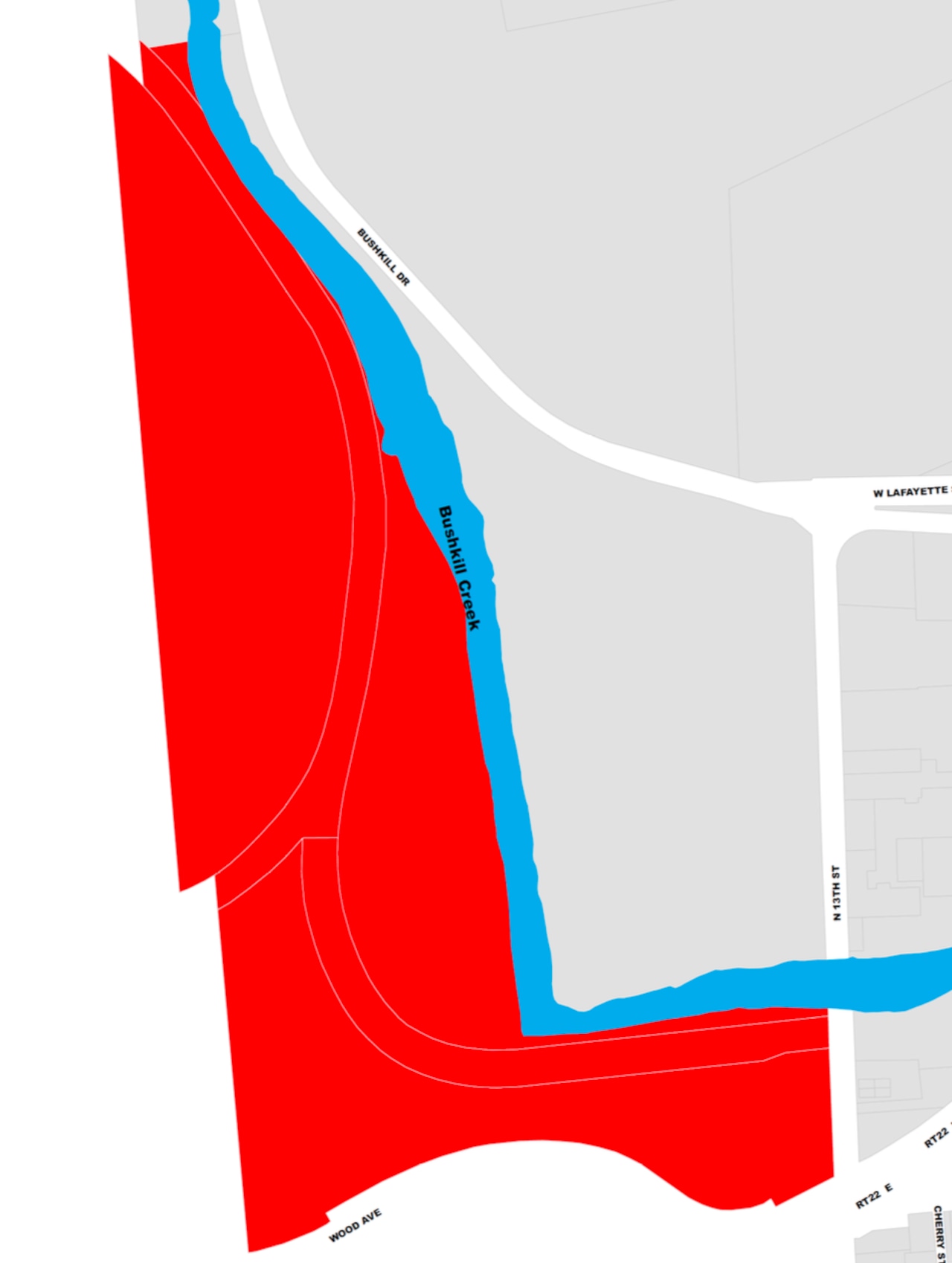 Developers of the 1525 Wood Ave Warehouse are seeking a special exception to relocate an existing tributary that will daylight into the Bushkill Creek, a retention basin, and a 40-foot-wide access road.Courtesy of the Easton Planning Commission.
“We are here not about the million square foot warehouse. We are here about this little piece of the property where the creek is being relocated,” he asserted.
The many residents in attendance were displeased with Kaplan’s many objections and were vocal during the meeting. Solicitor Robert Nitchkey had to remind residents to remain quiet during the testimonies.
During cross-examination, Kaplan pressed Germanoski on the extent of his site-specific knowledge and the scope of his review. He acknowledged he had not conducted fieldwork inside the property lines because the property is private but had reviewed available reports, including an April 2024 geotechnical study.
Kaplan also questioned whether sinkholes have been documented historically at the site and whether Germanoski could comment on the integrity of the existing culvert.
Germanoski said there was no clear evidence of recent sinkhole activity and that he could not assess the culvert’s condition because he was unfamiliar with its construction.
Attorney Cody Harding also cross-examined Germanoski, representing the Stop the Wood Ave Warehouse Coalition.
Harding asked whether the transition from forested and permeable ground to warehouse development could change runoff patterns and increase the potential for surface instability. Germanoski said increased coverage generally increases runoff, and without proper management, water can mobilize subsurface materials in karst-prone areas.
Harding also asked whether the committee should require additional subsurface testing, such as ground-penetrating radar, along the proposed stream path to detect possible voids.
“If I were engineering or evaluating the stability, or potential future instability of the realigned stream, I would have geophysical surveys run along that path where the water is going to be redirected,” Germanoski said.
He added that geophysical testing could reveal the conditions driving instability or help determine if the rock is “tight” and without major discontinuities.
In rebuttal to the opponents’ testimony thus far, Scannell called civil and environmental engineer Frank Brown. He defended the project’s stormwater design and hydrologic modeling.
He said the new channel is designed to avoid contaminated soils while increasing stability and capacity.
“Water flowing through the new channel, as I said several times already, will be the same as the existing channel since stormwater runoff will not go through the new channel,” Brown said. “The new channel will be 30% to 70% larger and basically have a much greater flow capacity than the existing channel.”
Brown also addressed a criticism from Brandes’s testimony suggesting that increased runoff from these larger storms could cause harm downstream.
He countered this by showing that the relative increase in runoff volume from the larger storms due to the project would be less than 1% (0.5% for a 10-year storm projection, 0.3% for a 100-year storm projection).
“Does anyone really think that less than 1% water is going to cause erosion downstream? If you believe that, you’ve got to be pretty unscientific,” he said.
The board will continue the hearing at 6 p.m. on Jan. 15 in City Hall.