
Maryland, Virginia, Delaware and Pennsylvania agreed to a new watershed agreement on Tuesday.Many of the goals outlined in the previous agreement had suggested completion dates in 2025. Now, the agreement must outline goals for the next 15 years.”We included a charge to include tribes as a formal and enduring partner in the Chesapeake Bay Program with recommendations to be completed in the first half of 2026,” Maryland Gov. Wes Moore said.| READ: Health of Chesapeake Bay slightly declined in 2024, report showsThe agreement focuses on four pillars. One is thriving habitats, fisheries and wildlife. The second is healthy landscapes. The third is clean water and the fourth is engaged communities.”It’s not just aspirational goals, but achievable goals that we will achieve at a reasonable — if not surprising — pace,” said Virginia Gov. Glenn Youngkin.Some of the big picture goals include maintaining blue crab abundance in the bay and restoring 3,000 acres of wetlands by 2040.There are also revisions to how states reduce nitrogen, phosphorous and sediment in their waterways.”We can’t succeed at this if we don’t cooperate. If there’s a single state, if there’s a single city, if there’s a single county among us that disregards what we’re doing and pollutes without regard, we are all the worse because of it,” said Delaware Gov. Matt Meyer.The Chesapeake Bay Program will implement the revisions to the agreement and report back to the watershed states.Also on Tuesday, the Chesapeake Executive Council elected Pennsylvania Gov. Josh Shapiro as its chair.Shapiro succeeds Moore, who held the position for the last two years.
BALTIMORE —
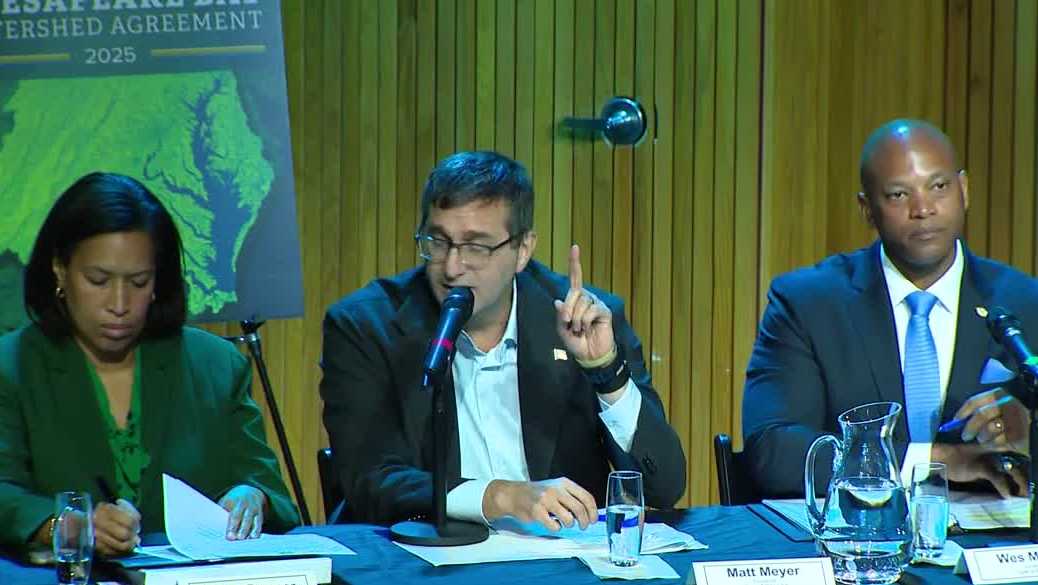
Maryland, Virginia, Delaware and Pennsylvania agreed to a new watershed agreement on Tuesday.
Many of the goals outlined in the previous agreement had suggested completion dates in 2025. Now, the agreement must outline goals for the next 15 years.
“We included a charge to include tribes as a formal and enduring partner in the Chesapeake Bay Program with recommendations to be completed in the first half of 2026,” Maryland Gov. Wes Moore said.
| READ: Health of Chesapeake Bay slightly declined in 2024, report shows
The agreement focuses on four pillars. One is thriving habitats, fisheries and wildlife. The second is healthy landscapes. The third is clean water and the fourth is engaged communities.
“It’s not just aspirational goals, but achievable goals that we will achieve at a reasonable — if not surprising — pace,” said Virginia Gov. Glenn Youngkin.
Some of the big picture goals include maintaining blue crab abundance in the bay and restoring 3,000 acres of wetlands by 2040.
There are also revisions to how states reduce nitrogen, phosphorous and sediment in their waterways.
“We can’t succeed at this if we don’t cooperate. If there’s a single state, if there’s a single city, if there’s a single county among us that disregards what we’re doing and pollutes without regard, we are all the worse because of it,” said Delaware Gov. Matt Meyer.
The Chesapeake Bay Program will implement the revisions to the agreement and report back to the watershed states.
Also on Tuesday, the Chesapeake Executive Council elected Pennsylvania Gov. Josh Shapiro as its chair.
Shapiro succeeds Moore, who held the position for the last two years.